Jetty documentation
Jetty is where you find, share, and run reliable AI workflows. You write a runbook — one markdown file that gives an agent its job, its bar for “done”, and its checks — and Jetty runs it in a managed sandbox, records every run in full, and helps you improve it until it works every time.
These docs are written for builders: developers who live in Claude Code, Codex, or Cursor and want a runbook running in minutes instead of a framework to stand up. Pick a starting point.
Get started
From zero to a runbook you trust, in one sitting.
Product overview
What Jetty does, in two motions: run the workload, then read the run.
AI workloads
The job you hand to Jetty, and the pieces that carry it out.
AI WorkloadsWhat counts as an AI workload, and the two pieces every one is built from: a runbook and a runtime. RunbooksThe hero artifact: one markdown file with the job, the bar for “done”, and the checks.
 Runtime ConfigurationThe agents Jetty runs inside its own sandboxes, which providers back each, and how to pick one.antigravityGoogle's current terminal agent (agy) in Gemini-API-key mode: catalog slugs, effort tiers, MCP support.claude-codeThe default runtime: Anthropic's agent with MCP, full usage telemetry, and the loop Jetty's skills are tuned against.codexOpenAI's agent on a pinned release: Responses-API only, config.toml routing, the reasoning-effort knob.gemini-cliGoogle's earlier terminal agent; kept for existing runbooks; start new Gemini work on antigravity.gooseBlock's agent, included for comparison: bare model ids, direct providers, best-effort output parsing.hermesNous Research's agent; the one runtime that reaches all six providers, including self-hosted vLLM.opencodeThe open-source SST agent with permissions pre-allowed and Playwright + Firecrawl MCP ready on every run.piA small provider-agnostic agent with no MCP client by design: CLI tools and skills instead.
 IntegrationsHow a workload connects to the world: integrations are environment variables injected into every run: Slack, databases, GitHub, CRMs, your own app.
 RunsEvery run is captured end to end: each step, its inputs, outputs, files, and status, plus labels to group and compare runs.
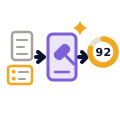 Agent EvaluationsCode checks, checklists, and LLM or agent judges live in the runbook and run in flight. Every run records a verdict you can investigate and improve against.REST APIThe Jetty REST API: run runbooks as tasks (deploy, run, monitor — the primary endpoint), the OpenAI-compatible chat-completions compatibility layer, schedules, webhooks, and GitHub-PR APIs.Machine InstructionsThe runbook API surface for agents and programmatic callers: tasks, runs, init_params, trajectories, files, MCP config, sweeps, snapshots, webhooks, schedules.ActionsThe pre-built actions that run alongside runbooks — AI models, control flow, data processing, evaluation — and the path expressions that wire them together.
 Jetty and Friends
Already have an agent in another framework? Keep it. Jetty becomes the independent evaluation, observability, and optimization layer around it, or you run one of the four built-in runtimes inside Jetty's own sandboxes.
Jetty and FriendsKeep your agent in any framework; use Jetty as the independent grader, store, and A/B harness. Flue and eve worked examples.Bring Your Friends and FrameworkKeep your agent in its own framework and let Jetty grade every run: the pattern, with Eve and Flue worked examples.Eve + JettyMount the @jetty/eve extension into a Vercel eve agent: live grading, a grade-steered experiment bandit, and an eval reporter. Catch a regression before it ships.Flue + JettyThe complete flue-jetty walkthrough: grade every Flue agent run with an independent rubric and catch a regression before it ships.Client SDK@jetty/sdk for TypeScript: JettyClient, runAndWait, etc.MCP Server27 tools for Claude Code, Cursor, VS Code, Windsurf, Zed, Codex, and WebMCP. Go deeper
The task-shaped guides, when you want them.
GuidesEvery guide in one place: use cases from teams running AI workloads, improving a runbook from its own runs, and scheduling workloads.Build vs. Buy EvaluationWhat AI agent evaluation costs to build versus buy: the variables that matter, a framework for making the call, and how to test it against your own workload.Building AI EvaluationsA way to know, before you ship, whether your agent is actually doing the job it was built to handle at the level of quality you expect.Creating a BenchmarkPick one axis of comparison, write the runbook that defines the job, and run the task set against every candidate in parallel so the comparison is reproducible.Defining Agent ChecklistsKeep your agent on task with a checklist: the conditions that define done, ticked and rechecked inside every run, then investigated across runs and kept honest in production.Improving Agent RunbooksPull the latest runs with your coding agent, tighten the evals they expose, and let the optimize-runbook skill propose evidence-backed edits.ResearchPapers Jetty has contributed to, on agent benchmark standards, reproducible ML evaluations and AI accountability.Scheduling AI WorkloadsRun a runbook on a cron cadence so evals stay fresh as models and providers drift.Use CasesStories from teams running AI workloads on Jetty: what they set up, how parallel runs and evals changed the work, and what came out.
Ready to build?
Get started → — token to first runbook in under ten minutes.
Prefer to talk it through? Book a 20-minute walkthrough → Bring a task from your own work and we'll turn it into a runbook together.