Towards Transparent Reward Design in Clinical Reinforcement Learning
Caro Strickland, Baptiste Bonin, Audrey Durand · SMASH 2026 spotlightRead the paper ↗
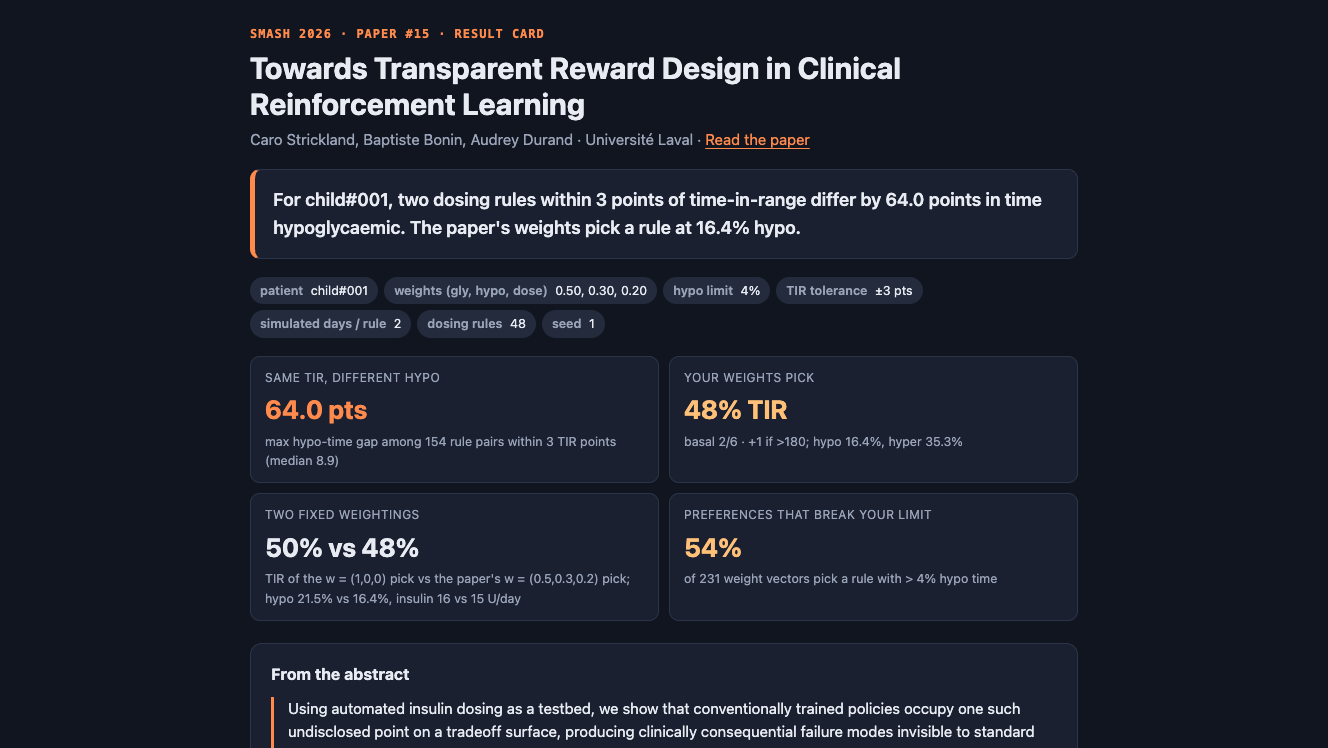
From the abstractUsing automated insulin dosing as a testbed, we show that conventionally trained policies occupy one such undisclosed point on a tradeoff surface, producing clinically consequential failure modes invisible to standard metrics. We construct an approximate Pareto frontier through preference-conditioned RL and show that it recovers policies with similar aggregate performance but different risk profiles across three simulated patients.
Example runs
Default inputs
For child#001, two dosing rules within 3 points of time-in-range differ by 64.0 points in time hypoglycaemic. The paper's weights pick a rule at 16.4% hypo. 48 simple dosing rules replace trained RL policies. Simulated patients; not clinical guidance.
Inputs
Acceptance checklist
15/15 checks passed.- Set up the sandbox and parameters
- Extract the tested code
- Run the experiment
- Write the narrative
- Render the result card and summary
- The headline states this run's finding with its numbers, not a description of the method
- Paper numbers are quoted exactly and any disagreement with the paper is stated plainly
- Caveats say what is synthetic, reconstructed or an extension of the paper
- Each try-next suggestion would plausibly give a contrasting result
- Result card, numbers, narrative and summary were written
- Experiment numbers are valid JSON and the experiment stayed within its time budget
- The narrative has a headline, three idea bullets, findings, try-next runs and caveats
- Every try-next suggestion uses only this runbook's parameters
- Every number in the headline appears in the run's results
- The card embeds its figures, shows the headline, and contains no NaN
Runbook
| version | 1.0.0 |
| evaluation | programmatic |
| evals_version | 2 |
| agent | claude-code |
| model | anthropic/claude-haiku-5.5 |
| model_provider | openrouter |
| snapshot | python312-uv |
| primary_outputs | result_card.html |
Who Chose This Trade-off? Transparent Rewards for Insulin Dosing (SMASH 2026 · Paper #15)
Objective
This runbook is an interactive companion to the SMASH 2026 paper "Towards Transparent Reward Design in Clinical Reinforcement Learning" (Caro Strickland, Baptiste Bonin, Audrey Durand). Read the paper: https://drive.google.com/file/d/1NuHr7dRpH-Qh5nYx7jZ9j1t1NRRW5bXk/view?usp=sharing
The paper's claim: an RL insulin-dosing policy trained on one scalar reward silently encodes a trade-off between competing clinical priorities, chosen by whoever wrote the reward. Splitting the reward into three objectives and reporting the Pareto front makes that trade-off visible. Two policies with the same time-in-range (TIR) can differ by tens of percentage points in time spent hypoglycaemic, which TIR alone never shows.
The participant brings their own preference weights over the three objectives (and their own hypo safety limit), picks a simglucose virtual patient, and the run: simulates a transparent family of 48 basal-only dosing rules on the FDA-accepted UVa/Padova simulator (simglucose); scores each rule on the paper's three-objective reward; finds the Pareto set; shows which rule their weights would choose; repeats the paper's "same TIR within 3 points, different hypo time" analysis; and maps every possible weight vector to the rule it picks. Output: a shareable result card.
Target wall-clock: under 5 minutes. The experiment takes about 25–60 s (96 one-day simulations, run in parallel).
The method as in the paper (§2), as implemented
- Reward vector per step:
r = (r_gly, r_hypo, r_dose)withr_gly = −RI(g_t),r_hypo = −LBGI(g_t)(Kovatchev risk index,RI = LBGI + HBGI), andr_dose = −max(0, a_t − b_p) / (a_max − b_p), whereb_pis the patient's basal need anda_max = 4 b_p. - Each component is normalized by its empirical standard deviation (over every simulated step of every rule).
- Actions: seven basal levels spaced linearly across
[0, 4 b_p]; basal-only dosing (no meal boluses). - Matched pairs: drop policies whose SD across episodes exceeds 20 points on TIR or hypo time; among all pairs within 3 TIR points, report the median and maximum hypo-time gap.
What this runbook does differently (and says so on the card): the paper trains SAC baselines and a
preference-conditioned Q-network (envelope MORL). Training deep RL is out of scope for a 5-minute CPU run, so this
runbook replaces the learned policies with an enumerated family of simple rules: the 7 basal levels × a CGM
hypo-suspend threshold (none / 80 / 110 mg/dL) × a high-glucose correction step (+0 / +1 / +2 levels while
CGM > 180 mg/dL). "Your weights' pick" is the rule maximizing w · r̄ (normalized mean reward), i.e. an oracle
scalarized optimum within the family, not a trained agent. Rules with TIR < 20% are excluded from the matched-pair
analysis (clinically absurd, e.g. no insulin at all). Episodes are one simulated day (480 × 3-min CGM steps, random
meals from simglucose's scenario generator) and are not cut short at simglucose's done flag.
Paper headline numbers (quote exactly)
- child#001: Baseline A (optimizing glycemic risk alone) hypoglycemic exposure 55.2%; baseline B (w = (0.5, 0.3, 0.2)) 0.0% hypo at the cost of 56.0% hyperglycemic exposure; both report a similar TIR.
- Table 1, hypo-exposure gap (pp) among policies within 3 TIR points: Adult 39/40 reliable, 98 pairs, median 0.0, max 42.8; Adolescent 39/40, 55 pairs, median 0.0, max 26.5; Child 28/40, 148 pairs, median 6.4, max 39.8 (text: child 90th percentile 21.1).
- Differential ("risk-decreasing") reward is exploitable: "a policy can collect higher reward by oscillating into and out of a hazardous state than by avoiding it altogether", so the paper uses absolute risk.
REQUIRED OUTPUT FILES (MANDATORY)
All in {{results_dir}}:
| File | Description |
|---|---|
result_card.html | Primary output. Self-contained, shareable one-page result card |
results.json | All computed numbers (written by experiment.py) |
card_data.json | Numbers/figures for the card (written by experiment.py) |
narrative.json | Your interpretation of this run (Step 4) |
fig_*.png | Figures (written by experiment.py) |
summary.md | 5–10 line plain-text summary |
validation_report.json | Evals v2 report: steps, code checks, checklist (see Write Validation Report) |
Parameters
| Parameter | Template Variable | Default | Description |
|---|---|---|---|
| Patient | {{patient}} | child#001 | simglucose virtual patient: adult#001, adolescent#001, child#001 (paper's three), or any adult#001–#010, adolescent#…, child#… |
| Weight: glycaemic risk | {{w_glycemic}} | 0.5 | Your preference weight on r_gly (paper's baseline B: 0.5) |
| Weight: hypo safety | {{w_hypo}} | 0.3 | Your preference weight on r_hypo (paper: 0.3) |
| Weight: insulin exposure | {{w_dose}} | 0.2 | Your preference weight on r_dose (paper: 0.2). Weights are renormalized to sum to 1 |
| Hypo limit | {{max_hypo_pct}} | 4 | Your maximum acceptable % time < 70 mg/dL (international consensus target: < 4%) |
| TIR tolerance | {{tir_tolerance}} | 3 | Two rules count as "same TIR" if within this many percentage points (paper: 3) |
| Days per rule | {{n_days}} | 2 | Simulated days (meal scenarios) per rule; ≥ 2 enables the paper's reliability filter |
| Seed | {{seed}} | 1 | Seed for meal scenarios and CGM noise |
Dependencies
numpy, matplotlib, pandas, scipy (preinstalled or pulled in by simglucose) plus simglucose (pure Python; pulls in gym/gymnasium/pathos, all small). simglucose imports pkg_resources, so it needs setuptools<70. No other downloads.
Step 1: Set up
mkdir -p {{results_dir}} /app/work && cd /app/work
python -c "import numpy, matplotlib, pandas, scipy" 2>/dev/null || uv pip install --system -q numpy matplotlib pandas scipy
python -W ignore -c "import pkg_resources, simglucose.patient.t1dpatient" 2>/dev/null || uv pip install --system -q "setuptools<70" simglucose
python -W ignore -c "import pkg_resources, simglucose.patient.t1dpatient; print('simglucose OK')"
nproc
Write /app/work/params.json (numbers as JSON numbers; if a value still looks like an unsubstituted {{…}}
placeholder, use the table default):
{"patient": "{{patient}}", "w_glycemic": {{w_glycemic}}, "w_hypo": {{w_hypo}}, "w_dose": {{w_dose}},
 "max_hypo_pct": {{max_hypo_pct}}, "tir_tolerance": {{tir_tolerance}}, "n_days": {{n_days}}, "seed": {{seed}},
 "runbook_url": ""}
Validate before running: patient must match adult#0NN, adolescent#0NN or child#0NN with NN in 01–10 (else use
child#001); weights must be ≥ 0 and not all zero (else use 0.5, 0.3, 0.2); clamp max_hypo_pct to [0, 50],
tir_tolerance to [0.5, 10], n_days to [1, 4]. Record any correction as a caveat. The script itself lowers n_days
if the sandbox has too few cores for the time budget (it prints a line saying so; mention it as a caveat).
Step 2: Get the code (extract it, don't retype it)
The tested implementation of the method is embedded in the Appendix at the end of this runbook. Do not rewrite, "improve", or re-derive it. Always run the command below first, exactly as written. It copies the files out of this runbook's text (which the sandbox exposes to running processes) in about a second, and it is far faster and more reliable than retyping several hundred lines. Do not skip it on the assumption that it won't work: run it and read its output.
cd /app/work && cat > extract.py <<'PYEOF'
"""Extract the runbook's embedded files without retyping them.

The runbook text reaches the agent as one command-line argument, so it is readable from /proc.
Every embedded file sits under a heading "### `/app/work/<name>`" followed by one fenced block.
Exits non-zero if any requested file can't be found, so the caller falls back to writing it by hand.

usage: python3 extract.py <name> [<name> ...]   (writes /app/work/<name>)
"""
import ast, glob, re, sys
from pathlib import Path

want = sys.argv[1:]
cands = []
for p in glob.glob("/proc/[0-9]*/cmdline"):
    try:
        s = Path(p).read_bytes().decode("utf-8", "ignore")
    except OSError:
        continue
    if all(f"### `/app/work/{w}`" in s for w in want):
        cands.append(s)
if not cands:
    sys.exit("runbook text not found in /proc; write the files by hand")
# The agent's own argv holds the raw text; wrapper shells hold a shell-quoted copy, so prefer the shortest
# and undo shell single-quote escaping as a fallback.
best = min(cands, key=len).replace("'\"'\"'", "'")
ok = True
for w in want:
    m = re.search(r"### `/app/work/" + re.escape(w) + r"`\s*\n+```[a-z]*\n(.*?)\n```\n", best, re.S)
    if not m or len(m.group(1)) < 50:
        print(f"MISSING {w}"); ok = False; continue
    code = m.group(1) + "\n"
    if w.endswith(".py"):
        try:
            ast.parse(code)
        except SyntaxError as e:
            print(f"MISSING {w} (extracted text does not parse: {e})"); ok = False; continue
    Path("/app/work", w).write_text(code)
    print(f"extracted {w}: {code.count(chr(10))} lines")
sys.exit(0 if ok else 1)
PYEOF
python3 extract.py experiment.py render_card.py validate.py
If it exits non-zero or prints MISSING, write each missing file from the Appendix exactly as given, one
heredoc per file (quoted delimiter, e.g. cat > experiment.py <<'PYEOF'). If a later step fails, fix only
environment problems (missing package, network retry), never the methodology.
Step 3: Run the experiment
cd /app/work && export OMP_NUM_THREADS=4 OPENBLAS_NUM_THREADS=4 MKL_NUM_THREADS=4 SMASH_CPUS=4 && timeout 300 python -W ignore experiment.py params.json {{results_dir}}Expected: 25–60 s depending on cores. Ends with a done: line (max same-TIR hypo gap, your pick, % of unsafe preferences).
The sandbox has 4 CPUs even though nproc may report more; the exports keep numpy/BLAS and process pools from oversubscribing them.
Step 4: Interpret: write narrative.json
Read {{results_dir}}/results.json and card_data.json, and look at every fig_*.png. Write
{{results_dir}}/narrative.json with keys headline, idea (exactly 3), findings (2–4), try_next (2–3),
caveats (2–4):
- headline (≤ 30 words): the most striking result of this run with 1–2 numbers copied from
results.json. Usually the worst matched pair (worst_pair.hypo_gapatworst_pair.tir_diffTIR difference), or that the participant's own weights pick a rule above their hypo limit (your_pick.hypovsmax_hypo_pct) when a safer rule with similar TIR exists. - idea: (1) a scalar reward hides a trade-off chosen by the reward designer; (2) split it into glycaemic risk, hypo risk and insulin exposure and report the Pareto front instead; (3) TIR alone cannot tell a "dangerously low" policy from a "dangerously high" one.
- findings: (1) matched pairs:
n_matched_pairs,gap_median,gap_maxvs the paper's Table 1 row for the same cohort; describe the two traces infig_pair_traces.pngin plain words; (2) your weights' pick (your_pick: label, TIR, hypo, hyper) vs the two fixed weightings (baseline_A_pick= w (1,0,0),baseline_B_pick= paper's w) and whether any Pareto rule (ruleswithpareto: true) has similar TIR and lower hypo; (3) the simplex map:simplex_unsafe_fractionof weight vectors pick a rule above the hypo limit,simplex_distinct_rulesdifferent rules are reachable; (4) optional: differential vs absolute reward (diff_vs_abs_spearman,best_by_differential), noting that an undiscounted differential return telescopes to RI(start) − RI(end) and so is blind to everything in between. - Use plain words: "hypo" = blood glucose below 70 mg/dL; "TIR" = % of time 70–180 mg/dL.
- try_next: 2–3 contrasting runs with exact values, using only the keys
patient, w_glycemic, w_hypo, w_dose, max_hypo_pct, tir_tolerance, n_days, seed. Good contrasts:adult#001(the paper's 42.8-point adult gap; the easiest patient),adolescent#001, weights leaning hard on hypo safety (e.g. 0.1, 0.8, 0.1), or a strictertir_toleranceof 1. - caveats (2–4): simulated patients (UVa/Padova via simglucose), not people; an enumerated family of simple basal-only rules replaces the paper's trained SAC / preference-conditioned agents, so "picks" are oracle optima within that family; one-day episodes with random meals and no meal boluses; not clinical guidance.
Step 5: Render the card and summary
cd /app/work && python render_card.py {{results_dir}}/card_data.json {{results_dir}}/narrative.json {{results_dir}}/result_card.htmlWrite {{results_dir}}/summary.md (5–10 lines: patient, weights, matched-pair stats vs paper, your pick, unsafe
fraction, headline).
Writing style for narrative.json
These rules apply to every field and override any longer limits stated earlier in this runbook. Let the paper and the numbers speak; the card is not the place for commentary.
- Length:
headlineone sentence;idea1–3 bullets of at most 30 words;findings1–2 paragraphs of at most 60 words each;caveats1–2 bullets of at most 20 words. Cut anything the tiles, figures or tables already show. - Plain statements of what was measured. Write "Sensitivity gap −0.284 [−0.354, −0.218]; the paper reports +0.088", not an interpretation of what it means for the field.
- Avoid: em-dash asides; "not X, but Y" framings; colon-then-reveal sentences; rhetorical questions; words such as crucially, notably, strikingly, remarkably, collapses, illustrating, underscores, highlights, delve, powerful, key insight, worth noting; exclamation marks; restating the method before the result.
- Use the paper's own terms for its concepts. Quote the paper's numbers exactly.
Code Checks
Jetty runs these checks itself in the sandbox after the agent finishes, so they cannot be skipped or
misreported. validate.py (see Write Validation Report) runs the same checks first so you can fix problems before you stop.
outputs-exist — Result card, numbers, narrative and summary were written
cd {{results_dir}} && for f in result_card.html results.json card_data.json narrative.json summary.md; do test -s "$f" || { echo "missing or empty: $f"; exit 1; }; done; echo "all 5 outputs present"results-valid — Experiment numbers are valid JSON and the experiment stayed within its time budget
python3 - "{{results_dir}}" 300 <<'PY'
import json, sys
from pathlib import Path
R, budget = Path(sys.argv[1]), float(sys.argv[2])
res = json.loads((R / "results.json").read_text())
json.loads((R / "card_data.json").read_text())
rt = float(res.get("runtime_sec", 0))
if rt > budget:
    sys.exit(f"experiment took {rt}s, budget {budget}s")
print(f"results.json and card_data.json parse; experiment {rt}s within {budget:.0f}s")
PY
narrative-complete — The narrative is complete and within the length limits
python3 - "{{results_dir}}" <<'PY'
import json, sys
from pathlib import Path
n = json.loads((Path(sys.argv[1]) / "narrative.json").read_text())
problems = []
if not str(n.get("headline", "")).strip(): problems.append("no headline")
if len(str(n.get("headline", "")).split()) > 45: problems.append("headline over 45 words")
if not 1 <= len(n.get("idea", [])) <= 3: problems.append(f"idea has {len(n.get('idea', []))} bullets, need 1-3")
if not 1 <= len(n.get("findings", [])) <= 2: problems.append(f"{len(n.get('findings', []))} findings, need 1-2")
if any(len(f.split()) > 70 for f in n.get("findings", [])): problems.append("a findings paragraph is over 60 words")
if not 2 <= len(n.get("try_next", [])) <= 3: problems.append(f"{len(n.get('try_next', []))} try_next, need 2-3")
if not 1 <= len(n.get("caveats", [])) <= 2: problems.append(f"{len(n.get('caveats', []))} caveats, need 1-2")
if problems: sys.exit("; ".join(problems))
print("headline, %d idea bullets, %d findings, %d try_next, %d caveats" % (len(n["idea"]), len(n["findings"]), len(n["try_next"]), len(n["caveats"])))
PY
try-next-valid — Every try-next suggestion uses only this runbook's parameters
python3 - "{{results_dir}}" "patient,w_glycemic,w_hypo,w_dose,max_hypo_pct,tir_tolerance,n_days,seed" <<'PY'
import json, sys
from pathlib import Path
allowed = set(sys.argv[2].split(","))
n = json.loads((Path(sys.argv[1]) / "narrative.json").read_text())
bad = sorted({k for t in n.get("try_next", []) for k in (t.get("params") or {}) if k not in allowed})
empty = [t.get("label", "?") for t in n.get("try_next", []) if not t.get("params")]
if bad or empty: sys.exit(f"unknown parameters: {bad}; suggestions without params: {empty}")
print("all try_next parameters are declared runbook parameters")
PY
headline-grounded — Every number in the headline appears in the run's results
python3 - "{{results_dir}}" <<'PY'
import json, re, sys
from pathlib import Path
R = Path(sys.argv[1])
blob = (R / "results.json").read_text() + (R / "card_data.json").read_text()
vals = [float(x) for x in re.findall(r"-?\d+(?:\.\d+)?(?:[eE]-?\d+)?", blob)]
head = json.loads((R / "narrative.json").read_text())["headline"]
nums = re.findall(r"(?<![\w.−-])[−-]?\d[\d,]*(?:\.\d+)?(?![\w-])", head)
missing = []
for n in nums:
    s = n.replace("−", "-").replace(",", ""); v = float(s); dec = len(s.split(".")[1]) if "." in s else 0
    tol = 0.5 * 10 ** (-dec) + 1e-9
    if not any(abs(abs(x) - abs(v)) <= tol or abs(abs(x * 100) - abs(v)) <= max(tol, 0.5) for x in vals):
        missing.append(n)
if missing: sys.exit(f"headline numbers not found in results: {missing}")
print(f"{len(nums)} headline number(s) all grounded in results")
PY
card-integrity — The card embeds its figures, shows the headline, and contains no NaN
python3 - "{{results_dir}}" <<'PY'
import html, json, re, sys
from pathlib import Path
R = Path(sys.argv[1])
card = (R / "result_card.html").read_text()
text = re.sub(r"data:image/[a-z]+;base64,[A-Za-z0-9+/=]+", "", card)
head = json.loads((R / "narrative.json").read_text())["headline"]
problems = []
if card.count("data:image/png;base64") < 1: problems.append("no embedded figures")
if re.search(r"\bNaN\b|\bnan%|\bInfinity\b", text): problems.append("NaN/Infinity in card text")
if len(card) > 5_000_000: problems.append(f"card is {len(card) // 1024} KB")
plain = html.unescape(re.sub(r"<[^>]+>", "", text))
if re.sub(r"[*`]", "", head)[:40] not in plain: problems.append("headline not on card")
if problems: sys.exit("; ".join(problems))
print(f"card {len(card) // 1024} KB, {card.count('data:image/png;base64')} figures, headline present")
PY
Checklist
- The headline states this run's finding with its numbers, not a description of the method
- Paper numbers are quoted exactly and any disagreement with the paper is stated plainly
- Caveats say what is synthetic, reconstructed or an extension of the paper
- Each try-next suggestion would plausibly give a contrasting result
Write Validation Report
Judge the four Checklist items honestly against your outputs and write them to /app/work/checklist.json as a
list, using the checklist ids Jetty gives you (one entry per item):
[{"id": "<checklist id>", "status": "pass", "message": "one line on why"}]Then write the report and self-check in one command:
cd /app/work && python3 validate.py {{results_dir}} patient,w_glycemic,w_hypo,w_dose,max_hypo_pct,tir_tolerance,n_days,seed 300 checklist.jsonvalidate.py writes {{results_dir}}/validation_report.json in the v2 shape Jetty reads (version: 2, one
step entry per runbook step, one code_check entry per check above, one checklist entry per item). Jetty
replaces the code_check entries with its own independent run of the same checks. Do not write the report by hand.
Iteration (up to 2 rounds)
If validate.py prints any FAIL, fix the named problem (usually a headline number that does not match
results.json, or an unknown try_next key), re-render the card (Step 5) and rerun the command above. Never
rerun the experiment just to change the narrative.
Appendix: code
These files are extracted verbatim in Step 2.
/app/work/experiment.py
"""Transparent reward lab — SMASH 2026 paper #15 (Caro Strickland, Baptiste Bonin, Audrey Durand).

The paper decomposes the scalar insulin-dosing reward into three objectives on the UVa/Padova simulator
(simglucose):  r = (r_gly, r_hypo, r_dose) with r_gly = -RI(g), r_hypo = -LBGI(g),
r_dose = -max(0, a - b_p)/(a_max - b_p); normalizes each by its standard deviation; and shows that policies
with the same time-in-range (TIR, within 3 points) can differ by tens of points in hypoglycaemic time.

This runbook does NOT train RL agents (no GPU, < 90 s). Instead it simulates a transparent family of simple
basal-only dosing rules for one simglucose patient (the paper's 7 basal levels on [0, 4 b_p], plus a CGM
hypo-suspend threshold and a high-glucose correction step), scores every rule on the paper's three objectives,
finds the Pareto set, picks the rule your preference weights w would choose (the scalarized optimum), and runs
the paper's matched-pair analysis: among rules within `tir_tolerance` points of TIR, how different is the hypo time?

usage: python experiment.py params.json outdir
"""
import json, os, sys, time, warnings, logging
from pathlib import Path
from itertools import combinations
from multiprocessing import Pool, cpu_count

warnings.filterwarnings("ignore")
logging.disable(logging.CRITICAL)
import numpy as np

T0 = time.time()
LEVELS = 7                     # paper: seven basal levels spaced linearly across [0, 4 b_p]
SUSPEND = [None, 80, 110]      # CGM below this (mg/dL) -> deliver 0 (hypo-suspend), None = never
CORRECT = [0, 1, 2]            # levels added while CGM > 180 mg/dL (capped at the top level)
STEPS = 480                    # one day at the Dexcom 3-min sample time
MIN_TIR = 20                   # matched-pair analysis ignores clinically absurd rules (TIR < 20%; e.g. no insulin at all)


def log(m):
    print(f"[{time.time() - T0:6.1f}s] {m}", flush=True)


def risk(bg):
    """Kovatchev et al. (2005) risk index split into LBGI/HBGI components (as in simglucose.analysis.risk)."""
    f = 1.509 * (np.log(np.clip(bg, 10, 600)) ** 1.084 - 5.381)
    lb = np.where(f < 0, 10 * f ** 2, 0.0); hb = np.where(f > 0, 10 * f ** 2, 0.0)
    return lb, hb


def simulate(job):
    """One simulated day for one dosing rule. Returns true BG, CGM and delivered basal (U/min) per 3-min step."""
    name, k, susp, corr, day, seed = job
    from datetime import datetime
    from simglucose.patient.t1dpatient import T1DPatient
    from simglucose.sensor.cgm import CGMSensor
    from simglucose.actuator.pump import InsulinPump
    from simglucose.simulation.scenario_gen import RandomScenario
    from simglucose.simulation.env import T1DSimEnv
    from simglucose.controller.base import Action
    pat = T1DPatient.withName(name)
    bp = pat._params.u2ss * pat._params.BW / 6000.0          # physiological basal need b_p (U/min)
    levels = np.linspace(0, 4 * bp, LEVELS)
    env = T1DSimEnv(pat, CGMSensor.withName("Dexcom", seed=seed + 1000 * day),
                    InsulinPump.withName("Insulet"), RandomScenario(datetime(2026, 1, 1, 0, 0), seed=seed + day))
    obs = env.reset(); cgm = obs.observation.CGM
    bg, cg, ins = [], [], []
    for _ in range(STEPS):
        lvl = k
        if susp is not None and cgm < susp:
            lvl = 0
        elif cgm > 180:
            lvl = min(LEVELS - 1, k + corr)
        a = float(levels[lvl])
        o = env.step(Action(basal=a, bolus=0))   # episode is NOT cut at simglucose's done flag: full day always
        cgm = o.observation.CGM
        bg.append(o.info["bg"]); cg.append(cgm); ins.append(a)
    return job, bp, np.array(bg), np.array(cg), np.array(ins)


def main():
    P = json.loads(Path(sys.argv[1]).read_text())
    OUT = Path(sys.argv[2]); OUT.mkdir(parents=True, exist_ok=True)
    name = str(P["patient"]); n_days = int(P["n_days"]); seed = int(P["seed"])
    w = np.array([float(P["w_glycemic"]), float(P["w_hypo"]), float(P["w_dose"])], float)
    w = np.clip(w, 0, None); w = w / w.sum() if w.sum() > 0 else np.array([0.5, 0.3, 0.2])
    tol = float(P["tir_tolerance"]); floor = float(P["max_hypo_pct"])

    policies = [(k, s, c) for k in range(LEVELS) for s in SUSPEND for c in CORRECT
                if (c == 0 or k + c <= LEVELS - 1) and not (k == 0 and s is not None)]   # drop duplicates
    jobs = [(name, k, s, c, d, seed) for (k, s, c) in policies for d in range(n_days)]
    nproc = max(1, min(int(os.environ.get("SMASH_CPUS") or cpu_count()), len(jobs)))
    # budget guard: ~2.5 core-seconds per simulated day; keep the simulation phase under ~75 s
    while n_days > 1 and len(policies) * n_days * 2.5 / nproc > 75:
        n_days -= 1
    if n_days != int(P["n_days"]):
        log(f"only {nproc} cores: reducing n_days {P['n_days']} -> {n_days} to stay within the time budget")
    jobs = [(name, k, s, c, d, seed) for (k, s, c) in policies for d in range(n_days)]
    log(f"patient {name}: {len(policies)} dosing rules x {n_days} simulated day(s) = {len(jobs)} sims on {nproc} cores")
    with Pool(nproc) as pool:
        sims = pool.map(simulate, jobs, chunksize=1)
    log("simulations finished")

    bp = sims[0][1]; amax = 4 * bp
    by = {}
    for job, _, bg, cg, ins in sims:
        by.setdefault(job[1:4], []).append((bg, cg, ins))
    # ---- per-step reward vectors (paper §2): r_gly = -RI, r_hypo = -LBGI, r_dose = -max(0, a-bp)/(amax-bp)
    allr = []
    for key in policies:
        for bg, cg, ins in by[key]:
            lb, hb = risk(bg)
            allr.append(np.c_[-(lb + hb), -lb, -np.maximum(0, ins - bp) / (amax - bp)])
    sd = np.concatenate(allr).std(0) + 1e-12   # "normalize each by its empirically estimated standard deviation"
    rows = []
    for i, key in enumerate(policies):
        days = by[key]; per = []
        for bg, cg, ins in days:
            lb, hb = risk(bg); r = np.c_[-(lb + hb), -lb, -np.maximum(0, ins - bp) / (amax - bp)]
            ri = lb + hb
            per.append({"tir": 100 * np.mean((bg >= 70) & (bg <= 180)), "hypo": 100 * np.mean(bg < 70),
                        "hyper": 100 * np.mean(bg > 180), "severe": 100 * np.mean(bg < 54),
                        "dose_u_day": float(ins.sum() * 3), "r": r.mean(0) / sd,
                        "diff_return": float(ri[0] - ri[-1]),     # undiscounted differential return telescopes
                        "abs_return": float(-ri.sum())})
        k, s, c = key
        lab = f"basal {k}/6" + (f" · suspend<{s}" if s else "") + (f" · +{c} if >180" if c else "")
        rows.append({"id": i, "label": lab, "level": k, "basal_x_bp": round(4 * k / 6, 3), "suspend": s, "correct": c,
                     "tir": float(np.mean([p["tir"] for p in per])), "hypo": float(np.mean([p["hypo"] for p in per])),
                     "hyper": float(np.mean([p["hyper"] for p in per])), "severe": float(np.mean([p["severe"] for p in per])),
                     "tir_sd": float(np.std([p["tir"] for p in per])), "hypo_sd": float(np.std([p["hypo"] for p in per])),
                     "dose_u_day": float(np.mean([p["dose_u_day"] for p in per])),
                     "r_norm": [float(x) for x in np.mean([p["r"] for p in per], 0)],
                     "diff_return": float(np.mean([p["diff_return"] for p in per])),
                     "abs_return": float(np.mean([p["abs_return"] for p in per]))})
    R = np.array([r["r_norm"] for r in rows])
    # ---- Pareto set on the three (maximized) objectives
    dominated = np.array([any(np.all(R[j] >= R[i]) and np.any(R[j] > R[i]) for j in range(len(R))) for i in range(len(R))])
    for r, d in zip(rows, dominated):
        r["pareto"] = bool(not d)

    def pick(wv):
        return int(np.argmax(R @ np.asarray(wv, float) + 1e-6 * R.sum(1)))   # tiny tie-break: better on all objectives

    you, A, B = pick(w), pick([1, 0, 0]), pick([0.5, 0.3, 0.2])
    # ---- matched-pair analysis (paper §2/Table 1): reliable rules only (SD <= 20 pp on TIR and hypo)
    reliable = [r for r in rows if r["tir_sd"] <= 20 and r["hypo_sd"] <= 20 and r["tir"] >= MIN_TIR]
    pairs = [(a, b, abs(a["hypo"] - b["hypo"])) for a, b in combinations(reliable, 2) if abs(a["tir"] - b["tir"]) <= tol]
    gaps = np.array([g for *_, g in pairs]) if pairs else np.array([0.0])
    worst = max(pairs, key=lambda t: (t[2], -abs(t[0]["tir"] - t[1]["tir"]))) if pairs else None
    log(f"{len(rows)} rules, {int((~dominated).sum())} Pareto-optimal; {len(pairs)} matched pairs within {tol} TIR pts; "
        f"max hypo gap {gaps.max():.1f}")
    # ---- preference-simplex map: which rule does each weight vector pick?
    grid = [(a / 20, b / 20, 1 - a / 20 - b / 20) for a in range(21) for b in range(21 - a)]
    gpick = [pick(g) for g in grid]
    unsafe_frac = float(np.mean([rows[g]["hypo"] > floor for g in gpick]))
    distinct = len(set(gpick))
    # ---- differential vs absolute reward (paper §1): undiscounted differential return only sees the endpoints
    dr = np.array([r["diff_return"] for r in rows]); ar = np.array([r["abs_return"] for r in rows])
    rank = lambda x: np.argsort(np.argsort(x))
    rho = float(np.corrcoef(rank(dr), rank(ar))[0, 1])
    best_diff = rows[int(np.argmax(dr))]; best_abs = rows[int(np.argmax(ar))]

    res = {"params": P, "patient": name, "n_days_used": n_days, "cores": nproc, "basal_need_u_per_min": bp, "basal_need_u_per_h": bp * 60,
           "weights_normalized": [float(x) for x in w], "objective_sd": [float(x) for x in sd],
           "n_rules": len(rows), "n_pareto": int((~dominated).sum()), "n_reliable": len(reliable),
           "n_matched_pairs": len(pairs), "gap_median": float(np.median(gaps)), "gap_p90": float(np.percentile(gaps, 90)),
           "gap_max": float(gaps.max()),
           "worst_pair": ({"a": worst[0], "b": worst[1], "tir_diff": abs(worst[0]["tir"] - worst[1]["tir"]),
                           "hypo_gap": worst[2]} if worst else None),
           "your_pick": rows[you], "baseline_A_pick": rows[A], "baseline_B_pick": rows[B],
           "your_pick_violates_floor": bool(rows[you]["hypo"] > floor),
           "simplex_unsafe_fraction": unsafe_frac, "simplex_distinct_rules": distinct, "simplex_points": len(grid),
           "diff_vs_abs_spearman": rho, "best_by_differential": best_diff, "best_by_absolute": best_abs,
           "constant_basal": [r for r in rows if r["suspend"] is None and r["correct"] == 0],
           "rules": rows}

    # ------------------------------------------------------------------ figures
    import matplotlib
    matplotlib.use("Agg")
    import matplotlib.pyplot as plt
    plt.rcParams.update({"font.size": 10, "axes.spines.top": False, "axes.spines.right": False})
    INK, ACC, BLUE, MUTED, GOOD = "#1f2a44", "#d9480f", "#1971c2", "#adb5bd", "#2b8a3e"
    tir = np.array([r["tir"] for r in rows]); hyp = np.array([r["hypo"] for r in rows])

    fig, ax = plt.subplots(figsize=(6.4, 4.6))
    ax.axhspan(floor, max(100, hyp.max() + 5), color=ACC, alpha=0.04, lw=0)
    ax.axhline(floor, color=ACC, lw=0.8, ls=":")
    ax.text(1, floor + 1, f"your hypo limit {floor:g}%", color=ACC, fontsize=8, va="bottom")
    ax.scatter(tir[dominated], hyp[dominated], s=18, color=MUTED, label="dominated rule", zorder=2)
    ax.scatter(tir[~dominated], hyp[~dominated], s=26, color=BLUE, label="Pareto-optimal rule (3 objectives)", zorder=3)
    if worst:
        a, b = worst[0], worst[1]
        ax.plot([a["tir"], b["tir"]], [a["hypo"], b["hypo"]], color=ACC, lw=2, zorder=4)
        ax.scatter([a["tir"], b["tir"]], [a["hypo"], b["hypo"]], s=70, facecolor="none", edgecolor=ACC, lw=2, zorder=5,
                   label=f"same TIR (±{tol:g}), {worst[2]:.1f}-pt hypo gap")
    mk = [(A, "s", INK, "single-objective pick (w = 1,0,0)"), (B, "D", GOOD, "paper's fixed w = (0.5,0.3,0.2)"),
          (you, "*", ACC, "your weights' pick")]
    for idx, m, col, lab in mk:
        ax.scatter([tir[idx]], [hyp[idx]], marker=m, s=150 if m == "*" else 70, color=col, edgecolor="white",
                   lw=0.8, zorder=6, label=lab)
    ax.set_xlabel("% time in range (70–180 mg/dL)"); ax.set_ylabel("% time hypoglycaemic (<70 mg/dL)")
    ax.set_xlim(0, 100); ax.set_ylim(-2, max(20, hyp.max() + 4))
    ax.legend(frameon=False, fontsize=7.5, loc="upper center", bbox_to_anchor=(0.5, -0.16), ncol=2)
    fig.tight_layout(); fig.savefig(OUT / "fig_tradeoff.png", dpi=160); plt.close(fig)

    # glucose traces of the worst matched pair (day 1)
    if worst:
        fig, ax = plt.subplots(figsize=(6.4, 2.9))
        hrs = np.arange(STEPS) * 3 / 60
        ax.axhspan(70, 180, color=GOOD, alpha=0.07, lw=0)
        for r_, col in [(worst[0], BLUE), (worst[1], ACC)]:
            bg = by[(r_["level"], r_["suspend"], r_["correct"])][0][0]
            ax.plot(hrs, np.clip(bg, 0, 600), color=col, lw=1.4,
                    label=f"{r_['label']}: TIR {r_['tir']:.0f}%, hypo {r_['hypo']:.0f}%")
        ax.axhline(70, color=ACC, lw=0.7, ls=":"); ax.axhline(180, color=INK, lw=0.7, ls=":")
        ax.set_xlabel("hour of simulated day 1"); ax.set_ylabel("blood glucose (mg/dL)"); ax.set_xlim(0, 24)
        ax.set_xticks(range(0, 25, 4))
        ax.legend(frameon=False, fontsize=7.5, loc="upper center", bbox_to_anchor=(0.5, 1.22), ncol=1)
        fig.tight_layout(); fig.savefig(OUT / "fig_pair_traces.png", dpi=160); plt.close(fig)

    # preference simplex map: hypo time of the rule each w picks
    fig, ax = plt.subplots(figsize=(6.4, 3.9))
    g = np.array(grid); X = g[:, 1] + 0.5 * g[:, 2]; Y = g[:, 2] * np.sqrt(3) / 2
    tv = np.array([rows[i]["tir"] for i in gpick]); hv = np.array([rows[i]["hypo"] for i in gpick])
    sc = ax.scatter(X, Y, c=tv, cmap="Blues", s=80, marker="h", edgecolor="none", vmin=0, vmax=100)
    unsafe = hv > floor
    ax.scatter(X[unsafe], Y[unsafe], s=80, marker="h", facecolor="none", edgecolor=ACC, lw=1.4)
    ax.plot([0, 1, 0.5, 0], [0, 0, np.sqrt(3) / 2, 0], color=INK, lw=0.8)
    for (xx, yy, t, ha) in [(0, -0.06, "glycaemic risk\n(r_gly)", "center"), (1, -0.06, "hypo safety\n(r_hypo)", "center"),
                            (0.56, np.sqrt(3) / 2 - 0.02, "insulin exposure\n(r_dose)", "left")]:
        ax.text(xx, yy, t, ha=ha, va="top", fontsize=8.5)
    pw = lambda v: (v[1] + 0.5 * v[2], v[2] * np.sqrt(3) / 2)
    for v, m, col, lab in [([1, 0, 0], "s", INK, "w = (1,0,0)"), ([0.5, 0.3, 0.2], "D", GOOD, "paper w"), (w, "*", ACC, "your w")]:
        xx, yy = pw(v); ax.scatter([xx], [yy], marker=m, s=140 if m == "*" else 60, color=col, edgecolor="white", zorder=5, label=lab)
    cb = fig.colorbar(sc, ax=ax, shrink=0.8); cb.set_label("% TIR of the rule this w picks")
    ax.set_aspect("equal"); ax.axis("off"); ax.set_ylim(-0.17, 0.92); ax.set_xlim(-0.08, 1.08)
    ax.legend(frameon=False, fontsize=8, loc="upper left", bbox_to_anchor=(-0.02, 1.0))
    fig.tight_layout(); fig.savefig(OUT / "fig_simplex.png", dpi=160); plt.close(fig)

    # ------------------------------------------------------------------ card data
    yp = rows[you]
    tiles = [
        {"label": "Same TIR, different hypo", "value": f"{gaps.max():.1f} pts" if pairs else "n/a",
         "sub": (f"max hypo-time gap among {len(pairs)} rule pairs within {tol:g} TIR points (median {np.median(gaps):.1f})"),
         "tone": "accent"},
        {"label": "Your weights pick", "value": f"{yp['tir']:.0f}% TIR",
         "sub": f"{yp['label']}; hypo {yp['hypo']:.1f}%, hyper {yp['hyper']:.1f}%",
         "tone": "warn" if yp["hypo"] > floor else "good"},
        {"label": "Two fixed weightings", "value": f"{rows[A]['tir']:.0f}% vs {rows[B]['tir']:.0f}%",
         "sub": f"TIR of the w = (1,0,0) pick vs the paper's w = (0.5,0.3,0.2) pick; hypo {rows[A]['hypo']:.1f}% vs "
                f"{rows[B]['hypo']:.1f}%, insulin {rows[A]['dose_u_day']:.0f} vs {rows[B]['dose_u_day']:.0f} U/day",
         "tone": "neutral"},
        {"label": "Preferences that break your limit", "value": f"{100 * unsafe_frac:.0f}%",
         "sub": f"of {len(grid)} weight vectors pick a rule with > {floor:g}% hypo time", "tone": "warn" if unsafe_frac > 0 else "good"},
    ]
    cohort = "adult" if name.startswith("adult") else "adolescent" if name.startswith("adolescent") else "child"
    paper_gap = {"adult": ("98", "0.0", "42.8"), "adolescent": ("55", "0.0", "26.5"), "child": ("148", "6.4", "39.8")}[cohort]
    compare = [
        {"metric": f"Matched pairs within 3 TIR pts ({cohort})", "paper": paper_gap[0], "yours": f"{len(pairs)}",
         "note": f"{len(reliable)}/{len(rows)} rules kept (SD ≤ 20 pts, TIR ≥ {MIN_TIR}%); paper: 40 preference vectors"},
        {"metric": "Median hypo gap among matched pairs (pp)", "paper": paper_gap[1], "yours": f"{np.median(gaps):.1f}", "note": ""},
        {"metric": "Max hypo gap among matched pairs (pp)", "paper": paper_gap[2], "yours": f"{gaps.max():.1f}", "note": ""},
        {"metric": "child#001 fixed-weight failure modes",
         "paper": "Baseline A hypo 55.2%; baseline B hypo 0.0%, hyper 56.0%",
         "yours": f"A-pick hypo {rows[A]['hypo']:.1f}%; B-pick hypo {rows[B]['hypo']:.1f}%, hyper {rows[B]['hyper']:.1f}%",
         "note": "paper baselines are SAC agents; yours are the best rule in the family" + ("" if cohort == "child" else f" ({name})")},
        {"metric": "Differential (risk-decreasing) reward",
         "paper": "a policy can collect higher reward by oscillating into and out of a hazardous state",
         "yours": f"rank corr. with absolute reward {rho:.2f}; its favourite rule has {best_diff['hypo']:.1f}% hypo",
         "note": "undiscounted sum telescopes to RI(start) − RI(end)"},
    ]
    card = {"paper": {"num": 15, "title": "Towards Transparent Reward Design in Clinical Reinforcement Learning",
                      "authors": "Caro Strickland, Baptiste Bonin, Audrey Durand", "url": "https://drive.google.com/file/d/1NuHr7dRpH-Qh5nYx7jZ9j1t1NRRW5bXk/view?usp=sharing", "affiliation": "Université Laval"},
            "inputs": {"patient": name, "weights (gly, hypo, dose)": ", ".join(f"{x:.2f}" for x in w),
                       "hypo limit": f"{floor:g}%", "TIR tolerance": f"±{tol:g} pts", "simulated days / rule": n_days,
                       "dosing rules": len(rows), "seed": seed},
            "tiles": tiles,
            "figures": [
                {"path": "fig_tradeoff.png", "title": "Which risk does each dosing rule trade for its time in range?",
                 "caption": "Each dot is one basal-only dosing rule simulated on the UVa/Padova model. Blue = Pareto-optimal "
                            "on the paper's three objectives. The orange line joins the matched pair with the biggest "
                            "hypoglycaemia gap at (almost) the same TIR."},
                {"path": "fig_pair_traces.png", "title": "Same score, different day",
                 "caption": "Glucose traces of that matched pair on simulated day 1. Green band = target range 70–180 mg/dL."},
                {"path": "fig_simplex.png", "title": "Who chose the trade-off? Every preference vector, mapped",
                 "caption": "Each hexagon is a weight vector w over the three objectives; colour = time in range of the rule "
                            "that maximizes w·r. Orange outlines mark weights whose pick exceeds your hypo limit."}],
            "compare": compare, "runbook": {"name": "smash-15-transparent-reward", "url": P.get("runbook_url", "")}}
    (OUT / "card_data.json").write_text(json.dumps(card, indent=2))
    res["runtime_sec"] = round(time.time() - T0, 1)
    (OUT / "results.json").write_text(json.dumps(res, indent=2))
    log(f"done: {len(rows)} rules; max same-TIR hypo gap {gaps.max():.1f} pts (median {np.median(gaps):.1f}); "
        f"your pick '{yp['label']}' TIR {yp['tir']:.1f}% hypo {yp['hypo']:.1f}%; unsafe preferences {100 * unsafe_frac:.0f}%")


if __name__ == "__main__":
    main()
/app/work/render_card.py
"""Render a SMASH 2026 paper-playground result card (one self-contained HTML file).

usage: python render_card.py card_data.json narrative.json out.html

card_data.json  (written by the experiment script — numbers only)
  paper:   {num, title, authors, affiliation, url?}
  inputs:  {label: value}                         the participant's run settings
  tiles:   [{label, value, sub, tone}]            tone: accent|good|warn|neutral
  figures: [{path, title, caption}]               PNGs, embedded as base64
  compare: [{metric, paper, yours, note}]         paper-vs-your-run table (optional)
  runbook: {name, url}                            fork link (optional)
narrative.json  (written by the agent — words only)
  headline:  one sentence, the finding of THIS run
  idea:      [1-3 bullets] the paper's contribution in plain language
  abstract:  (optional) a verbatim abstract excerpt, shown instead of idea
  findings:  [2-4 short paragraphs] what this run shows, tied to the numbers
  try_next:  [{label, why, params}]               2-3 follow-up runs with exact parameter values
  caveats:   [bullets]
"""
import base64, html, json, sys
from pathlib import Path

data = json.loads(Path(sys.argv[1]).read_text())
narr = json.loads(Path(sys.argv[2]).read_text())
base = Path(sys.argv[1]).parent
e = lambda s: html.escape(str(s))


def md_inline(s):
    """Escape, then allow **bold**, *italic* and `code` only."""
    import re
    s = e(s)
    s = re.sub(r"\*\*(.+?)\*\*", r"<strong>\1</strong>", s)
    s = re.sub(r"(?<![\w*])\*(?!\s)(.+?)(?<!\s)\*(?![\w*])", r"<em>\1</em>", s)
    return re.sub(r"`(.+?)`", r"<code>\1</code>", s)


p = data["paper"]
tiles = "".join(
    f'<div class="tile {e(t.get("tone", "neutral"))}"><div class="tl">{e(t["label"])}</div>'
    f'<div class="tv">{e(t["value"])}</div><div class="ts">{md_inline(t.get("sub", ""))}</div></div>'
    for t in data.get("tiles", []))
# Columns that fill every row: 4 tiles as 2x2, never 3 + 1 orphan.
n_tiles = len(data.get("tiles", []))
tile_cols = 2 if n_tiles == 4 else min(max(n_tiles, 1), 3)
inputs = "".join(f'<span class="chip"><b>{e(k)}</b> {e(v)}</span>' for k, v in data.get("inputs", {}).items())
figs = ""
for f in data.get("figures", []):
    fp = Path(f["path"]); fp = fp if fp.is_absolute() else base / fp
    if fp.exists():
        b64 = base64.b64encode(fp.read_bytes()).decode()
        figs += (f'<figure><figcaption class="ft">{e(f.get("title", ""))}</figcaption>'
                 f'<img alt="{e(f.get("title", ""))}" src="data:image/png;base64,{b64}">'
                 f'<figcaption>{md_inline(f.get("caption", ""))}</figcaption></figure>')
compare = ""
if data.get("compare"):
    rows = "".join(f'<tr><td>{md_inline(r["metric"])}</td><td>{md_inline(r["paper"])}</td>'
                   f'<td class="y">{md_inline(r["yours"])}</td><td class="n">{md_inline(r.get("note", ""))}</td></tr>'
                   for r in data["compare"])
    compare = (f'<section><h2>Paper vs. your run</h2><div class="tw"><table><thead><tr><th>Metric</th>'
               f'<th>Paper</th><th>Your run</th><th></th></tr></thead><tbody>{rows}</tbody></table></div></section>')
idea = "".join(f"<li>{md_inline(b)}</li>" for b in narr.get("idea", []))
abstract = narr.get("abstract", "")
findings = "".join(f"<p>{md_inline(x)}</p>" for x in narr.get("findings", []))
tries = "".join(
    f'<li><strong>{md_inline(t["label"])}</strong> — {md_inline(t.get("why", ""))}'
    f'<pre>{e(json.dumps(t.get("params", {}), ensure_ascii=False))}</pre></li>' for t in narr.get("try_next", []))
cav = "".join(f"<li>{md_inline(c)}</li>" for c in narr.get("caveats", []))
rb = data.get("runbook", {})
fork = (f'<a class="fork" href="{e(rb["url"])}">Fork this runbook on Jetty →</a>' if rb.get("url") else "")

page = f"""<!doctype html><html lang="en"><head><meta charset="utf-8">
<meta name="viewport" content="width=device-width,initial-scale=1">
<title>SMASH 2026 · #{e(p['num'])} · Result card</title>
<style>
:root{{--bg:#f6f4ef;--card:#fff;--ink:#1f2a44;--muted:#5c677d;--line:#e3dfd5;--accent:#d9480f;--good:#2b8a3e;--warn:#e67700;--chip:#efece4}}
@media (prefers-color-scheme:dark){{:root{{--bg:#11151f;--card:#1a2030;--ink:#e8ebf2;--muted:#9aa4b8;--line:#2c3447;--accent:#ff8a4c;--good:#69db7c;--warn:#ffc078;--chip:#232b3d}}
figure img{{background:#fff;border-radius:6px}}}}
*{{box-sizing:border-box}}body{{margin:0;background:var(--bg);color:var(--ink);font:15px/1.55 ui-sans-serif,system-ui,-apple-system,"Segoe UI",Roboto,sans-serif}}
main{{max-width:860px;margin:0 auto;padding:28px 16px 48px}}
.kicker{{font:600 12px/1 ui-monospace,SFMono-Regular,Menlo,monospace;letter-spacing:.08em;text-transform:uppercase;color:var(--accent)}}
h1{{font-size:clamp(22px,4vw,30px);line-height:1.2;margin:10px 0 6px}}.authors{{color:var(--muted);margin:0 0 18px}}.authors a{{color:var(--accent);text-underline-offset:3px}}
.headline{{background:var(--card);border:1px solid var(--line);border-left:5px solid var(--accent);border-radius:10px;padding:16px 18px;font-size:18px;font-weight:600;margin:0 0 18px}}
.chips{{display:flex;flex-wrap:wrap;gap:6px;margin:0 0 18px}}.chip{{background:var(--chip);border-radius:999px;padding:4px 10px;font-size:12.5px}}.chip b{{font-weight:600;color:var(--muted);margin-right:4px}}
.tiles{{display:grid;grid-template-columns:repeat(var(--cols),minmax(0,1fr));gap:10px;margin:0 0 22px}}
@media (max-width:560px){{.tiles{{grid-template-columns:1fr}}}}
.tile{{background:var(--card);border:1px solid var(--line);border-radius:10px;padding:12px 14px}}.tl{{font-size:12px;color:var(--muted);text-transform:uppercase;letter-spacing:.04em}}
.tv{{font-size:26px;font-weight:700;margin:2px 0;font-variant-numeric:tabular-nums}}.ts{{font-size:12.5px;color:var(--muted)}}
.tile.accent .tv{{color:var(--accent)}}.tile.good .tv{{color:var(--good)}}.tile.warn .tv{{color:var(--warn)}}
section{{background:var(--card);border:1px solid var(--line);border-radius:12px;padding:18px 20px;margin:0 0 16px}}
h2{{font-size:16px;margin:0 0 10px}}ul{{padding-left:20px;margin:0}}li{{margin:4px 0}}p{{margin:0 0 10px}}
figure{{margin:0 0 18px}}figure img{{width:100%;height:auto;display:block}}figcaption{{font-size:13px;color:var(--muted);margin-top:6px}}.ft{{font-weight:600;color:var(--ink);font-size:14px;margin:0 0 6px}}
.tw{{overflow-x:auto}}table{{border-collapse:collapse;width:100%;font-size:13.5px;font-variant-numeric:tabular-nums}}th,td{{text-align:left;padding:7px 8px;border-bottom:1px solid var(--line);vertical-align:top}}th{{color:var(--muted);font-weight:600}}td.y{{font-weight:600}}td.n{{color:var(--muted);font-size:12.5px}}
pre{{background:var(--chip);border-radius:6px;padding:6px 8px;font-size:12px;white-space:pre-wrap;word-break:break-word;margin:4px 0 8px}}code{{background:var(--chip);border-radius:4px;padding:1px 4px;font-size:.92em}}
.fork{{display:inline-block;background:var(--ink);color:var(--bg);text-decoration:none;font-weight:600;border-radius:8px;padding:10px 14px;margin-top:6px}}
footer{{color:var(--muted);font-size:12.5px;margin-top:22px}}
.abs{{margin:0;padding-left:14px;border-left:3px solid var(--accent);color:var(--ink)}}
</style></head><body><main>
<div class="kicker">SMASH 2026 · Paper #{e(p['num'])} · Result card</div>
<h1>{e(p['title'])}</h1><p class="authors">{e(p['authors'])}{(' · ' + e(p['affiliation'])) if p.get('affiliation') else ''}{(f' · <a href="{e(p["url"])}">Read the paper</a>') if p.get('url') else ''}</p>
<div class="headline">{md_inline(narr['headline'])}</div>
<div class="chips">{inputs}</div>
<div class="tiles" style="--cols:{tile_cols}">{tiles}</div>
{f'<section><h2>From the abstract</h2><blockquote class="abs">{e(abstract)}</blockquote></section>' if abstract else f'<section><h2>The idea</h2><ul>{idea}</ul></section>'}
{f'<section><h2>What this run shows</h2>{findings}</section>' if findings else ''}
<section><h2>Evidence</h2>{figs}</section>
{compare}
<section><h2>Try next</h2><ul>{tries}</ul>{fork}</section>
<section><h2>Read this before sharing</h2><ul>{cav}</ul></section>
<footer>Generated by a Jetty runbook built from the authors' SMASH 2026 paper. Numbers on this card come from code run in a sandbox; the words were written by an AI agent reading those numbers. This is an interactive companion, not the authors' own results unless labelled “Paper”.</footer>
</main></body></html>"""
Path(sys.argv[3]).write_text(page)
print(f"wrote {sys.argv[3]} ({len(page) // 1024} KB)")
/app/work/validate.py
"""Self-check a SMASH paper-playground run and write validation_report.json (evals v2 shape).

Runs the same checks as the runbook's `## Code Checks` (which Jetty re-runs independently after the agent
exits and substitutes for these entries), adds one `step` entry per runbook step and the agent's checklist
judgements, and prints PASS/FAIL lines.

usage: python validate.py <results_dir> <param,param,...> <budget_sec> [checklist.json]
"""
import html, json, re, sys
from pathlib import Path

R = Path(sys.argv[1])
allowed = set(sys.argv[2].split(","))
budget = float(sys.argv[3])
checklist_path = Path(sys.argv[4]) if len(sys.argv) > 4 else None


def load(name):
    try:
        return json.loads((R / name).read_text())
    except Exception:
        return None


res, cdata, narr = load("results.json"), load("card_data.json"), load("narrative.json")
card = (R / "result_card.html").read_text() if (R / "result_card.html").exists() else ""


def c_outputs_exist():
    missing = [f for f in ["result_card.html", "results.json", "card_data.json", "narrative.json", "summary.md"]
               if not (R / f).exists() or (R / f).stat().st_size == 0]
    return not missing, f"missing or empty: {missing}" if missing else "all 5 outputs present"


def c_results_valid():
    if res is None or cdata is None:
        return False, "results.json or card_data.json does not parse"
    rt = float(res.get("runtime_sec", 0))
    return rt <= budget, f"experiment {rt}s (budget {budget:.0f}s)"


def c_narrative_complete():
    if narr is None:
        return False, "narrative.json does not parse"
    p = []
    if not str(narr.get("headline", "")).strip(): p.append("no headline")
    if len(str(narr.get("headline", "")).split()) > 45: p.append("headline over 45 words")
    if not 1 <= len(narr.get("idea", [])) <= 3: p.append(f"idea has {len(narr.get('idea', []))} bullets, need 1-3")
    if not 1 <= len(narr.get("findings", [])) <= 2: p.append(f"{len(narr.get('findings', []))} findings, need 1-2")
    if any(len(f.split()) > 70 for f in narr.get("findings", [])): p.append("a findings paragraph is over 60 words")
    if not 2 <= len(narr.get("try_next", [])) <= 3: p.append(f"{len(narr.get('try_next', []))} try_next, need 2-3")
    if not 1 <= len(narr.get("caveats", [])) <= 2: p.append(f"{len(narr.get('caveats', []))} caveats, need 1-2")
    return not p, "; ".join(p) or "complete and within the length limits"


def c_try_next_valid():
    if narr is None:
        return False, "narrative.json does not parse"
    bad = sorted({k for t in narr.get("try_next", []) for k in (t.get("params") or {}) if k not in allowed})
    empty = [t.get("label", "?") for t in narr.get("try_next", []) if not t.get("params")]
    ok = not bad and not empty
    return ok, "all try_next parameters are declared" if ok else f"unknown parameters: {bad}; without params: {empty}"


def c_headline_grounded():
    if narr is None or res is None:
        return False, "missing narrative or results"
    blob = json.dumps(res) + json.dumps(cdata or {})
    vals = [float(x) for x in re.findall(r"-?\d+(?:\.\d+)?(?:[eE]-?\d+)?", blob)]
    nums = re.findall(r"(?<![\w.−-])[−-]?\d[\d,]*(?:\.\d+)?(?![\w-])", narr.get("headline", ""))
    missing = []
    for n in nums:
        s = n.replace("−", "-").replace(",", ""); v = float(s); dec = len(s.split(".")[1]) if "." in s else 0
        tol = 0.5 * 10 ** (-dec) + 1e-9
        if not any(abs(abs(x) - abs(v)) <= tol or abs(abs(x * 100) - abs(v)) <= max(tol, 0.5) for x in vals):
            missing.append(n)
    return not missing, f"not found in results: {missing}" if missing else f"{len(nums)} headline number(s) grounded"


def c_card_integrity():
    if not card or narr is None:
        return False, "no card or narrative"
    text = re.sub(r"data:image/[a-z]+;base64,[A-Za-z0-9+/=]+", "", card)
    plain = html.unescape(re.sub(r"<[^>]+>", "", text))
    p = []
    if card.count("data:image/png;base64") < 1: p.append("no embedded figures")
    if re.search(r"\bNaN\b|\bnan%|\bInfinity\b", text): p.append("NaN/Infinity in card text")
    if len(card) > 5_000_000: p.append(f"card is {len(card) // 1024} KB")
    if re.sub(r"[*`]", "", narr.get("headline", ""))[:40] not in plain: p.append("headline not on card")
    return not p, "; ".join(p) or f"card {len(card) // 1024} KB, {card.count('data:image/png;base64')} figures"


CODE_CHECKS = [  # ids and names match the runbook's ## Code Checks headings
    ("outputs-exist", "Result card, numbers, narrative and summary were written", c_outputs_exist),
    ("results-valid", "Experiment numbers are valid JSON and the experiment stayed within its time budget", c_results_valid),
    ("narrative-complete", "The narrative is complete and within the length limits", c_narrative_complete),
    ("try-next-valid", "Every try-next suggestion uses only this runbook's parameters", c_try_next_valid),
    ("headline-grounded", "Every number in the headline appears in the run's results", c_headline_grounded),
    ("card-integrity", "The card embeds its figures, shows the headline, and contains no NaN", c_card_integrity),
]
STEPS = [  # (id, name, evidence that the step happened)
    ("setup", "Set up the sandbox and parameters", Path("/app/work/params.json").exists() or res is not None),
    ("get-code", "Extract the tested code", Path("/app/work/experiment.py").exists() or res is not None),
    ("experiment", "Run the experiment", res is not None),
    ("interpret", "Write the narrative", narr is not None),
    ("render", "Render the result card and summary", bool(card) and (R / "summary.md").exists()),
]

checks = [{"kind": "step", "id": i, "name": n, "status": "pass" if ok else "fail"} for i, n, ok in STEPS]
for cid, name, fn in CODE_CHECKS:
    try:
        ok, msg = fn()
    except Exception as e:  # a check that crashes is an error, never a silent pass
        ok, msg = None, f"{type(e).__name__}: {e}"
    status = "pass" if ok else ("error" if ok is None else "fail")
    checks.append({"kind": "code_check", "id": cid, "name": name, "status": status, "message": str(msg)[:1000]})
    print(f"{'PASS' if ok else 'FAIL'} {cid}: {msg}")

if checklist_path and checklist_path.exists():
    for item in json.loads(checklist_path.read_text()):
        st = item.get("status", "skipped")
        st = st if st in ("pass", "fail", "skipped", "error") else "skipped"
        checks.append({"kind": "checklist", "id": str(item["id"]), "name": str(item.get("name") or item["id"]),
                       "status": st, "message": str(item.get("message", ""))[:1000]})
        print(f"{'PASS' if st == 'pass' else 'FAIL'} checklist {item['id']}: {item.get('message', '')}")
else:
    print("NOTE no checklist.json given; checklist items will be recorded as not reported")

gating = [c for c in checks if c["kind"] != "step"]
verdict = "fail" if any(c["status"] in ("fail", "error") for c in gating) else ("pass" if gating else "unknown")
(R / "validation_report.json").write_text(json.dumps({"version": 2, "verdict": verdict, "checks": checks}, indent=2))
print(json.dumps({"verdict": verdict, "passed": sum(c["status"] == "pass" for c in gating), "gating_checks": len(gating)}))