From Extraction Accuracy to Clinical Usefulness: A Human-Centered Evaluation Framework for Source-Traceable Patient Summaries
Alissa Taylor · SMASH 2026 posterRead the paper ↗Poster ↗
From the abstractA fact can be extracted correctly and still mislead if it is presented without temporal context, detached from its source, merged with conflicting information, or rewritten in a way that changes perceived urgency, certainty, or relevance. The framework combines deterministic checks, review of clinical meaning, and task-based evaluation of how users interpret and verify summaries …
Example runs
Default inputs
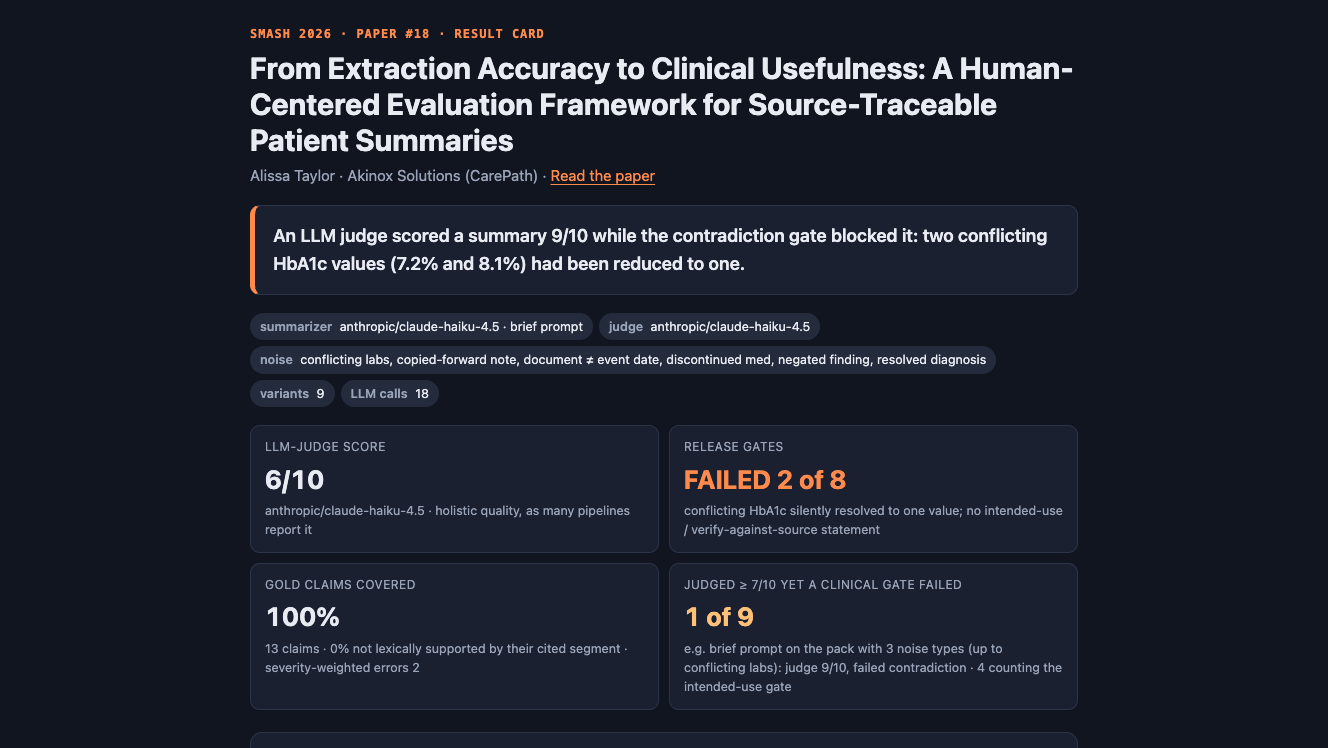
An LLM judge scored a summary 9/10 while the contradiction gate blocked it: two conflicting HbA1c values (7.2% and 8.1%) had been reduced to one. The patient pack is synthetic, written for this runbook. Gates are simplified lexical checks.
Inputs
Acceptance checklist
15/15 checks passed.- Set up the sandbox and parameters
- Extract the tested code
- Run the experiment
- Write the narrative
- Render the result card and summary
- The headline states this run's finding with its numbers, not a description of the method
- Paper numbers are quoted exactly and any disagreement with the paper is stated plainly
- Caveats say what is synthetic, reconstructed or an extension of the paper
- Each try-next suggestion would plausibly give a contrasting result
- Result card, numbers, narrative and summary were written
- Experiment numbers are valid JSON and the experiment stayed within its time budget
- The narrative has a headline, three idea bullets, findings, try-next runs and caveats
- Every try-next suggestion uses only this runbook's parameters
- Every number in the headline appears in the run's results
- The card embeds its figures, shows the headline, and contains no NaN
Runbook
| version | 1.0.0 |
| evaluation | programmatic |
| evals_version | 2 |
| agent | claude-code |
| model | anthropic/claude-haiku-5.5 |
| model_provider | openrouter |
| snapshot | python312-uv |
| primary_outputs | result_card.html |
The Judge Says 9/10, the Gate Says No: Release Gates for Patient Summaries (SMASH 2026 · Paper #18)
Objective
This runbook is an interactive companion to the SMASH 2026 paper "From Extraction Accuracy to Clinical Usefulness: A Human-Centered Evaluation Framework for Source-Traceable Patient Summaries" (Alissa Taylor). Read the paper: https://drive.google.com/file/d/10P_qlRn02fwt-f2id3gu_oRUfPCTcpgr/view?usp=sharing
The paper's claim: extraction accuracy is necessary but not enough. A fact can be extracted correctly and still mislead if it loses its temporal context, its status (active vs resolved), its negation, or its source. The paper proposes layered evaluation: Layer 1 deterministic checks that act as high-sensitivity release gates "for failures that should never be averaged away by a favorable overall score"; Layer 2 claim-level metrics; Layer 3 human task-based testing. Model-as-judge scores are at most a secondary regression signal. Evaluation uses synthetic patient packs with controlled noise and provenance-aware gold labels.
The participant runs that pipeline on a small, fully synthetic patient pack (patient "SP-0187") with planted noise: a discontinued medication, a resolved diagnosis, conflicting HbA1c values, a copied-forward medication list, a letter whose document date differs from the event date, and a negated finding. An LLM writes a cited, structured summary; the release gates and claim metrics run in code; an LLM judge gives the usual holistic 1–10 score. The run repeats with other prompt styles and on a ladder of increasingly noisy packs, and asks: how often would a judge ship a summary that a deterministic gate blocks? Participants can also paste their own synthetic notes. Output: a shareable result card.
Target wall-clock: under 4 minutes. The experiment takes ~40 s (18 small LLM calls by default).
Layer-1 gates implemented (paper's list, as deterministic code)
1 schema validity · 2 valid source identifiers and citation coverage for every claim · 3 preservation of negation · 4 correct active / resolved / discontinued status · 5 medication start/stop boundaries and current dose (not a copied-forward one) · 6 event date rather than document date · 7 contradiction surfaced with both sources cited ("provenance when claims are merged") · 8 required intended-use language. Layer 2: gold-claim recall, governing-source citation, lexical support of each claim by its cited segment, severity-weighted errors.
Paper statements to quote (the paper reports no numbers; quote exactly)
- "These checks act as high-sensitivity release gates for failures that should never be averaged away by a favorable overall score."
- "A gain in readability should not offset broken evidence links, a known status inversion, or loss of negation."
- "If a claim lacks an accessible source, the presence of other well-supported claims should not compensate for it."
- Model-as-judge scores "should not serve as the sole evidence of clinical acceptability because judge models may share blind spots with the system being evaluated."
- "Errors should be stratified by likely consequence rather than counted equally."
REQUIRED OUTPUT FILES (MANDATORY)
All in {{results_dir}}:
| File | Description |
|---|---|
result_card.html | Primary output. Self-contained, shareable one-page result card |
results.json | All computed numbers, summaries, gate reasons (written by experiment.py) |
card_data.json | Numbers/figures for the card (written by experiment.py) |
narrative.json | Your interpretation of this run (Step 4) |
fig_*.png | Figures (written by experiment.py) |
summary.md | 5–10 line plain-text summary |
validation_report.json | Evals v2 report: steps, code checks, checklist (see Write Validation Report) |
Parameters
| Parameter | Template Variable | Default | Description |
|---|---|---|---|
| Summarizer prompt | {{summarizer_style}} | brief | brief (concise, readable, cited), careful (explicit rules on status, dates, conflicts, negation, intended use) or naive (just "summarize") |
| Summarizer size | {{summarizer_size}} | small | small (Claude Haiku) or large (Claude Sonnet; slower and costlier) |
| Judge size | {{judge_size}} | small | Model used as the holistic 1–10 judge |
| Noise types | {{noise_types}} | all | all, none, or a comma list of discontinued_med, resolved_dx, conflicting_labs, copied_forward, date_mismatch, negation |
| Compare prompt styles | {{compare_styles}} | true | Also run the other two prompt styles on the same pack |
| Noise ladder | {{degradation_ladder}} | true | Also run your prompt on packs with 0, 1, …, 6 noise types (same clinical state) |
| Your notes | {{custom_notes}} | — | Paste synthetic notes instead (never real patient data): documents separated by lines === type | YYYY-MM-DD. Without gold labels only the gold-free gates run (schema, citations, negation, intended use) |
Dependencies
numpy and matplotlib (preinstalled in python312-uv). No downloads; the patient pack is generated in code.
LLM access: llm.py (embedded) uses the sandbox's OpenRouter/Anthropic/OpenAI key.
Step 1: Set up
mkdir -p {{results_dir}} /app/work && cd /app/work
python -c "import numpy, matplotlib" 2>/dev/null || uv pip install --system -q numpy matplotlib
Write /app/work/params.json. If a value still looks like an unsubstituted {{…}} placeholder use the table
default; use "" for blank custom_notes. Convert the two switches to JSON booleans. Put custom_notes into a
JSON string with proper escaping (write the file with Python json.dump if the notes contain quotes or newlines).
If the pasted notes look like real patient data (real names, health-card numbers), do not run them: use the
default pack and say so in the caveats.
{"summarizer_style": "{{summarizer_style}}", "summarizer_size": "{{summarizer_size}}", "judge_size": "{{judge_size}}",
 "noise_types": "{{noise_types}}", "compare_styles": {{compare_styles}}, "degradation_ladder": {{degradation_ladder}},
 "custom_notes": "{{custom_notes}}", "runbook_url": ""}
Step 2: Get the code (extract it, don't retype it)
The tested implementation is embedded in the Appendix at the end of this runbook. Do not rewrite, "improve", or re-derive it. Always run the command below first, exactly as written. It copies the files out of this runbook's text (which the sandbox exposes to running processes) in about a second, and it is far faster and more reliable than retyping several hundred lines. Do not skip it on the assumption that it won't work: run it and read its output:
cd /app/work && cat > extract.py <<'PYEOF'
"""Extract the runbook's embedded files without retyping them.

The runbook text reaches the agent as one command-line argument, so it is readable from /proc.
Every embedded file sits under a heading "### `/app/work/<name>`" followed by one fenced block.
Exits non-zero if any requested file can't be found, so the caller falls back to writing it by hand.

usage: python3 extract.py <name> [<name> ...]   (writes /app/work/<name>)
"""
import ast, glob, re, sys
from pathlib import Path

want = sys.argv[1:]
cands = []
for p in glob.glob("/proc/[0-9]*/cmdline"):
    try:
        s = Path(p).read_bytes().decode("utf-8", "ignore")
    except OSError:
        continue
    if all(f"### `/app/work/{w}`" in s for w in want):
        cands.append(s)
if not cands:
    sys.exit("runbook text not found in /proc; write the files by hand")
# The agent's own argv holds the raw text; wrapper shells hold a shell-quoted copy, so prefer the shortest
# and undo shell single-quote escaping as a fallback.
best = min(cands, key=len).replace("'\"'\"'", "'")
ok = True
for w in want:
    m = re.search(r"### `/app/work/" + re.escape(w) + r"`\s*\n+```[a-z]*\n(.*?)\n```\n", best, re.S)
    if not m or len(m.group(1)) < 50:
        print(f"MISSING {w}"); ok = False; continue
    code = m.group(1) + "\n"
    if w.endswith(".py"):
        try:
            ast.parse(code)
        except SyntaxError as e:
            print(f"MISSING {w} (extracted text does not parse: {e})"); ok = False; continue
    Path("/app/work", w).write_text(code)
    print(f"extracted {w}: {code.count(chr(10))} lines")
sys.exit(0 if ok else 1)
PYEOF
python3 extract.py experiment.py llm.py render_card.py validate.py
If it exits non-zero or prints MISSING, write each missing file from the Appendix exactly as given, one
heredoc per file (quoted delimiter, e.g. cat > experiment.py <<'PYEOF'). If a later step fails, fix only
environment problems (missing package, network retry), never the methodology.
Step 3: Run the experiment
cd /app/work && export OMP_NUM_THREADS=4 OPENBLAS_NUM_THREADS=4 MKL_NUM_THREADS=4 SMASH_CPUS=4 && timeout 300 python -W ignore experiment.py params.json {{results_dir}}Expected: ~40 s, ending with a done: line (judge score, failed gates, how many variants a judge would ship but a
gate blocks). On an HTTP error run it once more; finished calls are cached in /app/work/llm_cache.json.
The sandbox has 4 CPUs even though nproc may report more; the exports keep numpy/BLAS and process pools from oversubscribing them.
Step 4: Interpret: write narrative.json
Read {{results_dir}}/results.json (main, style_runs, ladder, all_runs with gate_reasons, audit,
judge_rationale) and card_data.json, and look at every fig_*.png. Write {{results_dir}}/narrative.json with
keys headline, idea (exactly 3), findings (2–4), try_next (2–3), caveats (2–4):
- headline (≤ 30 words): the sharpest judge-vs-gate contrast of this run with 1–2 numbers from
results.json, ideally fromjudged_7plus_but_clinical_gate_failed("the judge gave 9/10; the contradiction gate blocked it: HbA1c conflict silently resolved"). If none exists, report the main run's judge score and gate result honestly. - idea: (1) extraction accuracy is not clinical usefulness (time, status, negation, contradiction, source); (2) objectively testable properties become deterministic release gates that a good average score cannot offset; (3) evaluate on synthetic packs with controlled noise and provenance-aware gold labels, with judge scores secondary.
- findings: (1) the main summary: judge score vs gates, quoting the gate reasons and the claim-audit verdicts;
(2) prompt styles: which style passes the gates and how the judge ranked them; (3) the noise ladder: which noise
type first breaks a gate, and whether the judge score tracks it (check
judge_rationale: the judge may punish messiness of the record rather than errors of the summary); (4) Layer-2 metrics (recall can be 100% while a gate fails: extraction accuracy ≠ usefulness). - try_next: 2–3 runs with exact values using only the keys
summarizer_style, summarizer_size, judge_size, noise_types, compare_styles, degradation_ladder, custom_notes. Good contrasts:summarizer_stylecareful;summarizer_sizelarge; a single noise type (e.g.noise_typesconflicting_labs); pasted synthetic notes. - caveats: the pack is synthetic and written for this runbook (not CarePath's Synthea-derived benchmark); the gates are simplified lexical/structural checks written for this pack and can misfire on unusual phrasing (the claim audit shows what they matched); the judge and summarizer are from the same model family; a single run per variant at temperature 0, so scores can move between runs; the paper reports no numbers, so nothing here is a reproduction of results.
Step 5: Render the card and summary
cd /app/work && python render_card.py {{results_dir}}/card_data.json {{results_dir}}/narrative.json {{results_dir}}/result_card.htmlWrite {{results_dir}}/summary.md (5–10 lines: settings, main judge score and gate result with reasons, style
comparison, ladder, headline).
Writing style for narrative.json
These rules apply to every field and override any longer limits stated earlier in this runbook. Let the paper and the numbers speak; the card is not the place for commentary.
- Length:
headlineone sentence;idea1–3 bullets of at most 30 words;findings1–2 paragraphs of at most 60 words each;caveats1–2 bullets of at most 20 words. Cut anything the tiles, figures or tables already show. - Plain statements of what was measured. Write "Sensitivity gap −0.284 [−0.354, −0.218]; the paper reports +0.088", not an interpretation of what it means for the field.
- Avoid: em-dash asides; "not X, but Y" framings; colon-then-reveal sentences; rhetorical questions; words such as crucially, notably, strikingly, remarkably, collapses, illustrating, underscores, highlights, delve, powerful, key insight, worth noting; exclamation marks; restating the method before the result.
- Use the paper's own terms for its concepts. Quote the paper's numbers exactly.
Code Checks
Jetty runs these checks itself in the sandbox after the agent finishes, so they cannot be skipped or
misreported. validate.py (see Write Validation Report) runs the same checks first so you can fix problems before you stop.
outputs-exist — Result card, numbers, narrative and summary were written
cd {{results_dir}} && for f in result_card.html results.json card_data.json narrative.json summary.md; do test -s "$f" || { echo "missing or empty: $f"; exit 1; }; done; echo "all 5 outputs present"results-valid — Experiment numbers are valid JSON and the experiment stayed within its time budget
python3 - "{{results_dir}}" 300 <<'PY'
import json, sys
from pathlib import Path
R, budget = Path(sys.argv[1]), float(sys.argv[2])
res = json.loads((R / "results.json").read_text())
json.loads((R / "card_data.json").read_text())
rt = float(res.get("runtime_sec", 0))
if rt > budget:
    sys.exit(f"experiment took {rt}s, budget {budget}s")
print(f"results.json and card_data.json parse; experiment {rt}s within {budget:.0f}s")
PY
narrative-complete — The narrative is complete and within the length limits
python3 - "{{results_dir}}" <<'PY'
import json, sys
from pathlib import Path
n = json.loads((Path(sys.argv[1]) / "narrative.json").read_text())
problems = []
if not str(n.get("headline", "")).strip(): problems.append("no headline")
if len(str(n.get("headline", "")).split()) > 45: problems.append("headline over 45 words")
if not 1 <= len(n.get("idea", [])) <= 3: problems.append(f"idea has {len(n.get('idea', []))} bullets, need 1-3")
if not 1 <= len(n.get("findings", [])) <= 2: problems.append(f"{len(n.get('findings', []))} findings, need 1-2")
if any(len(f.split()) > 70 for f in n.get("findings", [])): problems.append("a findings paragraph is over 60 words")
if not 2 <= len(n.get("try_next", [])) <= 3: problems.append(f"{len(n.get('try_next', []))} try_next, need 2-3")
if not 1 <= len(n.get("caveats", [])) <= 2: problems.append(f"{len(n.get('caveats', []))} caveats, need 1-2")
if problems: sys.exit("; ".join(problems))
print("headline, %d idea bullets, %d findings, %d try_next, %d caveats" % (len(n["idea"]), len(n["findings"]), len(n["try_next"]), len(n["caveats"])))
PY
try-next-valid — Every try-next suggestion uses only this runbook's parameters
python3 - "{{results_dir}}" "summarizer_style,summarizer_size,judge_size,noise_types,compare_styles,degradation_ladder,custom_notes" <<'PY'
import json, sys
from pathlib import Path
allowed = set(sys.argv[2].split(","))
n = json.loads((Path(sys.argv[1]) / "narrative.json").read_text())
bad = sorted({k for t in n.get("try_next", []) for k in (t.get("params") or {}) if k not in allowed})
empty = [t.get("label", "?") for t in n.get("try_next", []) if not t.get("params")]
if bad or empty: sys.exit(f"unknown parameters: {bad}; suggestions without params: {empty}")
print("all try_next parameters are declared runbook parameters")
PY
headline-grounded — Every number in the headline appears in the run's results
python3 - "{{results_dir}}" <<'PY'
import json, re, sys
from pathlib import Path
R = Path(sys.argv[1])
blob = (R / "results.json").read_text() + (R / "card_data.json").read_text()
vals = [float(x) for x in re.findall(r"-?\d+(?:\.\d+)?(?:[eE]-?\d+)?", blob)]
head = json.loads((R / "narrative.json").read_text())["headline"]
nums = re.findall(r"(?<![\w.−-])[−-]?\d[\d,]*(?:\.\d+)?(?![\w-])", head)
missing = []
for n in nums:
    s = n.replace("−", "-").replace(",", ""); v = float(s); dec = len(s.split(".")[1]) if "." in s else 0
    tol = 0.5 * 10 ** (-dec) + 1e-9
    if not any(abs(abs(x) - abs(v)) <= tol or abs(abs(x * 100) - abs(v)) <= max(tol, 0.5) for x in vals):
        missing.append(n)
if missing: sys.exit(f"headline numbers not found in results: {missing}")
print(f"{len(nums)} headline number(s) all grounded in results")
PY
card-integrity — The card embeds its figures, shows the headline, and contains no NaN
python3 - "{{results_dir}}" <<'PY'
import html, json, re, sys
from pathlib import Path
R = Path(sys.argv[1])
card = (R / "result_card.html").read_text()
text = re.sub(r"data:image/[a-z]+;base64,[A-Za-z0-9+/=]+", "", card)
head = json.loads((R / "narrative.json").read_text())["headline"]
problems = []
if card.count("data:image/png;base64") < 1: problems.append("no embedded figures")
if re.search(r"\bNaN\b|\bnan%|\bInfinity\b", text): problems.append("NaN/Infinity in card text")
if len(card) > 5_000_000: problems.append(f"card is {len(card) // 1024} KB")
plain = html.unescape(re.sub(r"<[^>]+>", "", text))
if re.sub(r"[*`]", "", head)[:40] not in plain: problems.append("headline not on card")
if problems: sys.exit("; ".join(problems))
print(f"card {len(card) // 1024} KB, {card.count('data:image/png;base64')} figures, headline present")
PY
Checklist
- The headline states this run's finding with its numbers, not a description of the method
- Paper numbers are quoted exactly and any disagreement with the paper is stated plainly
- Caveats say what is synthetic, reconstructed or an extension of the paper
- Each try-next suggestion would plausibly give a contrasting result
Write Validation Report
Judge the four Checklist items honestly against your outputs and write them to /app/work/checklist.json as a
list, using the checklist ids Jetty gives you (one entry per item):
[{"id": "<checklist id>", "status": "pass", "message": "one line on why"}]Then write the report and self-check in one command:
cd /app/work && python3 validate.py {{results_dir}} summarizer_style,summarizer_size,judge_size,noise_types,compare_styles,degradation_ladder,custom_notes 300 checklist.jsonvalidate.py writes {{results_dir}}/validation_report.json in the v2 shape Jetty reads (version: 2, one
step entry per runbook step, one code_check entry per check above, one checklist entry per item). Jetty
replaces the code_check entries with its own independent run of the same checks. Do not write the report by hand.
Iteration (up to 2 rounds)
If validate.py prints any FAIL, fix the named problem (usually a headline number that does not match
results.json, or an unknown try_next key), re-render the card (Step 5) and rerun the command above. Never
rerun the experiment just to change the narrative.
Appendix: code
These files are extracted verbatim in Step 2.
/app/work/experiment.py
"""Source-traceable patient summaries: release gates vs an LLM judge — SMASH 2026 paper #18 (Alissa Taylor, Akinox).

A fixed SYNTHETIC patient pack with planted documentation noise (discontinued medication, resolved vs active
diagnosis, conflicting labs, copied-forward note, document date != event date, negation) and provenance-aware gold
labels. An LLM writes a cited, structured summary; the paper's Layer-1 deterministic release gates and Layer-2
claim metrics are computed in code; an LLM judge gives the usual holistic 1-10 score. The point: a fluent summary
can score well with a judge and still fail a gate that "should never be averaged away".

usage: python experiment.py params.json outdir
"""
import json, re, sys, time
from pathlib import Path

import numpy as np
import matplotlib
matplotlib.use("Agg")
import matplotlib.pyplot as plt

T0 = time.time()
P = json.loads(Path(sys.argv[1]).read_text())
OUT = Path(sys.argv[2]); OUT.mkdir(parents=True, exist_ok=True)
INK, ACC, BLUE, MUTED, GOOD = "#1f2a44", "#d9480f", "#1971c2", "#868e96", "#2b8a3e"
NOISE = ["discontinued_med", "resolved_dx", "conflicting_labs", "copied_forward", "date_mismatch", "negation"]
NOISE_LABEL = {"discontinued_med": "discontinued med", "resolved_dx": "resolved diagnosis", "conflicting_labs": "conflicting labs",
               "copied_forward": "copied-forward note", "date_mismatch": "document ≠ event date", "negation": "negated finding"}
GATES = [("schema", "Schema valid"), ("citations", "Citation validity & coverage"), ("negation", "Negation preserved"),
         ("status", "Active/resolved/discontinued status"), ("med_bounds", "Medication start/stop & current dose"),
         ("event_dates", "Event date (not document date)"), ("contradiction", "Conflict surfaced, both sources cited"),
         ("intended_use", "Intended-use language")]


def log(m):
    print(f"[{time.time() - T0:6.1f}s] {m}", flush=True)


def s(key, default):
    v = P.get(key, default)
    return default if v is None or (isinstance(v, str) and (v.strip() == "" or v.strip().startswith("{{"))) else v


STYLE = str(s("summarizer_style", "brief")); SIZE = str(s("summarizer_size", "small")); JUDGE = str(s("judge_size", "small"))
nt = str(s("noise_types", "all")).strip().lower()
ON = set(NOISE) if nt in ("all", "") else ({x.strip() for x in nt.split(",")} & set(NOISE) if nt != "none" else set())
COMPARE = str(s("compare_styles", "true")).lower() in ("true", "1", "yes")
LADDER = str(s("degradation_ladder", "true")).lower() in ("true", "1", "yes")
CUSTOM = str(s("custom_notes", "")).strip()

# ---------------------------------------------------------------- the synthetic patient pack (fully fictional)


def build_pack(on):
    """Documents as (id, type, document date, [segments]). Each noise type swaps in a harder version of the same
    underlying clinical state; with it off, the record states that fact cleanly."""
    d = []
    meds_2024 = ("metformin 500 mg twice daily; lisinopril 10 mg daily" if "discontinued_med" in on
                 else "metformin 500 mg twice daily; losartan 50 mg daily")
    d.append(("D1", "Referral letter (GP to endocrinology)", "2024-01-15", [
        "Re: synthetic patient SP-0187, 67-year-old man.",
        "Type 2 diabetes mellitus diagnosed 2016, suboptimally controlled.",
        "Hypertension, on treatment.",
        f"Current medications: {meds_2024}."]))
    d.append(("D2", "Medication reconciliation", "2024-06-10", [
        "Metformin increased from 500 mg to 1000 mg twice daily on 2024-06-10 (pharmacist reconciliation).",
        "No known drug allergies."]))
    if "discontinued_med" in on:
        d.append(("D3", "Progress note (family medicine)", "2024-09-03", [
            "Persistent dry cough for 6 weeks, attributed to ACE inhibitor.",
            "Lisinopril 10 mg daily stopped today, 2024-09-03.",
            "Started losartan 50 mg daily on 2024-09-03."]))
    else:
        d.append(("D3", "Progress note (family medicine)", "2024-09-03", [
            "Blood pressure 132/80 on losartan 50 mg daily; continue."]))
    if "resolved_dx" in on:
        d.append(("D4", "Discharge summary", "2023-03-02", [
            "Admitted 2023-02-24 with right lower lobe community-acquired pneumonia; treated with IV ceftriaxone.",
            "Acute kidney injury on admission (creatinine 168 umol/L), resolved by discharge with IV fluids.",
            "Pneumonia resolved clinically; discharged home 2023-03-02. Follow-up chest X-ray 2023-04-10 clear."]))
    d.append(("D5", "Laboratory report", "2025-02-11", [
        "HbA1c 7.2% (collected 2025-02-11).",
        "eGFR 68 mL/min/1.73m2 (collected 2025-02-11)."]))
    if "negation" in on:
        d.append(("D6", "Imaging report: left leg venous Doppler ultrasound", "2025-02-02", [
            "Indication: left calf swelling after a long flight.",
            "Findings: no evidence of deep vein thrombosis in the left leg.",
            "Impression: negative for DVT."]))
    d.append(("D7", "Endocrinology consult letter", "2025-03-05", [
        ("Most recent HbA1c 8.1%, so glycaemic control has worsened." if "conflicting_labs" in on
         else "Most recent HbA1c 7.2% (2025-02-11)."),
        "Plan: continue metformin 1000 mg twice daily; consider adding an SGLT2 inhibitor at next visit."]))
    if "copied_forward" in on:
        stale = "metformin 500 mg twice daily, lisinopril 10 mg daily" if "discontinued_med" in on else "metformin 500 mg twice daily, losartan 50 mg daily"
        d.append(("D8", "Progress note (family medicine)", "2025-03-20", [
            "Seen for routine follow-up; feels well.",
            f"Medications: {stale}.",
            "Plan: repeat labs in 3 months."]))
    else:
        cur = "metformin 1000 mg twice daily, losartan 50 mg daily"
        d.append(("D8", "Progress note (family medicine)", "2025-03-20", [
            "Seen for routine follow-up; feels well.", f"Medications: {cur}.", "Plan: repeat labs in 3 months."]))
    if "date_mismatch" in on:
        d.append(("D9", "Physiotherapy discharge letter", "2025-04-22", [
            "Patient sustained a fall at home on 2025-01-14 with a left distal radius fracture, treated in a cast.",
            "Completed 8 weeks of physiotherapy; wrist range of motion now near normal."]))
    else:
        d.append(("D9", "Emergency department note", "2025-01-14", [
            "Fall at home today with a left distal radius fracture; cast applied."]))
    return [{"id": i, "type": t, "date": dt, "segments": {f"{i}.{k + 1}": x for k, x in enumerate(seg)}} for i, t, dt, seg in d]


def gold_items(on):
    """Provenance-aware gold labels: concept, expected status, interval, governing source, severity (1-3)."""
    g = [{"key": "t2dm", "label": "Type 2 diabetes", "aliases": ["diabetes", "t2dm"], "status": "active", "src": ["D1.2"], "sev": 2},
         {"key": "htn", "label": "Hypertension", "aliases": ["hypertension", "htn"], "status": "active", "src": ["D1.3"], "sev": 2},
         {"key": "metformin", "label": "Metformin 1000 mg BID (since 2024-06-10)", "aliases": ["metformin"], "status": "active",
          "src": ["D2.1"], "sev": 3, "dose": "1000"},
         {"key": "losartan", "label": "Losartan 50 mg daily" + (" (started 2024-09-03)" if "discontinued_med" in on else ""),
          "aliases": ["losartan"], "status": "active", "src": ["D3.3" if "discontinued_med" in on else "D3.1"], "sev": 2},
         {"key": "hba1c", "label": "HbA1c " + ("7.2% (lab) vs 8.1% (letter): conflict" if "conflicting_labs" in on else "7.2%"),
          "aliases": ["hba1c", "a1c", "glycated"], "status": "conflicting" if "conflicting_labs" in on else "active",
          "src": ["D5.1", "D7.1"] if "conflicting_labs" in on else ["D5.1"], "sev": 2},
         {"key": "fracture", "label": "Fall with L distal radius fracture on 2025-01-14", "aliases": ["fracture", "fall", "radius"],
          "status": "historical", "src": ["D9.1"], "sev": 1, "event_date": "2025-01-14",
          "wrong_date": "2025-04-22" if "date_mismatch" in on else None}]
    if "discontinued_med" in on:
        g.append({"key": "lisinopril", "label": "Lisinopril stopped 2024-09-03 (cough)", "aliases": ["lisinopril", "ace inhibitor"],
                  "status": "discontinued", "src": ["D3.2"], "sev": 3, "stop": "2024-09-03"})
    if "resolved_dx" in on:
        g.append({"key": "pneumonia", "label": "Pneumonia 2023, resolved", "aliases": ["pneumonia"], "status": "resolved", "src": ["D4.1", "D4.3"], "sev": 2})
        g.append({"key": "aki", "label": "Acute kidney injury 2023, resolved", "aliases": ["kidney injury", "aki"], "status": "resolved", "src": ["D4.2"], "sev": 2})
    if "negation" in on:
        g.append({"key": "dvt", "label": "DVT ruled out (Doppler 2025-02-02)", "aliases": ["dvt", "deep vein thrombosis", "thrombosis"],
                  "status": "negated", "src": ["D6.2", "D6.3"], "sev": 3})
    return g


def parse_custom(txt):
    """Paste format: documents separated by lines starting with '===' (optionally '=== type | YYYY-MM-DD')."""
    docs, cur, head = [], [], ("Note", "")
    for line in txt.splitlines() + ["==="]:
        if line.strip().startswith("==="):
            body = " ".join(cur).strip()
            if body:
                segs = [x.strip() for x in re.split(r"(?<=[.!?])\s+|\n", body) if x.strip()]
                i = f"D{len(docs) + 1}"
                docs.append({"id": i, "type": head[0], "date": head[1], "segments": {f"{i}.{k + 1}": x for k, x in enumerate(segs)}})
            parts = [x.strip() for x in line.strip("= ").split("|")]
            head = (parts[0] or "Note", parts[1] if len(parts) > 1 else ""); cur = []
        else:
            cur.append(line)
    return docs


def pack_text(pack):
    return "\n\n".join(f"[{d['id']}] {d['type']} | document date {d['date'] or 'unknown'}\n" +
                       "\n".join(f"  ({sid}) {t}" for sid, t in d["segments"].items()) for d in pack)


# ---------------------------------------------------------------- LLM summarizer and judge

SCHEMA = ('{"summary_text": "<the summary a clinician reads>", "claims": [{"text": "<one clinical statement>", '
          '"category": "problem|medication|lab|event|finding", "status": "active|resolved|historical|discontinued|negated|conflicting|uncertain", '
          '"date": "YYYY-MM-DD or empty", "start": "YYYY-MM-DD or empty", "stop": "YYYY-MM-DD or empty", "citations": ["D1.2"]}]}')
STYLES = {
    "careful": ("You write source-traceable patient summaries for clinicians.",
                "Summarize this patient's record for a clinician taking over care. Rules: separate ACTIVE problems from RESOLVED or "
                "HISTORICAL ones; mark stopped medications as discontinued with their stop date and give current doses only from the most "
                "recent authoritative source (beware copied-forward lists); date events by when they happened, not when the document was "
                "written; preserve negations (a ruled-out finding must stay ruled out); if sources conflict, say so and cite both rather "
                "than picking one; cite segment ids for every claim; end the summary_text with an intended-use statement saying it is an "
                "AI-generated summary for clinician review that must be verified against the cited sources."),
    "brief": ("You write concise, readable clinical summaries.",
              "Write a concise, highly readable summary of this patient (under 120 words of summary_text) for a busy clinician. "
              "Cite the segment ids that support each claim."),
    "naive": ("You are a helpful assistant.",
              "Summarize this patient's record: list the problems, medications, recent labs and events. Cite segment ids for each claim."),
}


def summarize_prompts(pack, style):
    sysmsg, task = STYLES[style]
    return sysmsg, (f"{task}\n\nRecord (each segment has an id in parentheses):\n\n{pack_text(pack)}\n\n"
                    f"Use at most 14 claims. Return ONLY a JSON object with this shape (no markdown):\n{SCHEMA}")


def judge_prompt(pack, summ):
    claims = "\n".join(f"- {c.get('text', '')} [{', '.join(map(str, c.get('citations', []) or []))}]" for c in summ.get("claims", []))
    return (f"You are evaluating an AI-generated patient summary.\n\nSOURCE RECORD:\n{pack_text(pack)}\n\nSUMMARY:\n{summ.get('summary_text', '')}"
            f"\n\nCLAIMS WITH CITATIONS:\n{claims}\n\nRate the summary's overall quality for a clinician (accuracy, completeness, "
            'clarity, usefulness) on a 1-10 scale. Return ONLY JSON: {"score": <integer 1-10>, "rationale": "<= 30 words"}')


def safe_json(rep):
    """Parse the model's JSON; if it was cut off mid-claim, keep the complete claims (salvage) rather than discard all."""
    from llm import parse_json
    try:
        d = parse_json(rep)
        return d if isinstance(d, dict) else {}
    except ValueError:
        pass
    i = rep.find("{")
    for j in [m.start() for m in re.finditer(r"\}\s*,?\s*\n", rep)][::-1]:
        try:
            d = json.loads(rep[i:j + 1] + "]}")
            d["_salvaged"] = True
            return d
        except (json.JSONDecodeError, ValueError):
            continue
    return {}


# ---------------------------------------------------------------- Layer 1: deterministic release gates

STATUS_MAP = {"stopped": "discontinued", "ceased": "discontinued", "past": "historical", "previous": "historical", "prior": "historical",
              "ruled out": "negated", "absent": "negated", "negative": "negated", "excluded": "negated", "current": "active",
              "ongoing": "active", "chronic": "active", "conflict": "conflicting", "discrepant": "conflicting"}
NEG = r"\b(no|not|negative|without|ruled out|excluded|denies|absence|absent|free of)\b"
STOP = r"\b(stop\w*|discontinu\w*|ceas\w*|switch\w*|replac\w*|chang\w*|previous\w*|former\w*|prior|no longer|held|withdr\w*)"
RESOLVED = r"\b(resol\w*|histor\w*|hx|prior|previous\w*|past|treated|recover\w*|2023)"
CONFLICT = r"\b(conflict|conflicting|discrepan|differ|inconsisten|versus|vs\.?|whereas|however|but)\b"
INTENDED = r"(verify|verified|verification|clinical judg|not a substitute|clinician review|intended (use|for)|decision support|ai[- ]generated)"


def norm_status(x):
    x = str(x or "").lower().strip()
    return STATUS_MAP.get(x, x)


def clauses(text):
    return [c for c in re.split(r"(?<=[.;!?])\s+|\n+|•|•", text or "") if c.strip()]


def mentions(t, aliases):
    t = t.lower()
    return any(re.search(r"\b" + re.escape(a) + r"\b", t) for a in aliases)


def evaluate(summ, pack, gold, custom=False):
    seg_text = {sid: t for d in pack for sid, t in d["segments"].items()}
    claims = summ.get("claims") if isinstance(summ.get("claims"), list) else []
    text = str(summ.get("summary_text", ""))
    res = {k: {"pass": True, "applicable": True, "why": []} for k, _ in GATES}

    def fail(k, why):
        res[k]["pass"] = False; res[k]["why"].append(why)
    ok_schema = bool(text) and bool(claims) and all(isinstance(c, dict) and c.get("text") for c in claims)
    if not ok_schema:
        fail("schema", "missing summary_text or claims")
    for c in claims:
        cits = [str(x).strip("[]() ") for x in (c.get("citations") or [])] if isinstance(c, dict) else []
        if not cits:
            fail("citations", f"uncited claim: {str(c.get('text', ''))[:60]}")
        bad = [x for x in cits if x not in seg_text]
        if bad:
            fail("citations", f"invalid source id {bad[0]}")
    res["intended_use"]["pass"] = bool(re.search(INTENDED, text, re.I))
    if not res["intended_use"]["pass"]:
        res["intended_use"]["why"].append("no intended-use / verify-against-source statement")
    rel = lambda g: ([c for c in claims if isinstance(c, dict) and mentions(str(c.get("text", "")), g["aliases"])],
                     [cl for cl in clauses(text) if mentions(cl, g["aliases"])])
    audit = []
    if custom:  # gold-free negation check: phrases negated in the source must not be asserted in the summary
        negs = set()
        for t in seg_text.values():
            for m in re.finditer(r"\b(?:no evidence of|negative for|no|denies|without|ruled out)\s+([a-z][a-z \-]{3,40}?)(?=[.,;]|\s(?:in|on|at|and|or)\b|$)", t.lower()):
                term = m.group(1).strip()
                if len(term) > 3 and term not in ("known drug allergies", "change", "changes"):
                    negs.add(term)
        for term in negs:
            for cl in clauses(text):
                if term in cl.lower() and not re.search(NEG, cl.lower()):
                    fail("negation", f"'{term}' asserted without negation")
        for k in ("status", "med_bounds", "event_dates", "contradiction"):
            res[k]["applicable"] = False
        return res, audit, {}
    G = {g["key"]: g for g in gold}
    res["negation"]["applicable"] = "dvt" in G
    res["contradiction"]["applicable"] = G["hba1c"]["status"] == "conflicting"
    res["event_dates"]["applicable"] = G["fracture"]["wrong_date"] is not None
    res["status"]["applicable"] = any(k in G for k in ("lisinopril", "pneumonia", "aki"))
    res["med_bounds"]["applicable"] = "lisinopril" in G or "copied_forward" in ON_EVAL
    covered, supported_hits = 0, 0
    for g in gold:
        cs, cls = rel(g)
        said = "; ".join([f"{c.get('text', '')} [{norm_status(c.get('status'))}]" for c in cs][:2]) or ("; ".join(cls[:1]) or "— not mentioned")
        verdict = "ok"
        mentioned = bool(cs or cls)
        covered += mentioned
        cits = {str(x) for c in cs for x in (c.get("citations") or [])}
        if cs and any(seg in cits for seg in g["src"]):
            supported_hits += 1
        st = [norm_status(c.get("status")) for c in cs]
        if g["key"] == "dvt" and mentioned:
            if any(norm_status(c.get("status")) != "negated" and not re.search(NEG, str(c.get("text", "")).lower()) for c in cs) \
                    or any(not re.search(NEG, cl.lower()) for cl in cls):
                fail("negation", "DVT asserted although the Doppler was negative"); verdict = "NEGATION LOST"
        if g["key"] in ("pneumonia", "aki") and mentioned:
            if any(norm_status(c.get("status")) == "active" and not re.search(RESOLVED, str(c.get("text", "")).lower()) for c in cs) \
                    or any(not re.search(RESOLVED, cl.lower()) for cl in cls):
                fail("status", f"{g['label'].split(' 2023')[0]} presented as active"); verdict = "STATUS INVERSION"
        if g["key"] == "lisinopril" and mentioned:
            if any(norm_status(c.get("status")) == "active" and not re.search(STOP, str(c.get("text", "")).lower()) for c in cs) \
                    or any(not re.search(STOP, cl.lower()) for cl in cls):
                fail("status", "lisinopril presented as a current medication"); verdict = "STATUS INVERSION"
            elif not any(g["stop"] in (str(c.get("stop", "")) + str(c.get("text", ""))) or re.search(r"sep(tember)?\.? 2024|2024-09", str(c.get("text", "")).lower()) for c in cs) \
                    and not any(re.search(r"2024-09-03|sep(tember)?\.? (3,? )?2024", cl.lower()) for cl in cls):
                fail("med_bounds", "lisinopril stop date missing"); verdict = "STOP DATE MISSING"
        if g["key"] == "metformin" and "copied_forward" in ON_EVAL and mentioned:
            bad = [x for x in [str(c.get("text", "")) for c in cs if norm_status(c.get("status")) in ("active", "")] + cls
                   if re.search(r"\b500\s*mg", x.lower()) and not re.search(r"1,?000\s*mg|1 ?g\b|2,?000\s*mg", x.lower())
                   and not re.search(r"increas|previous|from 500|conflict|discrepan|lists|listed|documented|copied|outdated|stale|however", x.lower())]
            if bad:
                fail("med_bounds", "stale copied-forward dose (metformin 500 mg) given as current"); verdict = "STALE DOSE"
        if g["key"] == "fracture" and g["wrong_date"] and mentioned:
            dates = [str(c.get("date", "")) for c in cs] + [cl for cl in cls]
            if any(g["wrong_date"] in x for x in dates) and not any(g["event_date"] in x or re.search(r"jan(uary)?\.? (14,? )?2025", x.lower()) for x in dates):
                fail("event_dates", "fracture dated by the letter (2025-04-22), not the fall (2025-01-14)"); verdict = "WRONG EVENT DATE"
        if g["key"] == "hba1c" and g["status"] == "conflicting":
            alltxt = " ".join([str(c.get("text", "")) for c in cs] + cls)
            both_vals = "7.2" in alltxt and "8.1" in alltxt
            both_src = any(x.startswith("D5") for x in cits) and any(x.startswith("D7") for x in cits)
            flagged = any(x == "conflicting" for x in st) or re.search(CONFLICT, alltxt.lower())
            if not mentioned:
                fail("contradiction", "HbA1c conflict omitted"); verdict = "CONFLICT OMITTED"
            elif not (both_vals and flagged):
                fail("contradiction", "conflicting HbA1c silently resolved to one value"); verdict = "SILENTLY RESOLVED"
            elif not both_src:
                fail("contradiction", "conflict shown but not both sources cited"); verdict = "ONE SOURCE CITED"
        if not mentioned:
            verdict = "omitted"
        audit.append({"item": g["label"], "expected": g["status"], "said": said[:110], "verdict": verdict, "severity": g["sev"]})
    # Layer 2: claim metrics
    sup = 0
    for c in claims:
        if not isinstance(c, dict):
            continue
        words = {w for w in re.findall(r"[a-z0-9.]{4,}", str(c.get("text", "")).lower())}
        segs = " ".join(seg_text.get(str(x), "") for x in (c.get("citations") or [])).lower()
        if words and segs and len([w for w in words if w in segs]) / len(words) >= 0.3:
            sup += 1
    sev_fail = sum(a["severity"] for a in audit if a["verdict"] not in ("ok", "omitted"))
    l2 = {"n_claims": len(claims), "gold_recall": covered / len(gold), "gold_supported_by_governing_source": supported_hits / len(gold),
          "supported_claim_rate": sup / len(claims) if claims else 0.0, "unsupported_claim_rate": 1 - sup / len(claims) if claims else 1.0,
          "severity_weighted_errors": sev_fail, "omitted_items": sum(a["verdict"] == "omitted" for a in audit)}
    return res, audit, l2


ON_EVAL = set()


def run_variants(variants):
    """variants: list of (name, style, noise_set or None for custom)."""
    from llm import chat_many
    packs, golds, prompts, systems = [], [], [], []
    for name, style, on in variants:
        pack = parse_custom(CUSTOM) if on is None else build_pack(on)
        packs.append(pack); golds.append(None if on is None else gold_items(on))
    by_style = {}
    for i, (name, style, on) in enumerate(variants):
        by_style.setdefault(style, []).append(i)
    summ_raw = [None] * len(variants)
    for style, idx in by_style.items():
        sysmsg = summarize_prompts(packs[idx[0]], style)[0]
        reps = chat_many([summarize_prompts(packs[i], style)[1] for i in idx], system=sysmsg, size=SIZE, max_tokens=3200, workers=8)
        for i, r in zip(idx, reps):
            summ_raw[i] = r
    summs = [safe_json(r) for r in summ_raw]
    log(f"{len(variants)} summaries written")
    jreps = chat_many([judge_prompt(p, sm) for p, sm in zip(packs, summs)], system="You are an expert clinical documentation reviewer.",
                      size=JUDGE, max_tokens=200, workers=8)
    out = []
    global ON_EVAL
    for (name, style, on), pack, gold, sm, jr in zip(variants, packs, golds, summs, jreps):
        ON_EVAL = set(on or [])
        gates, audit, l2 = evaluate(sm, pack, gold or [], custom=on is None)
        jd = safe_json(jr)
        try:
            score = int(round(float(jd.get("score"))))
        except (TypeError, ValueError):
            m = re.search(r"\b(10|[1-9])\b", jr); score = int(m.group(1)) if m else None
        app = [k for k, _ in GATES if gates[k]["applicable"]]
        failed = [k for k in app if not gates[k]["pass"]]
        out.append({"name": name, "style": style, "noise": sorted(on) if on is not None else "custom", "judge_score": score,
                    "judge_rationale": jd.get("rationale", ""), "gates": gates, "gates_applicable": len(app),
                    "gates_failed": failed, "released": not failed, "audit": audit, "layer2": l2,
                    "summary_text": sm.get("summary_text", ""), "n_claims": len(sm.get("claims") or [])})
    return out, len(variants) * 2


def main():
    import llm
    custom = bool(CUSTOM)
    main_v = ("main", STYLE, None if custom else set(ON))
    variants = [main_v]
    if COMPARE:
        variants += [(f"style:{st}", st, None if custom else set(ON)) for st in STYLES if st != STYLE]
    ladder_sets = []
    if LADDER and not custom:
        cum = []
        for k in NOISE:
            ladder_sets.append(set(cum)); cum.append(k)
        ladder_sets.append(set(NOISE))
        for j, st in enumerate(ladder_sets):
            if st != set(ON):
                variants.append((f"ladder:{j}", STYLE, st))
    log(f"{len(variants)} variants (summarizer {SIZE}, judge {JUDGE}, style {STYLE}, noise {sorted(ON) if not custom else 'custom notes'})")
    runs, calls = run_variants(variants)
    main_r = runs[0]
    style_runs = [main_r] + [r for r in runs if r["name"].startswith("style:")]
    ladder = []
    if LADDER and not custom:
        for j, st in enumerate(ladder_sets):
            r = main_r if st == set(ON) else next(x for x in runs if x["name"] == f"ladder:{j}")
            ladder.append({"n_noise": len(st), "added": NOISE[j - 1] if j else "none", "judge_score": r["judge_score"],
                           "gates_failed": r["gates_failed"], "gates_applicable": r["gates_applicable"],
                           "gold_recall": r["layer2"].get("gold_recall"), "severity_weighted_errors": r["layer2"].get("severity_weighted_errors")})
    judged_high_but_blocked = [r for r in runs if (r["judge_score"] or 0) >= 7 and not r["released"]]
    content = lambda r: [g for g in r["gates_failed"] if g not in ("intended_use", "schema")]
    judged_high_content = [r for r in runs if (r["judge_score"] or 0) >= 7 and content(r)]
    res = {"params": P, "backend": llm.backend(), "summarizer_model": llm.model_name(SIZE), "judge_model": llm.model_name(JUDGE),
           "llm_calls": calls, "noise_on": sorted(ON) if not custom else "custom", "main": main_r, "style_runs": style_runs,
           "ladder": ladder, "n_variants": len(runs), "n_judged_7plus": sum((r["judge_score"] or 0) >= 7 for r in runs),
           "n_judged_7plus_but_gate_failed": len(judged_high_but_blocked),
           "n_judged_7plus_but_clinical_gate_failed": len(judged_high_content),
           "judged_7plus_but_clinical_gate_failed": [{"name": r["name"], "judge_score": r["judge_score"], "failed": content(r)} for r in judged_high_content],
           "judge_gate_agreement": float(np.mean([((r["judge_score"] or 0) >= 7) == r["released"] for r in runs])),
           "all_runs": [dict({k: r[k] for k in ("name", "style", "noise", "judge_score", "judge_rationale", "gates_failed", "released", "layer2", "audit", "summary_text")},
                             gate_reasons={g: r["gates"][g]["why"] for g in r["gates_failed"]}) for r in runs]}
    figures(res); card(res)
    res["runtime_sec"] = round(time.time() - T0, 1)
    (OUT / "results.json").write_text(json.dumps(res, indent=2, default=list))
    log(f"done: main ({STYLE}) judge {main_r['judge_score']}/10, gates failed {main_r['gates_failed'] or 'none'}; "
        f"{res['n_judged_7plus_but_gate_failed']}/{res['n_variants']} variants judged >=7 yet blocked; {calls} LLM calls")


# ---------------------------------------------------------------- figures and card

def figures(res):
    plt.rcParams.update({"font.size": 10, "axes.spines.top": False, "axes.spines.right": False})
    rows = res["style_runs"]
    fig, axs = plt.subplots(1, 2, figsize=(6.4, 0.9 + 0.62 * len(rows)), gridspec_kw={"width_ratios": [1, 1.5]})
    ax = axs[0]
    for i, r in enumerate(rows[::-1]):
        sc = r["judge_score"] or 0
        ax.barh(i, sc, color=ACC if not r["released"] else GOOD, height=0.55)
        ax.text(sc + 0.2, i, f"{sc}/10", va="center", fontsize=9, fontweight="bold")
    ax.set_yticks(range(len(rows))); ax.set_yticklabels([f"{r['style']}{' (yours)' if r['name'] == 'main' else ''}" for r in rows[::-1]], fontsize=9)
    ax.set_xlim(0, 11.5); ax.set_xlabel("LLM-judge score"); ax.set_title("Judge says…", fontsize=9, loc="left")
    ax = axs[1]
    for i, r in enumerate(rows[::-1]):
        for j, (k, _) in enumerate(GATES):
            gk = r["gates"][k]
            col = "#dee2e6" if not gk["applicable"] else (GOOD if gk["pass"] else ACC)
            ax.add_patch(plt.Rectangle((j, i - 0.3), 0.85, 0.6, color=col))
        ax.text(len(GATES) + 0.1, i, "RELEASE" if r["released"] else "BLOCKED", va="center", fontsize=8,
                color=GOOD if r["released"] else ACC, fontweight="bold")
    ax.set_xlim(0, len(GATES) + 1.9); ax.set_ylim(-0.6, len(rows) - 0.4)
    ax.set_xticks(np.arange(len(GATES)) + 0.42); ax.set_xticklabels([str(j + 1) for j in range(len(GATES))], fontsize=8)
    ax.set_yticks([]); ax.spines["left"].set_visible(False); ax.set_xlabel("Layer-1 release gate (see list below)")
    ax.set_title("…release gates say (green pass, orange fail, grey n/a)", fontsize=8, loc="left")
    fig.tight_layout(); fig.savefig(OUT / "fig_judge_vs_gates.png", dpi=160); plt.close(fig)

    if res["ladder"]:
        L = res["ladder"]; x = np.arange(len(L))
        fig, ax = plt.subplots(figsize=(6.4, 3.1))
        ax.plot(x, [(l["judge_score"] or 0) / 10 for l in L], "o-", color=MUTED, label="judge score / 10")
        ax.plot(x, [l["gold_recall"] for l in L], "s-", color=BLUE, label="gold-claim recall")
        ax.plot(x, [1 - len([g for g in l["gates_failed"] if g != "intended_use"]) / max(l["gates_applicable"] - 1, 1) for l in L], "D-", color=ACC,
                label="clinical gates passed (share)")
        for xi, l in zip(x, L):
            if l["gates_failed"]:
                ax.text(xi, 0.02, "\n".join(g.replace("_", " ") for g in l["gates_failed"]), ha="center", va="bottom", fontsize=6, color=ACC)
        ax.set_xticks(x); ax.set_xticklabels(["clean"] + ["+ " + NOISE_LABEL[l["added"]] for l in L[1:]], rotation=25, ha="right", fontsize=7.5)
        ax.set_ylim(0, 1.08); ax.legend(frameon=False, fontsize=7.5, loc="upper right", bbox_to_anchor=(1, 1.18), ncol=3)
        ax.set_ylabel("score"); ax.set_title(f"Same clinical state, more documentation noise ({STYLE} prompt)", fontsize=9, loc="left", pad=18)
        fig.tight_layout(); fig.savefig(OUT / "fig_degradation.png", dpi=160); plt.close(fig)

    A = res["main"]["audit"]
    if A:
        import textwrap
        wrapped = [(textwrap.wrap(a["item"], 34), textwrap.wrap(a["said"], 52)[:2], a["verdict"]) for a in A]
        heights = [max(len(w[0]), len(w[1]), 1) for w in wrapped]
        tot = sum(h * 0.45 + 0.35 for h in heights) + 1.3
        fig, ax = plt.subplots(figsize=(6.4, 0.3 + 0.3 * tot)); ax.axis("off"); ax.set_xlim(0, 1); ax.set_ylim(tot, 0)
        xs = [0.0, 0.37, 0.84]
        for x, h in zip(xs, ["Gold item (governing source)", "Summary says [status]", "Verdict"]):
            ax.text(x, 0.6, h, fontsize=7.5, fontweight="bold", va="center")
        y = 1.3
        for (it, sd, v), h in zip(wrapped, heights):
            ax.axhline(y - 0.15, color="#dee2e6", lw=0.6)
            ax.text(xs[0], y, "\n".join(it), fontsize=7, va="top", linespacing=1.25)
            ax.text(xs[1], y, "\n".join(sd), fontsize=7, va="top", color="#343a40", linespacing=1.25)
            ax.text(xs[2], y, v, fontsize=7, va="top", fontweight="bold", color=GOOD if v == "ok" else (MUTED if v == "omitted" else ACC))
            y += h * 0.45 + 0.35
        fig.tight_layout(pad=0.3); fig.savefig(OUT / "fig_claim_audit.png", dpi=160); plt.close(fig)


def card(res):
    m = res["main"]; L2 = m["layer2"]
    names = dict(GATES)
    failed_names = [names[k] for k in m["gates_failed"]]
    tiles = [{"label": "LLM-judge score", "value": f"{m['judge_score']}/10" if m["judge_score"] is not None else "n/a",
              "sub": f"{res['judge_model']} · holistic quality, as many pipelines report it", "tone": "neutral"},
             {"label": "Release gates", "value": "PASSED" if m["released"] else f"FAILED {len(m['gates_failed'])} of {m['gates_applicable']}",
              "sub": ("all applicable Layer-1 checks pass" if m["released"] else "; ".join(m["gates"][k]["why"][0] for k in m["gates_failed"] if m["gates"][k]["why"])[:160]),
              "tone": "good" if m["released"] else "accent"}]
    if L2:
        tiles.append({"label": "Gold claims covered", "value": f"{L2['gold_recall']:.0%}",
                      "sub": f"{L2['n_claims']} claims · {L2['unsupported_claim_rate']:.0%} not lexically supported by their cited segment · "
                             f"severity-weighted errors {L2['severity_weighted_errors']}", "tone": "neutral"})
    ex = res["judged_7plus_but_clinical_gate_failed"]

    def disp(n):
        if n.startswith("ladder:"):
            j = int(n.split(":")[1]); return f"{STYLE} prompt on the pack with {j} noise type{'s' if j != 1 else ''}" + (f" (up to {NOISE_LABEL[NOISE[j - 1]]})" if j else "")
        return n.replace("style:", "") + " prompt" if n != "main" else "your run"
    tiles.append({"label": "Judged ≥ 7/10 yet a clinical gate failed", "value": f"{res['n_judged_7plus_but_clinical_gate_failed']} of {res['n_variants']}",
                  "sub": (f"e.g. {disp(ex[0]['name'])}: judge {ex[0]['judge_score']}/10, failed {', '.join(ex[0]['failed'])} · " if ex else "")
                         + f"{res['n_judged_7plus_but_gate_failed']} counting the intended-use gate",
                  "tone": "warn" if ex else "good"})
    inputs = {"summarizer": f"{res['summarizer_model']} · {STYLE} prompt", "judge": res["judge_model"],
              "noise": ", ".join(NOISE_LABEL[k] for k in res["noise_on"]) if isinstance(res["noise_on"], list) and res["noise_on"] else ("custom notes" if CUSTOM else "none"),
              "variants": res["n_variants"], "LLM calls": res["llm_calls"]}
    compare = [
        {"metric": "Release gates vs averaged scores", "paper": "“A gain in readability should not offset broken evidence links, a known status inversion, or loss of negation.”",
         "yours": f"{STYLE}: judge {m['judge_score']}/10, gates " + ("passed" if m["released"] else "FAILED (" + ", ".join(failed_names) + ")"), "note": "framework claim; no paper numbers"},
        {"metric": "Model-as-judge", "paper": "should not serve as the sole evidence of clinical acceptability because judge models may share blind spots with the system being evaluated",
         "yours": f"judge (≥7) and gates agreed on {res['judge_gate_agreement']:.0%} of {res['n_variants']} summaries", "note": "same model family judges itself"},
        {"metric": "Missing sources", "paper": "“If a claim lacks an accessible source, the presence of other well-supported claims should not compensate for it.”",
         "yours": "citation gate " + ("passed" if m["gates"]["citations"]["pass"] else "FAILED: " + m["gates"]["citations"]["why"][0]), "note": ""},
        {"metric": "Severity", "paper": "“Errors should be stratified by likely consequence rather than counted equally.”",
         "yours": f"severity-weighted errors {L2.get('severity_weighted_errors', 'n/a')} (gold severities 1–3)" if L2 else "custom notes: no gold labels", "note": ""},
        {"metric": "Controlled noise", "paper": "duplicate and copied-forward statements, missing fields, conflicting sources, resolved-versus-active ambiguity, medication changes, and differences between document date and clinical-event date",
         "yours": f"{len(res['noise_on']) if isinstance(res['noise_on'], list) else 'custom'} noise types planted; ladder of {len(res['ladder'])} packs" if res["ladder"] else "custom notes (gold-free gates only)", "note": "Synthea-style pack written for this runbook"}]
    figs = [{"path": "fig_judge_vs_gates.png", "title": "Would a judge ship it, and would the release gates?",
             "caption": "Left: holistic LLM-judge score for each prompt style on the same pack. Right: the paper's Layer-1 checks — "
                        + "; ".join(f"{j + 1} {n}" for j, (_, n) in enumerate(GATES)) + "."}]
    if (OUT / "fig_claim_audit.png").exists():
        figs.append({"path": "fig_claim_audit.png", "title": "Claim-level audit against provenance-aware gold labels",
                     "caption": "Each planted fact, what your summary said about it (status in brackets), and the deterministic verdict. "
                                "Capitalised verdicts are gate failures; 'omitted' only lowers recall."})
    if (OUT / "fig_degradation.png").exists():
        figs.append({"path": "fig_degradation.png", "title": "Does quality degrade as documentation noise is added?",
                     "caption": "The same underlying clinical state presented with one more noise type at a time (the paper's controlled-noise design). "
                                "Failed gates are listed under each point."})
    Path(OUT / "card_data.json").write_text(json.dumps({
        "paper": {"num": 18, "title": "From Extraction Accuracy to Clinical Usefulness: A Human-Centered Evaluation Framework for Source-Traceable Patient Summaries",
                  "authors": "Alissa Taylor", "url": "https://drive.google.com/file/d/10P_qlRn02fwt-f2id3gu_oRUfPCTcpgr/view?usp=sharing", "affiliation": "Akinox Solutions (CarePath)"},
        "inputs": inputs, "tiles": tiles, "figures": figs, "compare": compare,
        "runbook": {"name": "smash-18-source-traceable-summaries", "url": P.get("runbook_url", "")}}, indent=2, ensure_ascii=False))


if __name__ == "__main__":
    main()
/app/work/llm.py
"""Minimal, dependency-free LLM client for SMASH paper-playground runbooks.

Works with whatever keys the Jetty sandbox provides:
  1. OPENROUTER_API_KEY                                   -> OpenRouter
  2. ANTHROPIC_API_KEY with ANTHROPIC_BASE_URL on openrouter (Jetty trial keys) -> OpenRouter
  3. ANTHROPIC_API_KEY                                    -> Anthropic Messages API
  4. OPENAI_API_KEY                                       -> OpenAI
Set SMASH_LLM_MOCK=1 to return deterministic placeholders (offline testing).

    from llm import chat, chat_many, backend
    text = chat("Say hi", system="Be brief", size="small", max_tokens=50)
"""
import concurrent.futures as cf, hashlib, json, os, time, urllib.request
from pathlib import Path

MODELS = {  # size -> (openrouter slug, anthropic id, openai id)
    "small": ("anthropic/claude-haiku-4.5", "claude-haiku-4-5", "gpt-4.1-mini"),
    "large": ("anthropic/claude-sonnet-4.6", "claude-sonnet-4-6", "gpt-4.1"),
}
CACHE = Path(os.environ.get("SMASH_LLM_CACHE", "/app/work/llm_cache.json"))
_cache = json.loads(CACHE.read_text()) if CACHE.exists() else {}


def backend():
    if os.environ.get("SMASH_LLM_MOCK"):
        return "mock"
    if os.environ.get("OPENROUTER_API_KEY"):
        return "openrouter"
    if os.environ.get("ANTHROPIC_API_KEY") and "openrouter" in os.environ.get("ANTHROPIC_BASE_URL", ""):
        return "openrouter-via-anthropic-key"
    if os.environ.get("ANTHROPIC_API_KEY"):
        return "anthropic"
    if os.environ.get("OPENAI_API_KEY"):
        return "openai"
    raise RuntimeError("no LLM key found (OPENROUTER_API_KEY / ANTHROPIC_API_KEY / OPENAI_API_KEY)")


def model_name(size="small"):
    b = backend(); i = {"openrouter": 0, "openrouter-via-anthropic-key": 0, "anthropic": 1, "openai": 2}.get(b, 0)
    return MODELS[size][i]


def _post(url, headers, body, timeout):
    req = urllib.request.Request(url, data=json.dumps(body).encode(), headers={"Content-Type": "application/json", **headers})
    with urllib.request.urlopen(req, timeout=timeout) as r:
        return json.loads(r.read())


def chat(prompt, system="", size="small", max_tokens=800, temperature=0.0, timeout=90, retries=3):
    b = backend(); model = model_name(size)
    key = hashlib.sha256(json.dumps([b, model, system, prompt, max_tokens, temperature]).encode()).hexdigest()
    if key in _cache:
        return _cache[key]
    if b == "mock":
        out = f"[mock {size} reply {key[:8]}]"
    else:
        for attempt in range(retries):
            try:
                if b.startswith("openrouter"):
                    k = os.environ.get("OPENROUTER_API_KEY") or os.environ["ANTHROPIC_API_KEY"]
                    msgs = ([{"role": "system", "content": system}] if system else []) + [{"role": "user", "content": prompt}]
                    r = _post("https://openrouter.ai/api/v1/chat/completions", {"Authorization": f"Bearer {k}"},
                              {"model": model, "messages": msgs, "max_tokens": max_tokens, "temperature": temperature}, timeout)
                    out = r["choices"][0]["message"]["content"]
                elif b == "anthropic":
                    base = os.environ.get("ANTHROPIC_BASE_URL", "https://api.anthropic.com").rstrip("/")
                    body = {"model": model, "max_tokens": max_tokens, "temperature": temperature,
                            "messages": [{"role": "user", "content": prompt}]}
                    if system:
                        body["system"] = system
                    r = _post(f"{base}/v1/messages", {"x-api-key": os.environ["ANTHROPIC_API_KEY"],
                                                      "anthropic-version": "2023-06-01"}, body, timeout)
                    out = "".join(c.get("text", "") for c in r["content"])
                else:
                    msgs = ([{"role": "system", "content": system}] if system else []) + [{"role": "user", "content": prompt}]
                    r = _post("https://api.openai.com/v1/chat/completions", {"Authorization": f"Bearer {os.environ['OPENAI_API_KEY']}"},
                              {"model": model, "messages": msgs, "max_tokens": max_tokens, "temperature": temperature}, timeout)
                    out = r["choices"][0]["message"]["content"]
                break
            except Exception as e:  # network/rate-limit: back off and retry
                if attempt == retries - 1:
                    raise
                time.sleep(2 * (attempt + 1))
    _cache[key] = out
    return out


def chat_many(prompts, system="", size="small", max_tokens=800, temperature=0.0, workers=8):
    """Run many prompts concurrently; returns replies in order. Saves the cache afterwards."""
    with cf.ThreadPoolExecutor(workers) as ex:
        outs = list(ex.map(lambda p: chat(p, system, size, max_tokens, temperature), prompts))
    save_cache()
    return outs


def save_cache():
    try:
        CACHE.parent.mkdir(parents=True, exist_ok=True); CACHE.write_text(json.dumps(_cache))
    except OSError:
        pass


def parse_json(text):
    """Pull the first JSON object/array out of a model reply."""
    s = text.strip()
    if s.startswith("```"):
        s = s.split("\n", 1)[1].rsplit("```", 1)[0]
    for o, c in (("{", "}"), ("[", "]")):
        i, j = s.find(o), s.rfind(c)
        if i != -1 and j > i:
            try:
                return json.loads(s[i:j + 1])
            except json.JSONDecodeError:
                continue
    raise ValueError("no JSON in reply: " + text[:200])
/app/work/render_card.py
"""Render a SMASH 2026 paper-playground result card (one self-contained HTML file).

usage: python render_card.py card_data.json narrative.json out.html

card_data.json  (written by the experiment script — numbers only)
  paper:   {num, title, authors, affiliation, url?}
  inputs:  {label: value}                         the participant's run settings
  tiles:   [{label, value, sub, tone}]            tone: accent|good|warn|neutral
  figures: [{path, title, caption}]               PNGs, embedded as base64
  compare: [{metric, paper, yours, note}]         paper-vs-your-run table (optional)
  runbook: {name, url}                            fork link (optional)
narrative.json  (written by the agent — words only)
  headline:  one sentence, the finding of THIS run
  idea:      [1-3 bullets] the paper's contribution in plain language
  abstract:  (optional) a verbatim abstract excerpt, shown instead of idea
  findings:  [2-4 short paragraphs] what this run shows, tied to the numbers
  try_next:  [{label, why, params}]               2-3 follow-up runs with exact parameter values
  caveats:   [bullets]
"""
import base64, html, json, sys
from pathlib import Path

data = json.loads(Path(sys.argv[1]).read_text())
narr = json.loads(Path(sys.argv[2]).read_text())
base = Path(sys.argv[1]).parent
e = lambda s: html.escape(str(s))


def md_inline(s):
    """Escape, then allow **bold**, *italic* and `code` only."""
    import re
    s = e(s)
    s = re.sub(r"\*\*(.+?)\*\*", r"<strong>\1</strong>", s)
    s = re.sub(r"(?<![\w*])\*(?!\s)(.+?)(?<!\s)\*(?![\w*])", r"<em>\1</em>", s)
    return re.sub(r"`(.+?)`", r"<code>\1</code>", s)


p = data["paper"]
tiles = "".join(
    f'<div class="tile {e(t.get("tone", "neutral"))}"><div class="tl">{e(t["label"])}</div>'
    f'<div class="tv">{e(t["value"])}</div><div class="ts">{md_inline(t.get("sub", ""))}</div></div>'
    for t in data.get("tiles", []))
# Columns that fill every row: 4 tiles as 2x2, never 3 + 1 orphan.
n_tiles = len(data.get("tiles", []))
tile_cols = 2 if n_tiles == 4 else min(max(n_tiles, 1), 3)
inputs = "".join(f'<span class="chip"><b>{e(k)}</b> {e(v)}</span>' for k, v in data.get("inputs", {}).items())
figs = ""
for f in data.get("figures", []):
    fp = Path(f["path"]); fp = fp if fp.is_absolute() else base / fp
    if fp.exists():
        b64 = base64.b64encode(fp.read_bytes()).decode()
        figs += (f'<figure><figcaption class="ft">{e(f.get("title", ""))}</figcaption>'
                 f'<img alt="{e(f.get("title", ""))}" src="data:image/png;base64,{b64}">'
                 f'<figcaption>{md_inline(f.get("caption", ""))}</figcaption></figure>')
compare = ""
if data.get("compare"):
    rows = "".join(f'<tr><td>{md_inline(r["metric"])}</td><td>{md_inline(r["paper"])}</td>'
                   f'<td class="y">{md_inline(r["yours"])}</td><td class="n">{md_inline(r.get("note", ""))}</td></tr>'
                   for r in data["compare"])
    compare = (f'<section><h2>Paper vs. your run</h2><div class="tw"><table><thead><tr><th>Metric</th>'
               f'<th>Paper</th><th>Your run</th><th></th></tr></thead><tbody>{rows}</tbody></table></div></section>')
idea = "".join(f"<li>{md_inline(b)}</li>" for b in narr.get("idea", []))
abstract = narr.get("abstract", "")
findings = "".join(f"<p>{md_inline(x)}</p>" for x in narr.get("findings", []))
tries = "".join(
    f'<li><strong>{md_inline(t["label"])}</strong> — {md_inline(t.get("why", ""))}'
    f'<pre>{e(json.dumps(t.get("params", {}), ensure_ascii=False))}</pre></li>' for t in narr.get("try_next", []))
cav = "".join(f"<li>{md_inline(c)}</li>" for c in narr.get("caveats", []))
rb = data.get("runbook", {})
fork = (f'<a class="fork" href="{e(rb["url"])}">Fork this runbook on Jetty →</a>' if rb.get("url") else "")

page = f"""<!doctype html><html lang="en"><head><meta charset="utf-8">
<meta name="viewport" content="width=device-width,initial-scale=1">
<title>SMASH 2026 · #{e(p['num'])} · Result card</title>
<style>
:root{{--bg:#f6f4ef;--card:#fff;--ink:#1f2a44;--muted:#5c677d;--line:#e3dfd5;--accent:#d9480f;--good:#2b8a3e;--warn:#e67700;--chip:#efece4}}
@media (prefers-color-scheme:dark){{:root{{--bg:#11151f;--card:#1a2030;--ink:#e8ebf2;--muted:#9aa4b8;--line:#2c3447;--accent:#ff8a4c;--good:#69db7c;--warn:#ffc078;--chip:#232b3d}}
figure img{{background:#fff;border-radius:6px}}}}
*{{box-sizing:border-box}}body{{margin:0;background:var(--bg);color:var(--ink);font:15px/1.55 ui-sans-serif,system-ui,-apple-system,"Segoe UI",Roboto,sans-serif}}
main{{max-width:860px;margin:0 auto;padding:28px 16px 48px}}
.kicker{{font:600 12px/1 ui-monospace,SFMono-Regular,Menlo,monospace;letter-spacing:.08em;text-transform:uppercase;color:var(--accent)}}
h1{{font-size:clamp(22px,4vw,30px);line-height:1.2;margin:10px 0 6px}}.authors{{color:var(--muted);margin:0 0 18px}}.authors a{{color:var(--accent);text-underline-offset:3px}}
.headline{{background:var(--card);border:1px solid var(--line);border-left:5px solid var(--accent);border-radius:10px;padding:16px 18px;font-size:18px;font-weight:600;margin:0 0 18px}}
.chips{{display:flex;flex-wrap:wrap;gap:6px;margin:0 0 18px}}.chip{{background:var(--chip);border-radius:999px;padding:4px 10px;font-size:12.5px}}.chip b{{font-weight:600;color:var(--muted);margin-right:4px}}
.tiles{{display:grid;grid-template-columns:repeat(var(--cols),minmax(0,1fr));gap:10px;margin:0 0 22px}}
@media (max-width:560px){{.tiles{{grid-template-columns:1fr}}}}
.tile{{background:var(--card);border:1px solid var(--line);border-radius:10px;padding:12px 14px}}.tl{{font-size:12px;color:var(--muted);text-transform:uppercase;letter-spacing:.04em}}
.tv{{font-size:26px;font-weight:700;margin:2px 0;font-variant-numeric:tabular-nums}}.ts{{font-size:12.5px;color:var(--muted)}}
.tile.accent .tv{{color:var(--accent)}}.tile.good .tv{{color:var(--good)}}.tile.warn .tv{{color:var(--warn)}}
section{{background:var(--card);border:1px solid var(--line);border-radius:12px;padding:18px 20px;margin:0 0 16px}}
h2{{font-size:16px;margin:0 0 10px}}ul{{padding-left:20px;margin:0}}li{{margin:4px 0}}p{{margin:0 0 10px}}
figure{{margin:0 0 18px}}figure img{{width:100%;height:auto;display:block}}figcaption{{font-size:13px;color:var(--muted);margin-top:6px}}.ft{{font-weight:600;color:var(--ink);font-size:14px;margin:0 0 6px}}
.tw{{overflow-x:auto}}table{{border-collapse:collapse;width:100%;font-size:13.5px;font-variant-numeric:tabular-nums}}th,td{{text-align:left;padding:7px 8px;border-bottom:1px solid var(--line);vertical-align:top}}th{{color:var(--muted);font-weight:600}}td.y{{font-weight:600}}td.n{{color:var(--muted);font-size:12.5px}}
pre{{background:var(--chip);border-radius:6px;padding:6px 8px;font-size:12px;white-space:pre-wrap;word-break:break-word;margin:4px 0 8px}}code{{background:var(--chip);border-radius:4px;padding:1px 4px;font-size:.92em}}
.fork{{display:inline-block;background:var(--ink);color:var(--bg);text-decoration:none;font-weight:600;border-radius:8px;padding:10px 14px;margin-top:6px}}
footer{{color:var(--muted);font-size:12.5px;margin-top:22px}}
.abs{{margin:0;padding-left:14px;border-left:3px solid var(--accent);color:var(--ink)}}
</style></head><body><main>
<div class="kicker">SMASH 2026 · Paper #{e(p['num'])} · Result card</div>
<h1>{e(p['title'])}</h1><p class="authors">{e(p['authors'])}{(' · ' + e(p['affiliation'])) if p.get('affiliation') else ''}{(f' · <a href="{e(p["url"])}">Read the paper</a>') if p.get('url') else ''}</p>
<div class="headline">{md_inline(narr['headline'])}</div>
<div class="chips">{inputs}</div>
<div class="tiles" style="--cols:{tile_cols}">{tiles}</div>
{f'<section><h2>From the abstract</h2><blockquote class="abs">{e(abstract)}</blockquote></section>' if abstract else f'<section><h2>The idea</h2><ul>{idea}</ul></section>'}
{f'<section><h2>What this run shows</h2>{findings}</section>' if findings else ''}
<section><h2>Evidence</h2>{figs}</section>
{compare}
<section><h2>Try next</h2><ul>{tries}</ul>{fork}</section>
<section><h2>Read this before sharing</h2><ul>{cav}</ul></section>
<footer>Generated by a Jetty runbook built from the authors' SMASH 2026 paper. Numbers on this card come from code run in a sandbox; the words were written by an AI agent reading those numbers. This is an interactive companion, not the authors' own results unless labelled “Paper”.</footer>
</main></body></html>"""
Path(sys.argv[3]).write_text(page)
print(f"wrote {sys.argv[3]} ({len(page) // 1024} KB)")
/app/work/validate.py
"""Self-check a SMASH paper-playground run and write validation_report.json (evals v2 shape).

Runs the same checks as the runbook's `## Code Checks` (which Jetty re-runs independently after the agent
exits and substitutes for these entries), adds one `step` entry per runbook step and the agent's checklist
judgements, and prints PASS/FAIL lines.

usage: python validate.py <results_dir> <param,param,...> <budget_sec> [checklist.json]
"""
import html, json, re, sys
from pathlib import Path

R = Path(sys.argv[1])
allowed = set(sys.argv[2].split(","))
budget = float(sys.argv[3])
checklist_path = Path(sys.argv[4]) if len(sys.argv) > 4 else None


def load(name):
    try:
        return json.loads((R / name).read_text())
    except Exception:
        return None


res, cdata, narr = load("results.json"), load("card_data.json"), load("narrative.json")
card = (R / "result_card.html").read_text() if (R / "result_card.html").exists() else ""


def c_outputs_exist():
    missing = [f for f in ["result_card.html", "results.json", "card_data.json", "narrative.json", "summary.md"]
               if not (R / f).exists() or (R / f).stat().st_size == 0]
    return not missing, f"missing or empty: {missing}" if missing else "all 5 outputs present"


def c_results_valid():
    if res is None or cdata is None:
        return False, "results.json or card_data.json does not parse"
    rt = float(res.get("runtime_sec", 0))
    return rt <= budget, f"experiment {rt}s (budget {budget:.0f}s)"


def c_narrative_complete():
    if narr is None:
        return False, "narrative.json does not parse"
    p = []
    if not str(narr.get("headline", "")).strip(): p.append("no headline")
    if len(str(narr.get("headline", "")).split()) > 45: p.append("headline over 45 words")
    if not 1 <= len(narr.get("idea", [])) <= 3: p.append(f"idea has {len(narr.get('idea', []))} bullets, need 1-3")
    if not 1 <= len(narr.get("findings", [])) <= 2: p.append(f"{len(narr.get('findings', []))} findings, need 1-2")
    if any(len(f.split()) > 70 for f in narr.get("findings", [])): p.append("a findings paragraph is over 60 words")
    if not 2 <= len(narr.get("try_next", [])) <= 3: p.append(f"{len(narr.get('try_next', []))} try_next, need 2-3")
    if not 1 <= len(narr.get("caveats", [])) <= 2: p.append(f"{len(narr.get('caveats', []))} caveats, need 1-2")
    return not p, "; ".join(p) or "complete and within the length limits"


def c_try_next_valid():
    if narr is None:
        return False, "narrative.json does not parse"
    bad = sorted({k for t in narr.get("try_next", []) for k in (t.get("params") or {}) if k not in allowed})
    empty = [t.get("label", "?") for t in narr.get("try_next", []) if not t.get("params")]
    ok = not bad and not empty
    return ok, "all try_next parameters are declared" if ok else f"unknown parameters: {bad}; without params: {empty}"


def c_headline_grounded():
    if narr is None or res is None:
        return False, "missing narrative or results"
    blob = json.dumps(res) + json.dumps(cdata or {})
    vals = [float(x) for x in re.findall(r"-?\d+(?:\.\d+)?(?:[eE]-?\d+)?", blob)]
    nums = re.findall(r"(?<![\w.−-])[−-]?\d[\d,]*(?:\.\d+)?(?![\w-])", narr.get("headline", ""))
    missing = []
    for n in nums:
        s = n.replace("−", "-").replace(",", ""); v = float(s); dec = len(s.split(".")[1]) if "." in s else 0
        tol = 0.5 * 10 ** (-dec) + 1e-9
        if not any(abs(abs(x) - abs(v)) <= tol or abs(abs(x * 100) - abs(v)) <= max(tol, 0.5) for x in vals):
            missing.append(n)
    return not missing, f"not found in results: {missing}" if missing else f"{len(nums)} headline number(s) grounded"


def c_card_integrity():
    if not card or narr is None:
        return False, "no card or narrative"
    text = re.sub(r"data:image/[a-z]+;base64,[A-Za-z0-9+/=]+", "", card)
    plain = html.unescape(re.sub(r"<[^>]+>", "", text))
    p = []
    if card.count("data:image/png;base64") < 1: p.append("no embedded figures")
    if re.search(r"\bNaN\b|\bnan%|\bInfinity\b", text): p.append("NaN/Infinity in card text")
    if len(card) > 5_000_000: p.append(f"card is {len(card) // 1024} KB")
    if re.sub(r"[*`]", "", narr.get("headline", ""))[:40] not in plain: p.append("headline not on card")
    return not p, "; ".join(p) or f"card {len(card) // 1024} KB, {card.count('data:image/png;base64')} figures"


CODE_CHECKS = [  # ids and names match the runbook's ## Code Checks headings
    ("outputs-exist", "Result card, numbers, narrative and summary were written", c_outputs_exist),
    ("results-valid", "Experiment numbers are valid JSON and the experiment stayed within its time budget", c_results_valid),
    ("narrative-complete", "The narrative is complete and within the length limits", c_narrative_complete),
    ("try-next-valid", "Every try-next suggestion uses only this runbook's parameters", c_try_next_valid),
    ("headline-grounded", "Every number in the headline appears in the run's results", c_headline_grounded),
    ("card-integrity", "The card embeds its figures, shows the headline, and contains no NaN", c_card_integrity),
]
STEPS = [  # (id, name, evidence that the step happened)
    ("setup", "Set up the sandbox and parameters", Path("/app/work/params.json").exists() or res is not None),
    ("get-code", "Extract the tested code", Path("/app/work/experiment.py").exists() or res is not None),
    ("experiment", "Run the experiment", res is not None),
    ("interpret", "Write the narrative", narr is not None),
    ("render", "Render the result card and summary", bool(card) and (R / "summary.md").exists()),
]

checks = [{"kind": "step", "id": i, "name": n, "status": "pass" if ok else "fail"} for i, n, ok in STEPS]
for cid, name, fn in CODE_CHECKS:
    try:
        ok, msg = fn()
    except Exception as e:  # a check that crashes is an error, never a silent pass
        ok, msg = None, f"{type(e).__name__}: {e}"
    status = "pass" if ok else ("error" if ok is None else "fail")
    checks.append({"kind": "code_check", "id": cid, "name": name, "status": status, "message": str(msg)[:1000]})
    print(f"{'PASS' if ok else 'FAIL'} {cid}: {msg}")

if checklist_path and checklist_path.exists():
    for item in json.loads(checklist_path.read_text()):
        st = item.get("status", "skipped")
        st = st if st in ("pass", "fail", "skipped", "error") else "skipped"
        checks.append({"kind": "checklist", "id": str(item["id"]), "name": str(item.get("name") or item["id"]),
                       "status": st, "message": str(item.get("message", ""))[:1000]})
        print(f"{'PASS' if st == 'pass' else 'FAIL'} checklist {item['id']}: {item.get('message', '')}")
else:
    print("NOTE no checklist.json given; checklist items will be recorded as not reported")

gating = [c for c in checks if c["kind"] != "step"]
verdict = "fail" if any(c["status"] in ("fail", "error") for c in gating) else ("pass" if gating else "unknown")
(R / "validation_report.json").write_text(json.dumps({"version": 2, "verdict": verdict, "checks": checks}, indent=2))
print(json.dumps({"verdict": verdict, "passed": sum(c["status"] == "pass" for c in gating), "gating_checks": len(gating)}))