Privacy-Preserving Text Inference for Health-Misinformation Classification and Semantic Retrieval
Jasleen Kaur, Chloe Cachet, Koray Karabina, Jean Belo Klamti, Philippe Lamontagne · SMASH 2026 posterRead the paper ↗
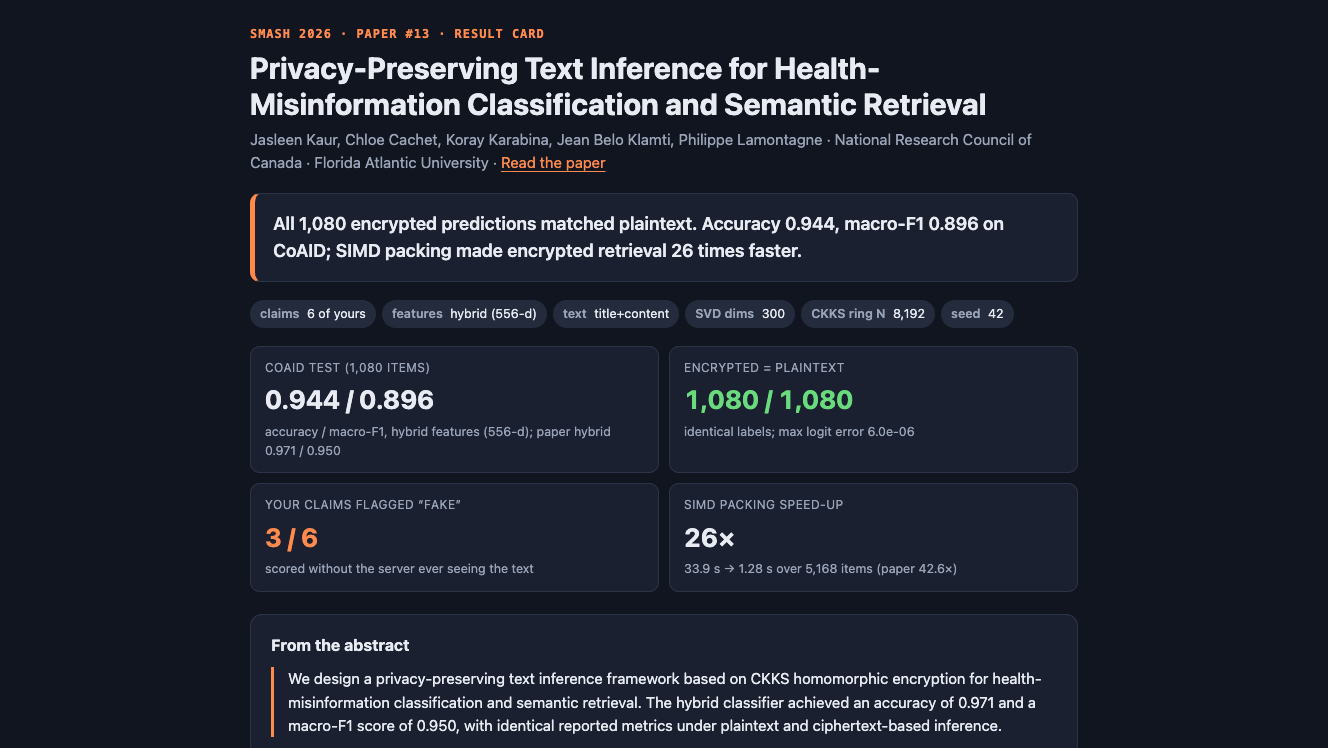
From the abstractWe design a privacy-preserving text inference framework based on CKKS homomorphic encryption for health-misinformation classification and semantic retrieval. The hybrid classifier achieved an accuracy of 0.971 and a macro-F1 score of 0.950, with identical reported metrics under plaintext and ciphertext-based inference.
Example runs
Default inputs
All 1,080 encrypted predictions matched plaintext. Accuracy 0.944, macro-F1 0.896 on CoAID; SIMD packing made encrypted retrieval 26 times faster. A small static embedder replaces BioBERT and MPNet. ISCC-SCT fingerprints and late-fusion retrieval are not reproduced.
Inputs
Acceptance checklist
15/15 checks passed.- Set up the sandbox and parameters
- Extract the tested code
- Run the experiment
- Write the narrative
- Render the result card and summary
- The headline states this run's finding with its numbers, not a description of the method
- Paper numbers are quoted exactly and any disagreement with the paper is stated plainly
- Caveats say what is synthetic, reconstructed or an extension of the paper
- Each try-next suggestion would plausibly give a contrasting result
- Result card, numbers, narrative and summary were written
- Experiment numbers are valid JSON and the experiment stayed within its time budget
- The narrative has a headline, three idea bullets, findings, try-next runs and caveats
- Every try-next suggestion uses only this runbook's parameters
- Every number in the headline appears in the run's results
- The card embeds its figures, shows the headline, and contains no NaN
Runbook
| version | 1.0.0 |
| evaluation | programmatic |
| evals_version | 2 |
| agent | claude-code |
| model | anthropic/claude-haiku-5.5 |
| model_provider | openrouter |
| snapshot | python312-uv |
| primary_outputs | result_card.html |
Private Claim Check: Score a Health Claim the Server Never Sees (SMASH 2026 · Paper #13)
Objective
This runbook is an interactive companion to the SMASH 2026 paper "Privacy-Preserving Text Inference for Health-Misinformation Classification and Semantic Retrieval" (Jasleen Kaur, Chloe Cachet, Koray Karabina, Jean Belo Klamti, Philippe Lamontagne). Read the paper: https://arxiv.org/abs/2610.20796
The paper's claims:
- A logistic-regression misinformation classifier on fused text features (BioBERT + PCA-256 MPNet + SVD-300
TF-IDF, 1,324-d) can be evaluated on CKKS-encrypted feature vectors: the server computes
z = x̃ᵀw + bon the ciphertext, the client decrypts and applies the sigmoid. Plaintext and ciphertext inference give identical accuracy and F1 on CoAID. - Encrypted semantic retrieval is practical once similarity scores are SIMD-packed into one ciphertext rather than returned one ciphertext per database item.
The participant brings their own health claims. The run trains the paper's classifier recipe on the public CoAID dataset, scores the participant's claims in plaintext and under encryption, checks the whole test split under encryption, benchmarks latency/ciphertext size at the paper's parameters, and runs naive vs packed encrypted retrieval of the most similar CoAID items. Output: a shareable result card.
Target wall-clock: under 4 minutes. The experiment itself takes ~15–30 s (4.3 MB CoAID + 30 MB embedder).
The method, as implemented
- Data. CoAID news (GitHub
cuilimeng/CoAID, releases 05-01/07-01/09-01/11-01-2020,NewsFake/NewsReal): text = title + news title + first 2,000 characters of content (text_field = title+content) or title only; exact duplicates removed; stratified 80/20 split (seed 42) → test 1,080 items (183 fake), close to the paper's 1,081 (184). - Client features. TF-IDF (1–2-grams) → truncated SVD (
svd_dim, paper 300) and/or a 256-d static sentence embedding (model2vecpotion-base-8M, stand-in for the paper's PCA-256 MPNet). Standardized on the client. Substitution: the paper's 768-d BioBERT block is not reproduced (no torch/GPU), so the hybrid is 556-d. - Model. L2 logistic regression (
C). Ablation in plaintext over TF-IDF / embedding / hybrid. - Encrypted inference. TenSEAL CKKS, scale 2^40, moduli [60, 40, 60] (N = 8,192) or [60, 40, 40, 60]
(N = 16,384 / 32,768; the paper uses N = 32,768). Client encrypts x; server returns
Enc(x)·w + b; client decrypts z, computes p = σ(z). Run on the whole test split (capped at 400 items when N = 32,768) and every claim. - Encrypted retrieval. Database = unique CoAID titles embedded (256-d, unit norm). Naive: one encrypted dot
product (one ciphertext) per item, timed on 200 items and extrapolated; packed: one
Enc(q)·DBᵀper N/2-item shard. ISCC-SCT fingerprints, Ridge late fusion and STS-B are not reproduced.
Paper headline numbers (quote exactly)
- Full hybrid: accuracy 0.971, macro-F1 0.950 (F1-fake 0.918, F1-real 0.983); TF-IDF alone 0.942 / 0.904; MPNet alone 0.938 / 0.899; BioBERT alone 0.944 / 0.905. Test set of 1,081 samples, 184 fake and 897 real.
- "Plaintext and ciphertext-based inference produced identical accuracy and F1 scores for every feature configuration."
- "The hybrid model required approximately 122.4 ms and 2.133 MB of communication per query."
- Retrieval over 7,128 items: naive 221.049 s → SIMD-packed 5.186 s (42.6×); communication 6.11 GB → 2.13 MB.
- CKKS: N = 32,768, coefficient moduli [60, 40, 40, 60], scale 2^40, Apple M4 MacBook Air.
REQUIRED OUTPUT FILES (MANDATORY)
All in {{results_dir}}:
| File | Description |
|---|---|
result_card.html | Primary output. Self-contained, shareable one-page result card |
results.json | All computed numbers (written by experiment.py) |
card_data.json | Numbers/figures for the card (written by experiment.py) |
narrative.json | Your interpretation of this run (Step 4) |
fig_*.png | Figures (written by experiment.py) |
summary.md | 5–10 line plain-text summary |
validation_report.json | Evals v2 report: steps, code checks, checklist (see Write Validation Report) |
Parameters
| Parameter | Template Variable | Default | Description |
|---|---|---|---|
| Your claims | {{claims}} | — | Up to 10 health claims separated by | (blank = 6 built-in examples, true and false). Scored under encryption |
| Features | {{features}} | hybrid | hybrid (TF-IDF→SVD + embedding), tfidf, or embed |
| Training text | {{text_field}} | title+content | title+content (paper-like) or title (short, closer to what people paste) |
| SVD dimensions | {{svd_dim}} | 300 | TF-IDF truncated-SVD size (paper: 300) |
| CKKS ring size | {{poly_modulus_degree}} | 8192 | 8192, 16384 or 32768 (paper). Used for the test-split and retrieval runs; the latency benchmark always covers all three |
| Retrieval database size | {{retrieval_db_size}} | 0 | Number of CoAID titles to search (0 = all ~5,200) |
| Regularization C | {{C}} | 1.0 | Inverse L2 strength of the logistic regression |
| Embedder | {{embedder}} | minishlab/potion-base-8M | model2vec static embedder (30 MB) |
| Seed | {{seed}} | 42 | Train/test split seed |
Dependencies
numpy, pandas, scikit-learn, matplotlib (preinstalled in python312-uv), plus tenseal (0.3.18) and model2vec
installed in Step 1 (~10–30 s). Downloads: 8 CoAID CSVs from raw.githubusercontent.com (4.3 MB) and the embedder
from Hugging Face (30 MB).
Step 1: Set up
mkdir -p {{results_dir}} /app/work && cd /app/work
python -c "import numpy, pandas, sklearn, matplotlib" 2>/dev/null || uv pip install --system -q numpy pandas scikit-learn matplotlib
python -c "import tenseal, model2vec" 2>/dev/null || uv pip install --system -q tenseal==0.3.18 model2vec
Write /app/work/params.json. Strings for text values, JSON numbers for the rest; if a value still looks like an
unsubstituted {{…}} placeholder use the table default (claims → ""). Validate: features ∈ {hybrid, tfidf,
embed}; text_field ∈ {title+content, title}; poly_modulus_degree ∈ {8192, 16384, 32768}; clamp svd_dim to
[20, 600], retrieval_db_size to 0 or [200, 6000], C to [0.001, 100]. Keep at most 10 claims, each ≤ 300
characters; escape quotes for JSON. Record any change as a caveat. n_encrypted_eval and naive_items are fixed
budget settings.
{"claims": "{{claims}}", "features": "{{features}}", "text_field": "{{text_field}}", "svd_dim": {{svd_dim}},
 "poly_modulus_degree": {{poly_modulus_degree}}, "retrieval_db_size": {{retrieval_db_size}}, "C": {{C}},
 "embedder": "{{embedder}}", "seed": {{seed}}, "n_encrypted_eval": 0, "naive_items": 200, "runbook_url": ""}
Step 2: Get the code (extract it, don't retype it)
The tested implementation of the method is embedded in the Appendix at the end of this runbook. Do not rewrite, "improve", or re-derive it. Always run the command below first, exactly as written. It copies the files out of this runbook's text (which the sandbox exposes to running processes) in about a second, and it is far faster and more reliable than retyping several hundred lines. Do not skip it on the assumption that it won't work: run it and read its output.
cd /app/work && cat > extract.py <<'PYEOF'
"""Extract the runbook's embedded files without retyping them.

The runbook text reaches the agent as one command-line argument, so it is readable from /proc.
Every embedded file sits under a heading "### `/app/work/<name>`" followed by one fenced block.
Exits non-zero if any requested file can't be found, so the caller falls back to writing it by hand.

usage: python3 extract.py <name> [<name> ...]   (writes /app/work/<name>)
"""
import ast, glob, re, sys
from pathlib import Path

want = sys.argv[1:]
cands = []
for p in glob.glob("/proc/[0-9]*/cmdline"):
    try:
        s = Path(p).read_bytes().decode("utf-8", "ignore")
    except OSError:
        continue
    if all(f"### `/app/work/{w}`" in s for w in want):
        cands.append(s)
if not cands:
    sys.exit("runbook text not found in /proc; write the files by hand")
# The agent's own argv holds the raw text; wrapper shells hold a shell-quoted copy, so prefer the shortest
# and undo shell single-quote escaping as a fallback.
best = min(cands, key=len).replace("'\"'\"'", "'")
ok = True
for w in want:
    m = re.search(r"### `/app/work/" + re.escape(w) + r"`\s*\n+```[a-z]*\n(.*?)\n```\n", best, re.S)
    if not m or len(m.group(1)) < 50:
        print(f"MISSING {w}"); ok = False; continue
    code = m.group(1) + "\n"
    if w.endswith(".py"):
        try:
            ast.parse(code)
        except SyntaxError as e:
            print(f"MISSING {w} (extracted text does not parse: {e})"); ok = False; continue
    Path("/app/work", w).write_text(code)
    print(f"extracted {w}: {code.count(chr(10))} lines")
sys.exit(0 if ok else 1)
PYEOF
python3 extract.py experiment.py render_card.py validate.py
If it exits non-zero or prints MISSING, write each missing file from the Appendix exactly as given, one
heredoc per file (quoted delimiter, e.g. cat > experiment.py <<'PYEOF'). If a later step fails, fix only
environment problems (missing package, network retry), never the methodology.
Step 3: Run the experiment
cd /app/work && export OMP_NUM_THREADS=4 OPENBLAS_NUM_THREADS=4 MKL_NUM_THREADS=4 SMASH_CPUS=4 && timeout 300 python -W ignore experiment.py params.json {{results_dir}}Expected: 15–30 s at N = 8,192 (≈ 60–90 s at N = 32,768). Ends with a done: line (accuracy/macro-F1, encrypted
labels identical, claims flagged, packed-retrieval speed-up). If a download fails, retry once.
The sandbox has 4 CPUs even though nproc may report more; the exports keep numpy/BLAS and process pools from oversubscribing them.
Step 4: Interpret: write narrative.json
Read {{results_dir}}/results.json and card_data.json, and look at every fig_*.png. Write
{{results_dir}}/narrative.json with keys headline, idea (exactly 3), findings (2–4), try_next (2–3),
caveats (2–4). Each findings paragraph ≤ 70 words; bold the one number that matters.
- headline (≤ 30 words): a finding with 1–2 numbers copied from
results.json, e.g.encrypted.labels_identicalofencrypted.n,retrieval.speedup, or a striking claim result. Write numbers without thousands separators in the headline (1080, not1,080) and avoid scientific notation there (the validator parses digits). - idea: plain-language version of the two claims above (why the text is sensitive; what the server computes; why packing matters).
- findings: (1) accuracy/macro-F1 of the chosen
featuresvs the paper's row (ablation; TF-IDF row is the like-for-like comparison) and the test split vs 1,081/184; (2) encryption is lossless:labels_identical,max_abs_logit_diff, and each claim'slabel_enc,p_fake_enc,abs_diff; name which of the participant's claims were flagged; mention the nearest CoAID items for one claim (retrieved, with their CoAID labels) if telling; (3) cost: N = 32,768 row oflatency_benchvs 122.4 ms / 2.133 MB;retrievalnaive vs packed vs 221.049 s → 5.186 s andsame_top5. - Never present the output as a fact-check. “Fake” means “resembles the CoAID fake class”; CoAID labels
partly encode the source and writing style (see
top_terms). If a true claim is flagged or a false one passes, say so plainly. - try_next: 2–3 contrasting runs with exact values, using only the keys
claims, features, text_field, svd_dim, poly_modulus_degree, retrieval_db_size, C, embedder, seed. Good contrasts:text_fieldtitlewith false-cure claims (style vs truth);poly_modulus_degree32768;featurestfidf; the same claim reworded as a social post. - caveats: feature substitutions (no BioBERT, static embedder instead of MPNet, 556-d not 1,324-d); retrieval without ISCC-SCT/STS-B; honest-but-curious threat model; timings on one CPU, naive retrieval extrapolated.
Step 5: Render the card and summary
cd /app/work && python render_card.py {{results_dir}}/card_data.json {{results_dir}}/narrative.json {{results_dir}}/result_card.htmlWrite {{results_dir}}/summary.md (5–10 lines: settings, accuracy/macro-F1 vs paper, encrypted agreement, each
claim's label, latency/size at N = 32,768, retrieval speed-up, headline).
Writing style for narrative.json
These rules apply to every field and override any longer limits stated earlier in this runbook. Let the paper and the numbers speak; the card is not the place for commentary.
- Length:
headlineone sentence;idea1–3 bullets of at most 30 words;findings1–2 paragraphs of at most 60 words each;caveats1–2 bullets of at most 20 words. Cut anything the tiles, figures or tables already show. - Plain statements of what was measured. Write "Sensitivity gap −0.284 [−0.354, −0.218]; the paper reports +0.088", not an interpretation of what it means for the field.
- Avoid: em-dash asides; "not X, but Y" framings; colon-then-reveal sentences; rhetorical questions; words such as crucially, notably, strikingly, remarkably, collapses, illustrating, underscores, highlights, delve, powerful, key insight, worth noting; exclamation marks; restating the method before the result.
- Use the paper's own terms for its concepts. Quote the paper's numbers exactly.
Code Checks
Jetty runs these checks itself in the sandbox after the agent finishes, so they cannot be skipped or
misreported. validate.py (see Write Validation Report) runs the same checks first so you can fix problems before you stop.
outputs-exist — Result card, numbers, narrative and summary were written
cd {{results_dir}} && for f in result_card.html results.json card_data.json narrative.json summary.md; do test -s "$f" || { echo "missing or empty: $f"; exit 1; }; done; echo "all 5 outputs present"results-valid — Experiment numbers are valid JSON and the experiment stayed within its time budget
python3 - "{{results_dir}}" 300 <<'PY'
import json, sys
from pathlib import Path
R, budget = Path(sys.argv[1]), float(sys.argv[2])
res = json.loads((R / "results.json").read_text())
json.loads((R / "card_data.json").read_text())
rt = float(res.get("runtime_sec", 0))
if rt > budget:
    sys.exit(f"experiment took {rt}s, budget {budget}s")
print(f"results.json and card_data.json parse; experiment {rt}s within {budget:.0f}s")
PY
narrative-complete — The narrative is complete and within the length limits
python3 - "{{results_dir}}" <<'PY'
import json, sys
from pathlib import Path
n = json.loads((Path(sys.argv[1]) / "narrative.json").read_text())
problems = []
if not str(n.get("headline", "")).strip(): problems.append("no headline")
if len(str(n.get("headline", "")).split()) > 45: problems.append("headline over 45 words")
if not 1 <= len(n.get("idea", [])) <= 3: problems.append(f"idea has {len(n.get('idea', []))} bullets, need 1-3")
if not 1 <= len(n.get("findings", [])) <= 2: problems.append(f"{len(n.get('findings', []))} findings, need 1-2")
if any(len(f.split()) > 70 for f in n.get("findings", [])): problems.append("a findings paragraph is over 60 words")
if not 2 <= len(n.get("try_next", [])) <= 3: problems.append(f"{len(n.get('try_next', []))} try_next, need 2-3")
if not 1 <= len(n.get("caveats", [])) <= 2: problems.append(f"{len(n.get('caveats', []))} caveats, need 1-2")
if problems: sys.exit("; ".join(problems))
print("headline, %d idea bullets, %d findings, %d try_next, %d caveats" % (len(n["idea"]), len(n["findings"]), len(n["try_next"]), len(n["caveats"])))
PY
try-next-valid — Every try-next suggestion uses only this runbook's parameters
python3 - "{{results_dir}}" "claims,features,text_field,svd_dim,poly_modulus_degree,retrieval_db_size,C,embedder,seed" <<'PY'
import json, sys
from pathlib import Path
allowed = set(sys.argv[2].split(","))
n = json.loads((Path(sys.argv[1]) / "narrative.json").read_text())
bad = sorted({k for t in n.get("try_next", []) for k in (t.get("params") or {}) if k not in allowed})
empty = [t.get("label", "?") for t in n.get("try_next", []) if not t.get("params")]
if bad or empty: sys.exit(f"unknown parameters: {bad}; suggestions without params: {empty}")
print("all try_next parameters are declared runbook parameters")
PY
headline-grounded — Every number in the headline appears in the run's results
python3 - "{{results_dir}}" <<'PY'
import json, re, sys
from pathlib import Path
R = Path(sys.argv[1])
blob = (R / "results.json").read_text() + (R / "card_data.json").read_text()
vals = [float(x) for x in re.findall(r"-?\d+(?:\.\d+)?(?:[eE]-?\d+)?", blob)]
head = json.loads((R / "narrative.json").read_text())["headline"]
nums = re.findall(r"(?<![\w.−-])[−-]?\d[\d,]*(?:\.\d+)?(?![\w-])", head)
missing = []
for n in nums:
    s = n.replace("−", "-").replace(",", ""); v = float(s); dec = len(s.split(".")[1]) if "." in s else 0
    tol = 0.5 * 10 ** (-dec) + 1e-9
    if not any(abs(abs(x) - abs(v)) <= tol or abs(abs(x * 100) - abs(v)) <= max(tol, 0.5) for x in vals):
        missing.append(n)
if missing: sys.exit(f"headline numbers not found in results: {missing}")
print(f"{len(nums)} headline number(s) all grounded in results")
PY
card-integrity — The card embeds its figures, shows the headline, and contains no NaN
python3 - "{{results_dir}}" <<'PY'
import html, json, re, sys
from pathlib import Path
R = Path(sys.argv[1])
card = (R / "result_card.html").read_text()
text = re.sub(r"data:image/[a-z]+;base64,[A-Za-z0-9+/=]+", "", card)
head = json.loads((R / "narrative.json").read_text())["headline"]
problems = []
if card.count("data:image/png;base64") < 1: problems.append("no embedded figures")
if re.search(r"\bNaN\b|\bnan%|\bInfinity\b", text): problems.append("NaN/Infinity in card text")
if len(card) > 5_000_000: problems.append(f"card is {len(card) // 1024} KB")
plain = html.unescape(re.sub(r"<[^>]+>", "", text))
if re.sub(r"[*`]", "", head)[:40] not in plain: problems.append("headline not on card")
if problems: sys.exit("; ".join(problems))
print(f"card {len(card) // 1024} KB, {card.count('data:image/png;base64')} figures, headline present")
PY
Checklist
- The headline states this run's finding with its numbers, not a description of the method
- Paper numbers are quoted exactly and any disagreement with the paper is stated plainly
- Caveats say what is synthetic, reconstructed or an extension of the paper
- Each try-next suggestion would plausibly give a contrasting result
Write Validation Report
Judge the four Checklist items honestly against your outputs and write them to /app/work/checklist.json as a
list, using the checklist ids Jetty gives you (one entry per item):
[{"id": "<checklist id>", "status": "pass", "message": "one line on why"}]Then write the report and self-check in one command:
cd /app/work && python3 validate.py {{results_dir}} claims,features,text_field,svd_dim,poly_modulus_degree,retrieval_db_size,C,embedder,seed 300 checklist.jsonvalidate.py writes {{results_dir}}/validation_report.json in the v2 shape Jetty reads (version: 2, one
step entry per runbook step, one code_check entry per check above, one checklist entry per item). Jetty
replaces the code_check entries with its own independent run of the same checks. Do not write the report by hand.
Iteration (up to 2 rounds)
If validate.py prints any FAIL, fix the named problem (usually a headline number that does not match
results.json, or an unknown try_next key), re-render the card (Step 5) and rerun the command above. Never
rerun the experiment just to change the narrative.
Appendix: code
These files are extracted verbatim in Step 2.
/app/work/experiment.py
"""Private claim check — SMASH 2026 paper #13 (Kaur, Cachet, Karabina, Klamti, Lamontagne; NRC Canada).

Re-implements the paper's client-server pipeline on the public CoAID dataset:
  1. train an L2 logistic regression on fused features: TF-IDF -> truncated SVD(300) (as in the paper) plus a
     small static sentence embedding (model2vec potion-base-8M, 256-d; stand-in for the paper's PCA-256 MPNet;
     the paper's 768-d BioBERT block is not reproduced);
  2. the client standardizes and CKKS-encrypts each feature vector; the server evaluates z = x.w + b on the
     ciphertext; the client decrypts z and applies the sigmoid (paper Eq. 1). Run on the whole test split and on
     the participant's own health claims, comparing plaintext and ciphertext logits;
  3. per-query latency and ciphertext size at the paper's CKKS parameters (N = 32,768) and smaller rings;
  4. encrypted semantic retrieval of the nearest CoAID items to each claim: naive (one ciphertext per database
     item) vs SIMD-packed (one matrix-vector product), the paper's 42.6x optimisation.

usage: python experiment.py params.json outdir
"""
import glob, io, json, os, sys, time, urllib.request
from pathlib import Path

os.environ.setdefault("HF_HUB_DISABLE_PROGRESS_BARS", "1")
os.environ.setdefault("TOKENIZERS_PARALLELISM", "false")
import numpy as np
import pandas as pd
import matplotlib
matplotlib.use("Agg")
import matplotlib.pyplot as plt
from sklearn.feature_extraction.text import TfidfVectorizer
from sklearn.decomposition import TruncatedSVD
from sklearn.preprocessing import StandardScaler
from sklearn.linear_model import LogisticRegression
from sklearn.model_selection import train_test_split
from sklearn.metrics import accuracy_score, f1_score

T0 = time.time()
P = json.loads(Path(sys.argv[1]).read_text())
OUT = Path(sys.argv[2]); OUT.mkdir(parents=True, exist_ok=True)
SEED = int(P.get("seed", 42))
INK, ACC, BLUE, MUTED, GOOD = "#1f2a44", "#d9480f", "#1971c2", "#868e96", "#2b8a3e"
RAW = "https://raw.githubusercontent.com/cuilimeng/CoAID/master"
FILES = [(d, f) for d in ["05-01-2020", "07-01-2020", "09-01-2020", "11-01-2020"]
         for f in ["NewsFakeCOVID-19", "NewsRealCOVID-19"]]
DEFAULT_CLAIMS = ("Drinking hot water every 15 minutes flushes the coronavirus into the stomach where acid kills it | "
                  "COVID-19 vaccines were tested in phase 3 clinical trials with tens of thousands of volunteers | "
                  "5G mobile networks spread the coronavirus | "
                  "Washing your hands with soap for 20 seconds helps prevent the spread of COVID-19 | "
                  "Says a photo shows doctors in Italy hugging after curing their last coronavirus patient | "
                  "A Facebook post says washing your hands with soap for 20 seconds helps prevent COVID-19")
# Paper Table 1 (accuracy, macro-F1) quoted exactly
PAPER_T1 = {"tfidf": ("TF-IDF", 0.942, 0.904), "embed": ("MPNet", 0.938, 0.899), "hybrid": ("Full hybrid", 0.971, 0.950)}


def log(m):
    print(f"[{time.time() - T0:6.1f}s] {m}", flush=True)


def fetch(url, tries=3):
    for k in range(tries):
        try:
            with urllib.request.urlopen(url, timeout=60) as r:
                return r.read()
        except Exception as ex:
            if k == tries - 1:
                raise
            log(f"retry {url.split('/')[-1]}: {ex}"); time.sleep(2)


def load_coaid():
    from concurrent.futures import ThreadPoolExecutor
    with ThreadPoolExecutor(8) as ex:
        blobs = list(ex.map(lambda df: fetch(f"{RAW}/{df[0]}/{df[1]}.csv"), FILES))
    rows = []
    for (d, f), b in zip(FILES, blobs):
        x = pd.read_csv(io.BytesIO(b)); x["label"] = int("Fake" in f); x["release"] = d; rows.append(x)
    df = pd.concat(rows, ignore_index=True)
    return df, sum(len(b) for b in blobs)


def ckks_ctx(N):
    import tenseal as ts
    cm = [60, 40, 60] if N <= 8192 else [60, 40, 40, 60]  # paper: N = 32,768, [60, 40, 40, 60], scale 2^40
    ctx = ts.context(ts.SCHEME_TYPE.CKKS, N, coeff_mod_bit_sizes=cm); ctx.global_scale = 2 ** 40
    ctx.generate_galois_keys()
    return ctx, cm


def short(s, n):
    s = " ".join(str(s).split())
    return s if len(s) <= n else s[: n - 1] + "…"


def main():
    import tenseal as ts
    from model2vec import StaticModel
    res = {"params": P}
    text_field = str(P.get("text_field", "title+content"))
    features = str(P.get("features", "hybrid"))
    if features not in PAPER_T1:
        features = "hybrid"
    svd_dim = int(P.get("svd_dim", 300))
    N = int(P.get("poly_modulus_degree", 8192))
    if N not in (8192, 16384, 32768):
        N = 8192
    claims = [c.strip() for c in str(P.get("claims", "") or DEFAULT_CLAIMS).replace("\n", "|").split("|") if c.strip()][:10]

    # ---------------- data
    df, nbytes = load_coaid()
    if text_field == "title":
        df["text"] = df["title"].fillna("")
    else:
        df["text"] = (df["title"].fillna("") + " " + df["newstitle"].fillna("") + " " + df["content"].fillna("").str[:2000]).str.strip()
    n_raw = len(df)
    df = df[df["text"].str.len() > 0].drop_duplicates("text").reset_index(drop=True)
    tr, te = train_test_split(df, test_size=0.2, stratify=df["label"], random_state=SEED)
    log(f"CoAID news: {n_raw} rows ({nbytes / 1e6:.1f} MB) -> {len(df)} unique; test {len(te)} ({int(te.label.sum())} fake)")

    # ---------------- client-side feature extraction (fit on train only)
    tfidf = TfidfVectorizer(ngram_range=(1, 2), min_df=2, sublinear_tf=True, max_features=50000)
    Xtr_t = tfidf.fit_transform(tr["text"]); Xte_t = tfidf.transform(te["text"])
    svd = TruncatedSVD(svd_dim, random_state=SEED); Ttr = svd.fit_transform(Xtr_t); Tte = svd.transform(Xte_t)
    t = time.time(); m2v = StaticModel.from_pretrained(str(P.get("embedder", "minishlab/potion-base-8M")))
    Etr = np.asarray(m2v.encode(tr["text"].tolist())); Ete = np.asarray(m2v.encode(te["text"].tolist()))
    log(f"features: TF-IDF {Xtr_t.shape[1]} terms -> SVD {svd_dim}; embedder {Etr.shape[1]}-d ({time.time() - t:.1f} s)")

    def fuse(T, E, which):
        return {"tfidf": T, "embed": E, "hybrid": np.hstack([T, E])}[which]
    ablation = {}
    models = {}
    for which in ["tfidf", "embed", "hybrid"]:
        A, B = fuse(Ttr, Etr, which), fuse(Tte, Ete, which)
        sc = StandardScaler().fit(A)
        clf = LogisticRegression(C=float(P.get("C", 1.0)), max_iter=5000).fit(sc.transform(A), tr["label"])
        pred = clf.predict(sc.transform(B))
        ablation[which] = {"dim": int(A.shape[1]), "accuracy": accuracy_score(te["label"], pred),
                           "macro_f1": f1_score(te["label"], pred, average="macro"),
                           "f1_fake": f1_score(te["label"], pred, pos_label=1), "f1_real": f1_score(te["label"], pred, pos_label=0)}
        models[which] = (sc, clf)
    sc, clf = models[features]
    w, b = clf.coef_[0], float(clf.intercept_[0])
    Xte = sc.transform(fuse(Tte, Ete, features))
    z_plain = Xte @ w + b
    log("plaintext: " + ", ".join(f"{k} acc {v['accuracy']:.3f} F1 {v['macro_f1']:.3f}" for k, v in ablation.items()))

    # ---------------- encrypted inference on the whole test split (server sees only ciphertexts)
    ctx, cm = ckks_ctx(N)
    wl = w.tolist()
    n_enc = len(Xte) if int(P.get("n_encrypted_eval", 0) or 0) <= 0 else min(len(Xte), int(P["n_encrypted_eval"]))
    if N == 32768:  # ~65 ms per claim: cap the encrypted pass to stay inside the time budget
        n_enc = min(n_enc, 400)
    t_enc = t_srv = t_dec = 0.0; z_enc = np.empty(n_enc)
    for i in range(n_enc):
        t0 = time.time(); c = ts.ckks_vector(ctx, Xte[i].tolist()); t1 = time.time()
        r = c.dot(wl) + b; t2 = time.time()
        z_enc[i] = r.decrypt()[0]; t3 = time.time()
        t_enc += t1 - t0; t_srv += t2 - t1; t_dec += t3 - t2
    y = te["label"].values[:n_enc]
    pred_p, pred_e = (z_plain[:n_enc] >= 0).astype(int), (z_enc >= 0).astype(int)
    enc = {"n": n_enc, "poly_modulus_degree": N, "coeff_mod_bit_sizes": cm, "scale_bits": 40,
           "max_abs_logit_diff": float(np.abs(z_enc - z_plain[:n_enc]).max()),
           "mean_abs_logit_diff": float(np.abs(z_enc - z_plain[:n_enc]).mean()),
           "labels_identical": int((pred_p == pred_e).sum()), "accuracy_plain": accuracy_score(y, pred_p),
           "accuracy_enc": accuracy_score(y, pred_e), "macro_f1_plain": f1_score(y, pred_p, average="macro"),
           "macro_f1_enc": f1_score(y, pred_e, average="macro"), "total_he_sec": t_enc + t_srv + t_dec,
           "per_query_ms": 1000 * (t_enc + t_srv + t_dec) / n_enc,
           "split_ms": {"encrypt": 1000 * t_enc / n_enc, "server": 1000 * t_srv / n_enc, "decrypt": 1000 * t_dec / n_enc}}
    log(f"encrypted test split (N={N}): {enc['labels_identical']}/{n_enc} labels identical, "
        f"max |dz| {enc['max_abs_logit_diff']:.2e}, {enc['per_query_ms']:.1f} ms/query")

    # ---------------- the participant's claims, plaintext vs ciphertext
    Tc = svd.transform(tfidf.transform(claims)); Ec = np.asarray(m2v.encode(claims))
    Xc = sc.transform(fuse(Tc, Ec, features))
    claim_rows = []
    for i, ctext in enumerate(claims):
        zp = float(Xc[i] @ w + b)
        t0 = time.time(); c = ts.ckks_vector(ctx, Xc[i].tolist()); r = c.dot(wl) + b; ze = float(r.decrypt()[0]); dt = time.time() - t0
        claim_rows.append({"claim": ctext, "z_plain": zp, "z_enc": ze, "abs_diff": abs(zp - ze),
                           "p_fake_plain": 1 / (1 + np.exp(-zp)), "p_fake_enc": 1 / (1 + np.exp(-ze)),
                           "label_plain": "fake" if zp >= 0 else "real", "label_enc": "fake" if ze >= 0 else "real",
                           "ms": 1000 * dt, "query_bytes": len(c.serialize()), "reply_bytes": len(r.serialize())})

    # what the linear model learned, in TF-IDF term space (exact: the SVD + scaler are linear)
    term_w = None
    if features in ("tfidf", "hybrid"):
        wt = w[:svd_dim] / sc.scale_[:svd_dim]
        term_w = svd.components_.T @ wt
        vocab = np.array(tfidf.get_feature_names_out())
        o = np.argsort(term_w)
        top_terms = {"fake": [(vocab[j], float(term_w[j])) for j in o[::-1][:10]],
                     "real": [(vocab[j], float(term_w[j])) for j in o[:10]]}
    else:
        top_terms = None

    # ---------------- latency / size at the paper's parameters and smaller rings
    bench = []
    reps = max(10, 3 * len(claims))
    for Nb in [8192, 16384, 32768]:
        cx, cmb = (ctx, cm) if Nb == N else ckks_ctx(Nb)
        ts_ = []
        for k in range(reps):
            x = Xte[k % len(Xte)].tolist()
            t0 = time.time(); c = cx and ts.ckks_vector(cx, x); r = c.dot(wl) + b; _ = r.decrypt(); ts_.append(time.time() - t0)
        bench.append({"N": Nb, "coeff_mod_bit_sizes": cmb, "ms": 1000 * float(np.median(ts_)),
                      "query_MB": len(c.serialize()) / 1e6, "reply_MB": len(r.serialize()) / 1e6,
                      "comm_MB": (len(c.serialize()) + len(r.serialize())) / 1e6})
    log("per-query latency: " + ", ".join(f"N={x['N']}: {x['ms']:.1f} ms, {x['comm_MB']:.2f} MB" for x in bench))

    # ---------------- encrypted retrieval: naive vs SIMD-packed
    db_text = df["title"].fillna("").tolist()
    db_label = df["label"].values
    seen, keep = set(), []
    for i, s in enumerate(db_text):  # unique titles only (duplicates create exact ties)
        k = " ".join(s.lower().split())
        if len(k) > 15 and k not in seen:
            seen.add(k); keep.append(i)
    db_n = int(P.get("retrieval_db_size", 0) or 0)
    if 0 < db_n < len(keep):
        keep = sorted(np.random.default_rng(SEED).choice(keep, db_n, replace=False).tolist())
    DB = np.asarray(m2v.encode([db_text[i] for i in keep]), dtype=np.float64)
    DB /= np.linalg.norm(DB, axis=1, keepdims=True)
    Qc = Ec / np.linalg.norm(Ec, axis=1, keepdims=True)
    slots = N // 2
    shards = [DB[i:i + slots].T.tolist() for i in range(0, len(DB), slots)]
    t_plain = t_pack = 0.0; pack_bytes = 0; same_top5 = 0; retrieved = []; max_score_err = 0.0
    for i in range(len(claims)):
        t0 = time.time(); sp = DB @ Qc[i]; t_plain += time.time() - t0
        t0 = time.time(); c = ts.ckks_vector(ctx, Qc[i].tolist()); outs = [c.matmul(s) for s in shards]
        se = np.concatenate([np.array(o.decrypt()) for o in outs]); t_pack += time.time() - t0
        pack_bytes = len(c.serialize()) + sum(len(o.serialize()) for o in outs)
        tp, tq = np.argsort(-sp)[:5], np.argsort(-se)[:5]
        same_top5 += int(set(tp) == set(tq))
        max_score_err = max(max_score_err, float(np.abs(se - sp).max()))
        retrieved.append([{"title": short(db_text[keep[j]], 140), "label": "fake" if db_label[keep[j]] else "real",
                           "cos": float(sp[j])} for j in tq[:3]])
    n_naive = min(int(P.get("naive_items", 200)), len(DB))
    c = ts.ckks_vector(ctx, Qc[0].tolist())
    t0 = time.time(); naive_ct = [c.dot(DB[j].tolist()) for j in range(n_naive)]; t_naive_srv = time.time() - t0
    t0 = time.time(); _ = [o.decrypt() for o in naive_ct]; t_naive_dec = time.time() - t0
    naive_item_bytes = len(naive_ct[0].serialize())
    per_item = (t_naive_srv + t_naive_dec) / n_naive
    naive_full = per_item * len(DB) + 1e-3
    pack_q = t_pack / len(claims)
    retr = {"db_items": len(DB), "dim": int(DB.shape[1]), "naive_measured_items": n_naive,
            "plain_sec": t_plain / len(claims), "packed_sec": pack_q, "naive_sec_extrapolated": naive_full,
            "speedup": naive_full / pack_q, "packed_comm_MB": pack_bytes / 1e6,
            "naive_comm_MB": (len(c.serialize()) + naive_item_bytes * len(DB)) / 1e6,
            "same_top5": same_top5, "n_claims": len(claims), "n_ciphertexts_packed": len(shards),
            "max_score_err": max_score_err, "naive_sec_at_7128": per_item * 7128}
    log(f"retrieval over {len(DB)} items: packed {pack_q:.3f} s vs naive ≈ {naive_full:.1f} s "
        f"({retr['speedup']:.0f}x); top-5 identical {same_top5}/{len(claims)}")

    res.update(n_rows_raw=n_raw, n_unique=len(df), n_train=len(tr), n_test=len(te), n_test_fake=int(te.label.sum()),
               download_MB=nbytes / 1e6, text_field=text_field, features=features, svd_dim=svd_dim,
               feature_dim=int(Xte.shape[1]), embed_dim=int(Etr.shape[1]), ablation=ablation, encrypted=enc,
               claims=claim_rows, top_terms=top_terms, latency_bench=bench, retrieval=retr, retrieved=retrieved)
    res["n_claims_fake"] = sum(r["label_enc"] == "fake" for r in claim_rows)
    res["claims_max_abs_logit_diff"] = max(r["abs_diff"] for r in claim_rows)
    figures(res)
    card(res)
    res["runtime_sec"] = round(time.time() - T0, 1)
    (OUT / "results.json").write_text(json.dumps(res, indent=2, default=lambda o: o.item() if hasattr(o, "item") else str(o)))
    a = ablation[features]
    log(f"done: {features} acc {a['accuracy']:.3f} / macro-F1 {a['macro_f1']:.3f}; encrypted labels identical "
        f"{enc['labels_identical']}/{enc['n']}; claims flagged fake {res['n_claims_fake']}/{len(claim_rows)}; "
        f"packed retrieval {retr['speedup']:.0f}x faster than naive")


def figures(res):
    plt.rcParams.update({"font.size": 10, "axes.spines.top": False, "axes.spines.right": False, "font.family": "DejaVu Sans"})
    # 1. claims
    cl = res["claims"]
    fig, ax = plt.subplots(figsize=(6.4, 0.9 + 0.62 * len(cl)))
    ys = np.arange(len(cl))[::-1]
    for yv, r in zip(ys, cl):
        ax.barh(yv, r["p_fake_plain"], color=ACC if r["label_plain"] == "fake" else BLUE, height=0.55, alpha=0.85)
        ax.plot(r["p_fake_enc"], yv, "D", color=INK, ms=6, mfc="white", mew=1.6, clip_on=False, zorder=5)
        ax.text(1.05, yv, f"{r['p_fake_enc']:.3f}\n|Δz| {r['abs_diff']:.0e}", va="center", fontsize=7.5, color=INK)
        ax.text(0.0, yv + 0.38, short(r["claim"], 88), fontsize=7.5, color=INK, va="bottom", zorder=4,
                bbox=dict(fc="white", ec="none", pad=0.6))
    ax.axvline(0.5, color=INK, ls="--", lw=1)
    ax.set_yticks([]); ax.set_xlim(-0.02, 1.02); ax.set_ylim(-0.6, len(cl) - 0.1)
    ax.set_xlabel("P(fake): bar = plaintext model, ◇ = decrypted from the encrypted score")
    ax.spines["left"].set_visible(False)
    fig.tight_layout(); fig.subplots_adjust(right=0.83); fig.savefig(OUT / "fig_claims.png", dpi=160); plt.close(fig)

    # 2. what the model learned
    if res["top_terms"]:
        tt = res["top_terms"]
        items = [(t, v) for t, v in tt["fake"][:9]] + [(t, v) for t, v in tt["real"][:9]][::-1]
        items.sort(key=lambda x: x[1])
        fig, ax = plt.subplots(figsize=(6.4, 3.8))
        ax.barh(range(len(items)), [v for _, v in items], color=[ACC if v > 0 else BLUE for _, v in items])
        ax.set_yticks(range(len(items))); ax.set_yticklabels([t for t, _ in items], fontsize=8)
        ax.axvline(0, color=INK, lw=1)
        ax.set_xlabel("effective weight on the term's TF-IDF value  (← real · fake →)")
        fig.tight_layout(); fig.savefig(OUT / "fig_terms.png", dpi=160); plt.close(fig)

    # 3. cost: per-query latency/comm vs ring size, and retrieval naive vs packed
    bench, rt = res["latency_bench"], res["retrieval"]
    fig, (a1, a2) = plt.subplots(1, 2, figsize=(6.4, 3.0), gridspec_kw={"width_ratios": [1, 1.15]})
    xs = np.arange(len(bench))
    a1.bar(xs, [x["ms"] for x in bench], color=[MUTED, MUTED, ACC], width=0.6)
    for i, x in enumerate(bench):
        a1.text(i, x["ms"] * 1.03, f"{x['ms']:.0f} ms\n{x['comm_MB']:.2f} MB", ha="center", fontsize=7)
    a1.axhline(122.4, color=INK, ls="--", lw=1); a1.text(-0.4, 122.4 * 1.04, "paper 122.4 ms (N = 32,768)", fontsize=7)
    a1.set_xticks(xs); a1.set_xticklabels([f"N={x['N'] // 1024}k" for x in bench]); a1.set_ylabel("ms per encrypted claim")
    a1.set_ylim(0, max(140, max(x["ms"] for x in bench) * 1.35)); a1.set_title("classification", fontsize=9)
    labs = ["plaintext", "naive\n(1 ct / item)", "SIMD-packed"]
    vals = [rt["plain_sec"], rt["naive_sec_extrapolated"], rt["packed_sec"]]
    a2.bar(range(3), vals, color=[MUTED, ACC, BLUE], width=0.6); a2.set_yscale("log")
    for i, v in enumerate(vals):
        a2.text(i, v * 1.3, f"{v * 1000:.2f} ms" if v < 0.01 else f"{v:.3g} s", ha="center", fontsize=7.5)
    a2.plot([1, 2], [221.049, 5.186], "D", color=INK, ms=6, label="paper (7,128 items)")
    a2.set_xticks(range(3)); a2.set_xticklabels(labs, fontsize=8); a2.set_ylabel("s per retrieval query")
    a2.set_ylim(min(vals) / 3, max(vals + [221.049]) * 6)
    a2.set_title(f"retrieval over {rt['db_items']:,} items", fontsize=9); a2.legend(frameon=False, fontsize=7, loc="upper left")
    fig.tight_layout(); fig.savefig(OUT / "fig_cost.png", dpi=160); plt.close(fig)


def card(res):
    f = res["features"]; a = res["ablation"][f]; e = res["encrypted"]; rt = res["retrieval"]
    b32 = next(x for x in res["latency_bench"] if x["N"] == 32768)
    tiles = [
        {"label": f"CoAID test ({res['n_test']:,} items)", "value": f"{a['accuracy']:.3f} / {a['macro_f1']:.3f}",
         "sub": f"accuracy / macro-F1, {f} features ({res['feature_dim']}-d); paper hybrid 0.971 / 0.950", "tone": "neutral"},
        {"label": "Encrypted = plaintext", "value": f"{e['labels_identical']:,} / {e['n']:,}",
         "sub": f"identical labels; max logit error {e['max_abs_logit_diff']:.1e}", "tone": "good"},
        {"label": "Your claims flagged “fake”", "value": f"{res['n_claims_fake']} / {len(res['claims'])}",
         "sub": "scored without the server ever seeing the text", "tone": "accent"},
        {"label": "SIMD packing speed-up", "value": f"{rt['speedup']:.0f}×",
         "sub": f"{rt['naive_sec_extrapolated']:.1f} s → {rt['packed_sec']:.2f} s over {rt['db_items']:,} items (paper 42.6×)", "tone": "neutral"},
    ]
    compare = []
    for k in ["tfidf", "embed", "hybrid"]:
        name, pa, pf = PAPER_T1[k]
        ours = {"tfidf": f"TF-IDF→SVD{res['svd_dim']}", "embed": f"potion-base-8M ({res['embed_dim']}-d)",
                "hybrid": f"TF-IDF→SVD + potion ({res['ablation']['hybrid']['dim']}-d)"}[k]
        compare.append({"metric": f"Acc / macro-F1: {name} (paper) vs {ours}", "paper": f"{pa} / {pf}",
                        "yours": f"{res['ablation'][k]['accuracy']:.3f} / {res['ablation'][k]['macro_f1']:.3f}",
                        "note": "no BioBERT block; MPNet replaced by a static embedder" if k != "tfidf" else "same recipe"})
    compare += [
        {"metric": "Test split", "paper": "1,081 samples (184 fake, 897 real)", "yours": f"{res['n_test']:,} ({res['n_test_fake']} fake)", "note": f"deduplicated CoAID news, {res['text_field']}"},
        {"metric": "Plaintext vs ciphertext predictions", "paper": "identical accuracy and F1 scores for every feature configuration",
         "yours": f"{e['labels_identical']}/{e['n']} labels identical", "note": f"N = {e['poly_modulus_degree']:,}"},
        {"metric": "Per-query cost at N = 32,768", "paper": "approximately 122.4 ms and 2.133 MB", "yours": f"{b32['ms']:.1f} ms, {b32['comm_MB']:.2f} MB",
         "note": f"{res['feature_dim']}-d vs 1,324-d vector; different CPU"},
        {"metric": "Retrieval naive → SIMD-packed", "paper": "221.049 s → 5.186 s (42.6×), 6.11 GB → 2.13 MB",
         "yours": f"{rt['naive_sec_extrapolated']:.1f} s → {rt['packed_sec']:.2f} s ({rt['speedup']:.0f}×), {rt['naive_comm_MB'] / 1e3:.2f} GB → {rt['packed_comm_MB']:.2f} MB",
         "note": f"{rt['db_items']:,} items, {rt['dim']}-d, N = {e['poly_modulus_degree']:,}; naive extrapolated from {rt['naive_measured_items']}"},
    ]
    figs = [{"path": "fig_claims.png", "title": "Your claims, scored on ciphertext",
             "caption": "Bars: the model's probability that a claim resembles CoAID's “fake” class, computed in the clear. Diamonds: the same "
                        "probability from the encrypted score the server returned (client decrypts, applies the sigmoid). |Δz| = logit difference."}]
    if res["top_terms"]:
        figs.append({"path": "fig_terms.png", "title": "What the classifier actually keys on",
                     "caption": "Exact term weights obtained by pushing the logistic-regression weights back through the scaler and SVD. "
                                "Many cues are about source and format (fact-check phrasing vs agency article titles), not medical truth."})
    figs.append({"path": "fig_cost.png", "title": "What encryption costs",
                 "caption": "Left: median time per encrypted claim (encrypt + server dot product + decrypt) by CKKS ring size; the paper uses "
                            "N = 32,768. Right: encrypted similarity search returning one ciphertext per item (naive) vs all scores packed into one ciphertext."})
    inputs = {"claims": f"{len(res['claims'])} of yours", "features": f"{f} ({res['feature_dim']}-d)", "text": res["text_field"],
              "SVD dims": res["svd_dim"], "CKKS ring N": f"{e['poly_modulus_degree']:,}", "seed": res["params"].get("seed", 42)}
    Path(OUT / "card_data.json").write_text(json.dumps({
        "paper": {"num": 13, "title": "Privacy-Preserving Text Inference for Health-Misinformation Classification and Semantic Retrieval",
                  "authors": "Jasleen Kaur, Chloe Cachet, Koray Karabina, Jean Belo Klamti, Philippe Lamontagne", "url": "https://arxiv.org/abs/2610.20796",
                  "affiliation": "National Research Council of Canada · Florida Atlantic University"},
        "inputs": inputs, "tiles": tiles, "figures": figs, "compare": compare,
        "runbook": {"name": "smash-13-private-claim-check", "url": P.get("runbook_url", "")}}, indent=2))


if __name__ == "__main__":
    main()
/app/work/render_card.py
"""Render a SMASH 2026 paper-playground result card (one self-contained HTML file).

usage: python render_card.py card_data.json narrative.json out.html

card_data.json  (written by the experiment script — numbers only)
  paper:   {num, title, authors, affiliation, url?}
  inputs:  {label: value}                         the participant's run settings
  tiles:   [{label, value, sub, tone}]            tone: accent|good|warn|neutral
  figures: [{path, title, caption}]               PNGs, embedded as base64
  compare: [{metric, paper, yours, note}]         paper-vs-your-run table (optional)
  runbook: {name, url}                            fork link (optional)
narrative.json  (written by the agent — words only)
  headline:  one sentence, the finding of THIS run
  idea:      [1-3 bullets] the paper's contribution in plain language
  abstract:  (optional) a verbatim abstract excerpt, shown instead of idea
  findings:  [2-4 short paragraphs] what this run shows, tied to the numbers
  try_next:  [{label, why, params}]               2-3 follow-up runs with exact parameter values
  caveats:   [bullets]
"""
import base64, html, json, sys
from pathlib import Path

data = json.loads(Path(sys.argv[1]).read_text())
narr = json.loads(Path(sys.argv[2]).read_text())
base = Path(sys.argv[1]).parent
e = lambda s: html.escape(str(s))


def md_inline(s):
    """Escape, then allow **bold**, *italic* and `code` only."""
    import re
    s = e(s)
    s = re.sub(r"\*\*(.+?)\*\*", r"<strong>\1</strong>", s)
    s = re.sub(r"(?<![\w*])\*(?!\s)(.+?)(?<!\s)\*(?![\w*])", r"<em>\1</em>", s)
    return re.sub(r"`(.+?)`", r"<code>\1</code>", s)


p = data["paper"]
tiles = "".join(
    f'<div class="tile {e(t.get("tone", "neutral"))}"><div class="tl">{e(t["label"])}</div>'
    f'<div class="tv">{e(t["value"])}</div><div class="ts">{md_inline(t.get("sub", ""))}</div></div>'
    for t in data.get("tiles", []))
# Columns that fill every row: 4 tiles as 2x2, never 3 + 1 orphan.
n_tiles = len(data.get("tiles", []))
tile_cols = 2 if n_tiles == 4 else min(max(n_tiles, 1), 3)
inputs = "".join(f'<span class="chip"><b>{e(k)}</b> {e(v)}</span>' for k, v in data.get("inputs", {}).items())
figs = ""
for f in data.get("figures", []):
    fp = Path(f["path"]); fp = fp if fp.is_absolute() else base / fp
    if fp.exists():
        b64 = base64.b64encode(fp.read_bytes()).decode()
        figs += (f'<figure><figcaption class="ft">{e(f.get("title", ""))}</figcaption>'
                 f'<img alt="{e(f.get("title", ""))}" src="data:image/png;base64,{b64}">'
                 f'<figcaption>{md_inline(f.get("caption", ""))}</figcaption></figure>')
compare = ""
if data.get("compare"):
    rows = "".join(f'<tr><td>{md_inline(r["metric"])}</td><td>{md_inline(r["paper"])}</td>'
                   f'<td class="y">{md_inline(r["yours"])}</td><td class="n">{md_inline(r.get("note", ""))}</td></tr>'
                   for r in data["compare"])
    compare = (f'<section><h2>Paper vs. your run</h2><div class="tw"><table><thead><tr><th>Metric</th>'
               f'<th>Paper</th><th>Your run</th><th></th></tr></thead><tbody>{rows}</tbody></table></div></section>')
idea = "".join(f"<li>{md_inline(b)}</li>" for b in narr.get("idea", []))
abstract = narr.get("abstract", "")
findings = "".join(f"<p>{md_inline(x)}</p>" for x in narr.get("findings", []))
tries = "".join(
    f'<li><strong>{md_inline(t["label"])}</strong> — {md_inline(t.get("why", ""))}'
    f'<pre>{e(json.dumps(t.get("params", {}), ensure_ascii=False))}</pre></li>' for t in narr.get("try_next", []))
cav = "".join(f"<li>{md_inline(c)}</li>" for c in narr.get("caveats", []))
rb = data.get("runbook", {})
fork = (f'<a class="fork" href="{e(rb["url"])}">Fork this runbook on Jetty →</a>' if rb.get("url") else "")

page = f"""<!doctype html><html lang="en"><head><meta charset="utf-8">
<meta name="viewport" content="width=device-width,initial-scale=1">
<title>SMASH 2026 · #{e(p['num'])} · Result card</title>
<style>
:root{{--bg:#f6f4ef;--card:#fff;--ink:#1f2a44;--muted:#5c677d;--line:#e3dfd5;--accent:#d9480f;--good:#2b8a3e;--warn:#e67700;--chip:#efece4}}
@media (prefers-color-scheme:dark){{:root{{--bg:#11151f;--card:#1a2030;--ink:#e8ebf2;--muted:#9aa4b8;--line:#2c3447;--accent:#ff8a4c;--good:#69db7c;--warn:#ffc078;--chip:#232b3d}}
figure img{{background:#fff;border-radius:6px}}}}
*{{box-sizing:border-box}}body{{margin:0;background:var(--bg);color:var(--ink);font:15px/1.55 ui-sans-serif,system-ui,-apple-system,"Segoe UI",Roboto,sans-serif}}
main{{max-width:860px;margin:0 auto;padding:28px 16px 48px}}
.kicker{{font:600 12px/1 ui-monospace,SFMono-Regular,Menlo,monospace;letter-spacing:.08em;text-transform:uppercase;color:var(--accent)}}
h1{{font-size:clamp(22px,4vw,30px);line-height:1.2;margin:10px 0 6px}}.authors{{color:var(--muted);margin:0 0 18px}}.authors a{{color:var(--accent);text-underline-offset:3px}}
.headline{{background:var(--card);border:1px solid var(--line);border-left:5px solid var(--accent);border-radius:10px;padding:16px 18px;font-size:18px;font-weight:600;margin:0 0 18px}}
.chips{{display:flex;flex-wrap:wrap;gap:6px;margin:0 0 18px}}.chip{{background:var(--chip);border-radius:999px;padding:4px 10px;font-size:12.5px}}.chip b{{font-weight:600;color:var(--muted);margin-right:4px}}
.tiles{{display:grid;grid-template-columns:repeat(var(--cols),minmax(0,1fr));gap:10px;margin:0 0 22px}}
@media (max-width:560px){{.tiles{{grid-template-columns:1fr}}}}
.tile{{background:var(--card);border:1px solid var(--line);border-radius:10px;padding:12px 14px}}.tl{{font-size:12px;color:var(--muted);text-transform:uppercase;letter-spacing:.04em}}
.tv{{font-size:26px;font-weight:700;margin:2px 0;font-variant-numeric:tabular-nums}}.ts{{font-size:12.5px;color:var(--muted)}}
.tile.accent .tv{{color:var(--accent)}}.tile.good .tv{{color:var(--good)}}.tile.warn .tv{{color:var(--warn)}}
section{{background:var(--card);border:1px solid var(--line);border-radius:12px;padding:18px 20px;margin:0 0 16px}}
h2{{font-size:16px;margin:0 0 10px}}ul{{padding-left:20px;margin:0}}li{{margin:4px 0}}p{{margin:0 0 10px}}
figure{{margin:0 0 18px}}figure img{{width:100%;height:auto;display:block}}figcaption{{font-size:13px;color:var(--muted);margin-top:6px}}.ft{{font-weight:600;color:var(--ink);font-size:14px;margin:0 0 6px}}
.tw{{overflow-x:auto}}table{{border-collapse:collapse;width:100%;font-size:13.5px;font-variant-numeric:tabular-nums}}th,td{{text-align:left;padding:7px 8px;border-bottom:1px solid var(--line);vertical-align:top}}th{{color:var(--muted);font-weight:600}}td.y{{font-weight:600}}td.n{{color:var(--muted);font-size:12.5px}}
pre{{background:var(--chip);border-radius:6px;padding:6px 8px;font-size:12px;white-space:pre-wrap;word-break:break-word;margin:4px 0 8px}}code{{background:var(--chip);border-radius:4px;padding:1px 4px;font-size:.92em}}
.fork{{display:inline-block;background:var(--ink);color:var(--bg);text-decoration:none;font-weight:600;border-radius:8px;padding:10px 14px;margin-top:6px}}
footer{{color:var(--muted);font-size:12.5px;margin-top:22px}}
.abs{{margin:0;padding-left:14px;border-left:3px solid var(--accent);color:var(--ink)}}
</style></head><body><main>
<div class="kicker">SMASH 2026 · Paper #{e(p['num'])} · Result card</div>
<h1>{e(p['title'])}</h1><p class="authors">{e(p['authors'])}{(' · ' + e(p['affiliation'])) if p.get('affiliation') else ''}{(f' · <a href="{e(p["url"])}">Read the paper</a>') if p.get('url') else ''}</p>
<div class="headline">{md_inline(narr['headline'])}</div>
<div class="chips">{inputs}</div>
<div class="tiles" style="--cols:{tile_cols}">{tiles}</div>
{f'<section><h2>From the abstract</h2><blockquote class="abs">{e(abstract)}</blockquote></section>' if abstract else f'<section><h2>The idea</h2><ul>{idea}</ul></section>'}
{f'<section><h2>What this run shows</h2>{findings}</section>' if findings else ''}
<section><h2>Evidence</h2>{figs}</section>
{compare}
<section><h2>Try next</h2><ul>{tries}</ul>{fork}</section>
<section><h2>Read this before sharing</h2><ul>{cav}</ul></section>
<footer>Generated by a Jetty runbook built from the authors' SMASH 2026 paper. Numbers on this card come from code run in a sandbox; the words were written by an AI agent reading those numbers. This is an interactive companion, not the authors' own results unless labelled “Paper”.</footer>
</main></body></html>"""
Path(sys.argv[3]).write_text(page)
print(f"wrote {sys.argv[3]} ({len(page) // 1024} KB)")
/app/work/validate.py
"""Self-check a SMASH paper-playground run and write validation_report.json (evals v2 shape).

Runs the same checks as the runbook's `## Code Checks` (which Jetty re-runs independently after the agent
exits and substitutes for these entries), adds one `step` entry per runbook step and the agent's checklist
judgements, and prints PASS/FAIL lines.

usage: python validate.py <results_dir> <param,param,...> <budget_sec> [checklist.json]
"""
import html, json, re, sys
from pathlib import Path

R = Path(sys.argv[1])
allowed = set(sys.argv[2].split(","))
budget = float(sys.argv[3])
checklist_path = Path(sys.argv[4]) if len(sys.argv) > 4 else None


def load(name):
    try:
        return json.loads((R / name).read_text())
    except Exception:
        return None


res, cdata, narr = load("results.json"), load("card_data.json"), load("narrative.json")
card = (R / "result_card.html").read_text() if (R / "result_card.html").exists() else ""


def c_outputs_exist():
    missing = [f for f in ["result_card.html", "results.json", "card_data.json", "narrative.json", "summary.md"]
               if not (R / f).exists() or (R / f).stat().st_size == 0]
    return not missing, f"missing or empty: {missing}" if missing else "all 5 outputs present"


def c_results_valid():
    if res is None or cdata is None:
        return False, "results.json or card_data.json does not parse"
    rt = float(res.get("runtime_sec", 0))
    return rt <= budget, f"experiment {rt}s (budget {budget:.0f}s)"


def c_narrative_complete():
    if narr is None:
        return False, "narrative.json does not parse"
    p = []
    if not str(narr.get("headline", "")).strip(): p.append("no headline")
    if len(str(narr.get("headline", "")).split()) > 45: p.append("headline over 45 words")
    if not 1 <= len(narr.get("idea", [])) <= 3: p.append(f"idea has {len(narr.get('idea', []))} bullets, need 1-3")
    if not 1 <= len(narr.get("findings", [])) <= 2: p.append(f"{len(narr.get('findings', []))} findings, need 1-2")
    if any(len(f.split()) > 70 for f in narr.get("findings", [])): p.append("a findings paragraph is over 60 words")
    if not 2 <= len(narr.get("try_next", [])) <= 3: p.append(f"{len(narr.get('try_next', []))} try_next, need 2-3")
    if not 1 <= len(narr.get("caveats", [])) <= 2: p.append(f"{len(narr.get('caveats', []))} caveats, need 1-2")
    return not p, "; ".join(p) or "complete and within the length limits"


def c_try_next_valid():
    if narr is None:
        return False, "narrative.json does not parse"
    bad = sorted({k for t in narr.get("try_next", []) for k in (t.get("params") or {}) if k not in allowed})
    empty = [t.get("label", "?") for t in narr.get("try_next", []) if not t.get("params")]
    ok = not bad and not empty
    return ok, "all try_next parameters are declared" if ok else f"unknown parameters: {bad}; without params: {empty}"


def c_headline_grounded():
    if narr is None or res is None:
        return False, "missing narrative or results"
    blob = json.dumps(res) + json.dumps(cdata or {})
    vals = [float(x) for x in re.findall(r"-?\d+(?:\.\d+)?(?:[eE]-?\d+)?", blob)]
    nums = re.findall(r"(?<![\w.−-])[−-]?\d[\d,]*(?:\.\d+)?(?![\w-])", narr.get("headline", ""))
    missing = []
    for n in nums:
        s = n.replace("−", "-").replace(",", ""); v = float(s); dec = len(s.split(".")[1]) if "." in s else 0
        tol = 0.5 * 10 ** (-dec) + 1e-9
        if not any(abs(abs(x) - abs(v)) <= tol or abs(abs(x * 100) - abs(v)) <= max(tol, 0.5) for x in vals):
            missing.append(n)
    return not missing, f"not found in results: {missing}" if missing else f"{len(nums)} headline number(s) grounded"


def c_card_integrity():
    if not card or narr is None:
        return False, "no card or narrative"
    text = re.sub(r"data:image/[a-z]+;base64,[A-Za-z0-9+/=]+", "", card)
    plain = html.unescape(re.sub(r"<[^>]+>", "", text))
    p = []
    if card.count("data:image/png;base64") < 1: p.append("no embedded figures")
    if re.search(r"\bNaN\b|\bnan%|\bInfinity\b", text): p.append("NaN/Infinity in card text")
    if len(card) > 5_000_000: p.append(f"card is {len(card) // 1024} KB")
    if re.sub(r"[*`]", "", narr.get("headline", ""))[:40] not in plain: p.append("headline not on card")
    return not p, "; ".join(p) or f"card {len(card) // 1024} KB, {card.count('data:image/png;base64')} figures"


CODE_CHECKS = [  # ids and names match the runbook's ## Code Checks headings
    ("outputs-exist", "Result card, numbers, narrative and summary were written", c_outputs_exist),
    ("results-valid", "Experiment numbers are valid JSON and the experiment stayed within its time budget", c_results_valid),
    ("narrative-complete", "The narrative is complete and within the length limits", c_narrative_complete),
    ("try-next-valid", "Every try-next suggestion uses only this runbook's parameters", c_try_next_valid),
    ("headline-grounded", "Every number in the headline appears in the run's results", c_headline_grounded),
    ("card-integrity", "The card embeds its figures, shows the headline, and contains no NaN", c_card_integrity),
]
STEPS = [  # (id, name, evidence that the step happened)
    ("setup", "Set up the sandbox and parameters", Path("/app/work/params.json").exists() or res is not None),
    ("get-code", "Extract the tested code", Path("/app/work/experiment.py").exists() or res is not None),
    ("experiment", "Run the experiment", res is not None),
    ("interpret", "Write the narrative", narr is not None),
    ("render", "Render the result card and summary", bool(card) and (R / "summary.md").exists()),
]

checks = [{"kind": "step", "id": i, "name": n, "status": "pass" if ok else "fail"} for i, n, ok in STEPS]
for cid, name, fn in CODE_CHECKS:
    try:
        ok, msg = fn()
    except Exception as e:  # a check that crashes is an error, never a silent pass
        ok, msg = None, f"{type(e).__name__}: {e}"
    status = "pass" if ok else ("error" if ok is None else "fail")
    checks.append({"kind": "code_check", "id": cid, "name": name, "status": status, "message": str(msg)[:1000]})
    print(f"{'PASS' if ok else 'FAIL'} {cid}: {msg}")

if checklist_path and checklist_path.exists():
    for item in json.loads(checklist_path.read_text()):
        st = item.get("status", "skipped")
        st = st if st in ("pass", "fail", "skipped", "error") else "skipped"
        checks.append({"kind": "checklist", "id": str(item["id"]), "name": str(item.get("name") or item["id"]),
                       "status": st, "message": str(item.get("message", ""))[:1000]})
        print(f"{'PASS' if st == 'pass' else 'FAIL'} checklist {item['id']}: {item.get('message', '')}")
else:
    print("NOTE no checklist.json given; checklist items will be recorded as not reported")

gating = [c for c in checks if c["kind"] != "step"]
verdict = "fail" if any(c["status"] in ("fail", "error") for c in gating) else ("pass" if gating else "unknown")
(R / "validation_report.json").write_text(json.dumps({"version": 2, "verdict": verdict, "checks": checks}, indent=2))
print(json.dumps({"verdict": verdict, "passed": sum(c["status"] == "pass" for c in gating), "gating_checks": len(gating)}))