Towards Robust, Performance-Based Contamination Detection for LLMs
Allenna Tang, Jackie Cheung · SMASH 2026 posterRead the paper ↗
From the abstractOur evasion is an argmax-preserving logit transform that makes signals on contaminated items resemble those on unseen items, while leaving every benchmark answer unchanged. We then introduce a detector based on Item Response Theory (IRT) residuals, which calibrates item difficulty on a population of 102 LLMs and flags items where a model outperforms its estimated ability. Because it reads only binary responses, its AUROC is exactly unchanged under the evasion.
Example runs
Default inputs
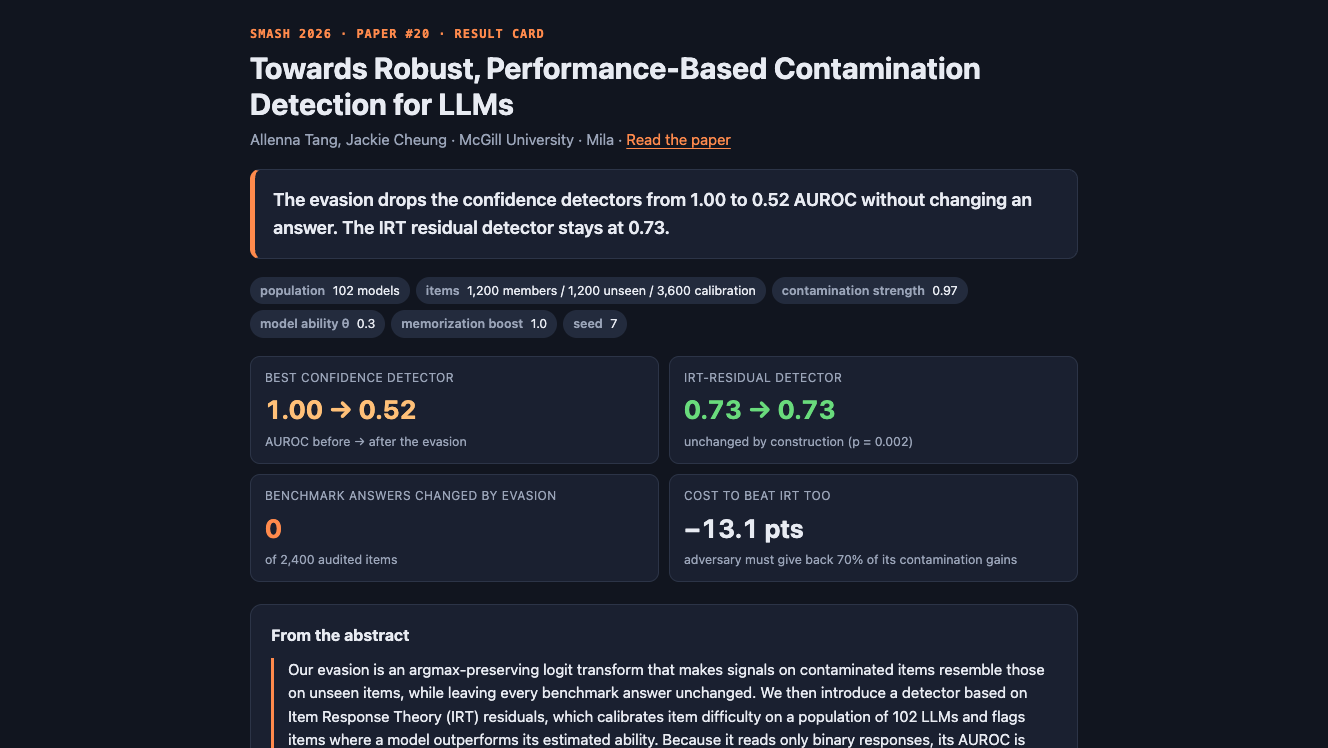
The evasion drops the confidence detectors from 1.00 to 0.52 AUROC without changing an answer. The IRT residual detector stays at 0.73. Items, models and token probabilities are simulated. The sandbagging analysis is an extension of the paper.
Inputs
Acceptance checklist
15/15 checks passed.- Set up the sandbox and parameters
- Extract the tested code
- Run the experiment
- Write the narrative
- Render the result card and summary
- The headline states this run's finding with its numbers, not a description of the method
- Paper numbers are quoted exactly and any disagreement with the paper is stated plainly
- Caveats say what is synthetic, reconstructed or an extension of the paper
- Each try-next suggestion would plausibly give a contrasting result
- Result card, numbers, narrative and summary were written
- Experiment numbers are valid JSON and the experiment stayed within its time budget
- The narrative has a headline, three idea bullets, findings, try-next runs and caveats
- Every try-next suggestion uses only this runbook's parameters
- Every number in the headline appears in the run's results
- The card embeds its figures, shows the headline, and contains no NaN
Runbook
| version | 1.0.0 |
| evaluation | programmatic |
| evals_version | 2 |
| agent | claude-code |
| model | anthropic/claude-haiku-5.5 |
| model_provider | openrouter |
| snapshot | python312-uv |
| primary_outputs | result_card.html |
Contamination Audit Lab: Evade the Detectors, Then Get Caught (SMASH 2026 · Paper #20)
Objective
This runbook is an interactive companion to the SMASH 2026 paper "Towards Robust, Performance-Based Contamination Detection for LLMs" (Allenna Tang, Jackie Cheung). Read the paper: https://drive.google.com/file/d/1eG9T_MAj1dUJLBNzRlAUpSu32xIt5zom/view?usp=sharing
The paper's two claims:
- Current contamination detectors can be cheaply evaded. An argmax-preserving logit transform reshapes the token probabilities on contaminated (member) benchmark items to look like unseen items, without changing a single benchmark answer. On Llama-3.1-8B-Instruct fine-tuned on MMLU items, Min-K%++, Min-K%, LOSS and ZLIB fall from near-perfect detection to chance.
- A performance-based detector is immune by construction. Calibrate item difficulty and discrimination with
a 2PL Item Response Theory model on a population of 102 LLMs, estimate the audited model's ability θ̂, and flag
items where it does better than predicted: residual
r_j = u_j − p_j(θ̂)withp_j(θ) = logistic(a_j(θ − b_j)). It reads only right/wrong answers, so the transform cannot touch it.
The participant plays both sides in a transparent, synthetic re-enactment of the experiment: choose how strongly the model is contaminated, how able it is, and how big the benchmark and model population are. The run: calibrates an IRT item bank; contaminates an audited model; computes the four confidence detectors from simulated token-probability rows; applies the paper's transform φ row by row; scores the IRT-residual detector; and then asks the question the paper implies: what would an adversary have to give up to beat the IRT detector too? Output: a shareable result card.
Target wall-clock: under 4 minutes. The experiment itself takes seconds.
The transform φ (paper §3.3, App. A), as implemented
At each position the row of probabilities is modified by resetting one target token to probability α and rescaling all
other tokens by a common factor (1 − α)/(1 − p_t) (relative probabilities preserved; still a valid distribution).
At non-answer positions the target is the actual next token and α is drawn from the empirical non-member confidence
distribution. At the answer position the target is the chosen option w; it is reset the same way, the other options are
clamped strictly below it, and the row is renormalized, so w stays the unique argmax. Draws are seeded on the item, so
repeated queries return identical outputs.
Paper headline numbers (quote exactly)
- AUROC before → after evasion: Min-K%++ 0.99 → 0.48, Min-K% 0.93 → 0.54, LOSS 0.99 → 0.54, ZLIB 0.99 → 0.45, IRT-residual 0.68 → 0.68 (ΔAUROC = 0.00).
- Control (uncontaminated base model): IRT AUROC 0.5016 (95% CI [0.487, 0.516], p = 0.495); contaminated 0.6781 (p = 0.003).
- Contamination: member accuracy 0.5996 → 0.9908 (6 epochs LoRA); non-member 0.5957 → 0.6622.
- MMLU split |M| = 2,812, |U| = 2,812, |C| = 8,418; item parameters from Fluid Benchmarking (102 LMs).
- Limitation: on very easy items r ≈ 0, so contamination there is undetectable (but also inflates the score least).
REQUIRED OUTPUT FILES (MANDATORY)
All in {{results_dir}}:
| File | Description |
|---|---|
result_card.html | Primary output. Self-contained, shareable one-page result card |
results.json | All computed numbers (written by experiment.py) |
card_data.json | Numbers/figures for the card (written by experiment.py) |
narrative.json | Your interpretation of this run (Step 4) |
fig_*.png | Figures (written by experiment.py) |
summary.md | 5–10 line plain-text summary |
validation_report.json | Evals v2 report: steps, code checks, checklist (see Write Validation Report) |
Parameters
| Parameter | Template Variable | Default | Description |
|---|---|---|---|
| Contamination strength | {{contamination}} | 0.97 | Fraction of the member items the model used to get wrong that contamination makes it answer right (paper: member accuracy 0.60 → 0.99 ≈ 0.97). Try 0.3 for light contamination |
| Model ability | {{model_ability}} | 0.3 | Audited model's true ability θ on the population scale (−2 weak … +2 strong) |
| Memorization boost | {{memorization_boost}} | 1.0 | How much training sharpens next-token probabilities on member text (drives the confidence detectors) |
| Member items | {{n_member_items}} | 1200 | Contaminated items |
| Calibration items | {{n_calibration_items}} | 3600 | Items used only to estimate θ̂ |
| Model population | {{n_population}} | 102 | LLMs used to calibrate the IRT item bank (paper: 102) |
| Seed | {{seed}} | 7 | Random seed |
Dependencies
numpy and matplotlib (preinstalled in python312-uv). No downloads.
Step 1: Set up
mkdir -p {{results_dir}} /app/work && cd /app/work
python -c "import numpy, matplotlib" 2>/dev/null || uv pip install --system -q numpy matplotlib
Write /app/work/params.json (JSON numbers; if a value still looks like an unsubstituted {{…}} placeholder use the
table default). Clamp: contamination to [0, 1], model_ability to [−3, 3], memorization_boost to [0, 4],
n_member_items to [200, 3000], n_calibration_items to [500, 8000], n_population to [20, 300]; record any clamp as a caveat.
{"contamination": {{contamination}}, "model_ability": {{model_ability}}, "memorization_boost": {{memorization_boost}},
 "n_member_items": {{n_member_items}}, "n_calibration_items": {{n_calibration_items}}, "n_population": {{n_population}},
 "seed": {{seed}}, "runbook_url": ""}
Step 2: Get the code (extract it, don't retype it)
The tested implementation of the method is embedded in the Appendix at the end of this runbook. Do not rewrite, "improve", or re-derive it. Always run the command below first, exactly as written. It copies the files out of this runbook's text (which the sandbox exposes to running processes) in about a second, and it is far faster and more reliable than retyping several hundred lines. Do not skip it on the assumption that it won't work: run it and read its output.
cd /app/work && cat > extract.py <<'PYEOF'
"""Extract the runbook's embedded files without retyping them.

The runbook text reaches the agent as one command-line argument, so it is readable from /proc.
Every embedded file sits under a heading "### `/app/work/<name>`" followed by one fenced block.
Exits non-zero if any requested file can't be found, so the caller falls back to writing it by hand.

usage: python3 extract.py <name> [<name> ...]   (writes /app/work/<name>)
"""
import ast, glob, re, sys
from pathlib import Path

want = sys.argv[1:]
cands = []
for p in glob.glob("/proc/[0-9]*/cmdline"):
    try:
        s = Path(p).read_bytes().decode("utf-8", "ignore")
    except OSError:
        continue
    if all(f"### `/app/work/{w}`" in s for w in want):
        cands.append(s)
if not cands:
    sys.exit("runbook text not found in /proc; write the files by hand")
# The agent's own argv holds the raw text; wrapper shells hold a shell-quoted copy, so prefer the shortest
# and undo shell single-quote escaping as a fallback.
best = min(cands, key=len).replace("'\"'\"'", "'")
ok = True
for w in want:
    m = re.search(r"### `/app/work/" + re.escape(w) + r"`\s*\n+```[a-z]*\n(.*?)\n```\n", best, re.S)
    if not m or len(m.group(1)) < 50:
        print(f"MISSING {w}"); ok = False; continue
    code = m.group(1) + "\n"
    if w.endswith(".py"):
        try:
            ast.parse(code)
        except SyntaxError as e:
            print(f"MISSING {w} (extracted text does not parse: {e})"); ok = False; continue
    Path("/app/work", w).write_text(code)
    print(f"extracted {w}: {code.count(chr(10))} lines")
sys.exit(0 if ok else 1)
PYEOF
python3 extract.py experiment.py render_card.py validate.py
If it exits non-zero or prints MISSING, write each missing file from the Appendix exactly as given, one
heredoc per file (quoted delimiter, e.g. cat > experiment.py <<'PYEOF'). If a later step fails, fix only
environment problems (missing package, network retry), never the methodology.
Step 3: Run the experiment
cd /app/work && export OMP_NUM_THREADS=4 OPENBLAS_NUM_THREADS=4 MKL_NUM_THREADS=4 SMASH_CPUS=4 && timeout 240 python -W ignore experiment.py params.json {{results_dir}}Expected: a few seconds. Ends with a done: line listing every detector's AUROC before → after.
The sandbox has 4 CPUs even though nproc may report more; the exports keep numpy/BLAS and process pools from oversubscribing them.
Step 4: Interpret: write narrative.json
Read {{results_dir}}/results.json and card_data.json, and look at every fig_*.png. Write
{{results_dir}}/narrative.json with keys headline, idea (exactly 3), findings (2–4), try_next (2–3),
caveats (2–4):
- headline (≤ 30 words): the most striking result of this run with 1–2 numbers copied from
results.json, typically the confidence detectors' collapse vs the IRT detector holding, or the sandbagging cost. - idea: the paper's two claims plus why "performance-based" is robust, in plain language.
- findings: (1) the evasion: before/after AUROCs vs the paper's Table 1, and
answers_changed_by_evasion(should be 0); (2) the IRT detector: AUROC and p-value vs the uncontaminated control (irt_control_auroc); (3) the trade-off (sandbag_to_chance): to push IRT to ≈ chance the adversary must give backfraction_given_backof its gains, losingpoints_lostbenchmark points and keeping onlyinflation_kept_pct% of the inflation; (4) the easy-item blind spot (irt_by_difficulty). Be clear that the IRT AUROC (~0.7) is modest; its strength is robustness, not accuracy. - try_next: 2–3 contrasting runs with exact values using only the keys
contamination, model_ability, memorization_boost, n_member_items, n_calibration_items, n_population, seed. Good contrasts: light contamination (contamination0.3); a very strong model (model_ability2.0, where most items are easy); a small calibration population (n_population20). - caveats: synthetic re-enactment (simulated population, items and token probabilities; not MMLU or Llama); sandbagging is this runbook's extension, not a result in the paper; AUROC levels depend on the simulation settings.
Step 5: Render the card and summary
cd /app/work && python render_card.py {{results_dir}}/card_data.json {{results_dir}}/narrative.json {{results_dir}}/result_card.htmlWrite {{results_dir}}/summary.md (5–10 lines: settings, AUROC table, control, sandbag cost, headline).
Writing style for narrative.json
These rules apply to every field and override any longer limits stated earlier in this runbook. Let the paper and the numbers speak; the card is not the place for commentary.
- Length:
headlineone sentence;idea1–3 bullets of at most 30 words;findings1–2 paragraphs of at most 60 words each;caveats1–2 bullets of at most 20 words. Cut anything the tiles, figures or tables already show. - Plain statements of what was measured. Write "Sensitivity gap −0.284 [−0.354, −0.218]; the paper reports +0.088", not an interpretation of what it means for the field.
- Avoid: em-dash asides; "not X, but Y" framings; colon-then-reveal sentences; rhetorical questions; words such as crucially, notably, strikingly, remarkably, collapses, illustrating, underscores, highlights, delve, powerful, key insight, worth noting; exclamation marks; restating the method before the result.
- Use the paper's own terms for its concepts. Quote the paper's numbers exactly.
Code Checks
Jetty runs these checks itself in the sandbox after the agent finishes, so they cannot be skipped or
misreported. validate.py (see Write Validation Report) runs the same checks first so you can fix problems before you stop.
outputs-exist — Result card, numbers, narrative and summary were written
cd {{results_dir}} && for f in result_card.html results.json card_data.json narrative.json summary.md; do test -s "$f" || { echo "missing or empty: $f"; exit 1; }; done; echo "all 5 outputs present"results-valid — Experiment numbers are valid JSON and the experiment stayed within its time budget
python3 - "{{results_dir}}" 240 <<'PY'
import json, sys
from pathlib import Path
R, budget = Path(sys.argv[1]), float(sys.argv[2])
res = json.loads((R / "results.json").read_text())
json.loads((R / "card_data.json").read_text())
rt = float(res.get("runtime_sec", 0))
if rt > budget:
    sys.exit(f"experiment took {rt}s, budget {budget}s")
print(f"results.json and card_data.json parse; experiment {rt}s within {budget:.0f}s")
PY
narrative-complete — The narrative is complete and within the length limits
python3 - "{{results_dir}}" <<'PY'
import json, sys
from pathlib import Path
n = json.loads((Path(sys.argv[1]) / "narrative.json").read_text())
problems = []
if not str(n.get("headline", "")).strip(): problems.append("no headline")
if len(str(n.get("headline", "")).split()) > 45: problems.append("headline over 45 words")
if not 1 <= len(n.get("idea", [])) <= 3: problems.append(f"idea has {len(n.get('idea', []))} bullets, need 1-3")
if not 1 <= len(n.get("findings", [])) <= 2: problems.append(f"{len(n.get('findings', []))} findings, need 1-2")
if any(len(f.split()) > 70 for f in n.get("findings", [])): problems.append("a findings paragraph is over 60 words")
if not 2 <= len(n.get("try_next", [])) <= 3: problems.append(f"{len(n.get('try_next', []))} try_next, need 2-3")
if not 1 <= len(n.get("caveats", [])) <= 2: problems.append(f"{len(n.get('caveats', []))} caveats, need 1-2")
if problems: sys.exit("; ".join(problems))
print("headline, %d idea bullets, %d findings, %d try_next, %d caveats" % (len(n["idea"]), len(n["findings"]), len(n["try_next"]), len(n["caveats"])))
PY
try-next-valid — Every try-next suggestion uses only this runbook's parameters
python3 - "{{results_dir}}" "contamination,model_ability,memorization_boost,n_member_items,n_calibration_items,n_population,seed" <<'PY'
import json, sys
from pathlib import Path
allowed = set(sys.argv[2].split(","))
n = json.loads((Path(sys.argv[1]) / "narrative.json").read_text())
bad = sorted({k for t in n.get("try_next", []) for k in (t.get("params") or {}) if k not in allowed})
empty = [t.get("label", "?") for t in n.get("try_next", []) if not t.get("params")]
if bad or empty: sys.exit(f"unknown parameters: {bad}; suggestions without params: {empty}")
print("all try_next parameters are declared runbook parameters")
PY
headline-grounded — Every number in the headline appears in the run's results
python3 - "{{results_dir}}" <<'PY'
import json, re, sys
from pathlib import Path
R = Path(sys.argv[1])
blob = (R / "results.json").read_text() + (R / "card_data.json").read_text()
vals = [float(x) for x in re.findall(r"-?\d+(?:\.\d+)?(?:[eE]-?\d+)?", blob)]
head = json.loads((R / "narrative.json").read_text())["headline"]
nums = re.findall(r"(?<![\w.−-])[−-]?\d[\d,]*(?:\.\d+)?(?![\w-])", head)
missing = []
for n in nums:
    s = n.replace("−", "-").replace(",", ""); v = float(s); dec = len(s.split(".")[1]) if "." in s else 0
    tol = 0.5 * 10 ** (-dec) + 1e-9
    if not any(abs(abs(x) - abs(v)) <= tol or abs(abs(x * 100) - abs(v)) <= max(tol, 0.5) for x in vals):
        missing.append(n)
if missing: sys.exit(f"headline numbers not found in results: {missing}")
print(f"{len(nums)} headline number(s) all grounded in results")
PY
card-integrity — The card embeds its figures, shows the headline, and contains no NaN
python3 - "{{results_dir}}" <<'PY'
import html, json, re, sys
from pathlib import Path
R = Path(sys.argv[1])
card = (R / "result_card.html").read_text()
text = re.sub(r"data:image/[a-z]+;base64,[A-Za-z0-9+/=]+", "", card)
head = json.loads((R / "narrative.json").read_text())["headline"]
problems = []
if card.count("data:image/png;base64") < 1: problems.append("no embedded figures")
if re.search(r"\bNaN\b|\bnan%|\bInfinity\b", text): problems.append("NaN/Infinity in card text")
if len(card) > 5_000_000: problems.append(f"card is {len(card) // 1024} KB")
plain = html.unescape(re.sub(r"<[^>]+>", "", text))
if re.sub(r"[*`]", "", head)[:40] not in plain: problems.append("headline not on card")
if problems: sys.exit("; ".join(problems))
print(f"card {len(card) // 1024} KB, {card.count('data:image/png;base64')} figures, headline present")
PY
Checklist
- The headline states this run's finding with its numbers, not a description of the method
- Paper numbers are quoted exactly and any disagreement with the paper is stated plainly
- Caveats say what is synthetic, reconstructed or an extension of the paper
- Each try-next suggestion would plausibly give a contrasting result
Write Validation Report
Judge the four Checklist items honestly against your outputs and write them to /app/work/checklist.json as a
list, using the checklist ids Jetty gives you (one entry per item):
[{"id": "<checklist id>", "status": "pass", "message": "one line on why"}]Then write the report and self-check in one command:
cd /app/work && python3 validate.py {{results_dir}} contamination,model_ability,memorization_boost,n_member_items,n_calibration_items,n_population,seed 240 checklist.jsonvalidate.py writes {{results_dir}}/validation_report.json in the v2 shape Jetty reads (version: 2, one
step entry per runbook step, one code_check entry per check above, one checklist entry per item). Jetty
replaces the code_check entries with its own independent run of the same checks. Do not write the report by hand.
Iteration (up to 2 rounds)
If validate.py prints any FAIL, fix the named problem (usually a headline number that does not match
results.json, or an unknown try_next key), re-render the card (Step 5) and rerun the command above. Never
rerun the experiment just to change the narrative.
Appendix: code
These files are extracted verbatim in Step 2.
/app/work/experiment.py
"""Contamination audit lab — SMASH 2026 paper #20 (Allenna Tang, Jackie Cheung).

A synthetic, fully transparent re-enactment of the paper's experiment:
  1. calibrate a 2PL IRT item bank on a population of LLMs (simulated response matrix);
  2. contaminate an audited model on member items M (a `contamination` fraction of its wrong member answers become right);
  3. score four confidence-based detectors (LOSS, ZLIB, Min-K%, Min-K%++) from token probability rows;
  4. apply the paper's argmax-preserving confidence-masking transform phi and re-score;
  5. score the IRT-residual detector r_j = u_j - p_j(theta_hat), which only reads right/wrong.
Then explore what an adversary must give up to beat the IRT detector ("sandbagging").

usage: python experiment.py params.json outdir
"""
import json, sys, time, zlib
from pathlib import Path

import numpy as np
import matplotlib
matplotlib.use("Agg")
import matplotlib.pyplot as plt

T0 = time.time()
P = json.loads(Path(sys.argv[1]).read_text())
OUT = Path(sys.argv[2]); OUT.mkdir(parents=True, exist_ok=True)
rng = np.random.default_rng(int(P["seed"]))

N_POP = int(P["n_population"])        # paper: 102 LMs (Fluid Benchmarking)
N_MEM = int(P["n_member_items"])      # paper: 2,812
N_UNS = N_MEM                         # paper: |U| = |M|
N_CAL = int(P["n_calibration_items"]) # paper: 8,418
N_ITEMS = N_MEM + N_UNS + N_CAL
CONTAM = float(P["contamination"])    # fraction of wrongly-answered member items that training makes right
                                      # (paper: member accuracy 0.60 -> 0.99, i.e. ~0.97)
THETA = float(P["model_ability"])
V, K_OPT, DELTA, MINK = 64, 4, 1e-3, 0.2


def log(m):
    print(f"[{time.time() - T0:6.1f}s] {m}", flush=True)


def logistic(x):
    return 1 / (1 + np.exp(-x))


def auroc(scores, labels):
    """P(random member scores above random non-member), ties = 1/2 (Mann-Whitney)."""
    s = np.asarray(scores); y = np.asarray(labels).astype(bool)
    order = np.argsort(s, kind="mergesort"); ranks = np.empty(len(s)); ranks[order] = np.arange(1, len(s) + 1)
    _, inv, cnt = np.unique(s, return_inverse=True, return_counts=True)
    sums = np.bincount(inv, ranks); ranks = (sums / cnt)[inv]
    n1, n0 = y.sum(), (~y).sum()
    return float((ranks[y].sum() - n1 * (n1 + 1) / 2) / (n1 * n0))


# ------------------------------------------------------------------ 1. IRT calibration on a population
a_true = np.exp(rng.normal(0.0, 0.35, N_ITEMS))           # discrimination
b_true = rng.normal(-0.4, 1.1, N_ITEMS)                    # difficulty
theta_pop = rng.normal(0, 1, N_POP)
U_pop = rng.random((N_POP, N_ITEMS)) < logistic(a_true * (theta_pop[:, None] - b_true))


def calibrate(U, iters=60):
    """Joint maximum likelihood for the 2PL (alternating Newton steps; abilities standardized each round)."""
    n_p, n_i = U.shape; th = np.zeros(n_p); a = np.ones(n_i); b = np.zeros(n_i)
    pc = U.mean(1).clip(0.02, 0.98); th = np.log(pc / (1 - pc)); th = (th - th.mean()) / th.std()
    for _ in range(iters):
        for _inner in range(2):
            p = logistic(a * (th[:, None] - b)); r = U - p; w = p * (1 - p)
            # d logL / d b = -a * sum(r); Newton step (observed information a^2 * sum(w))
            b = np.clip(b - (a * r).sum(0) / ((a ** 2 * w).sum(0) + 1e-6), -6, 6)
            p = logistic(a * (th[:, None] - b)); r = U - p; w = p * (1 - p); x = th[:, None] - b
            ga = (x * r).sum(0) - (np.log(a)) / a; ha = (x ** 2 * w).sum(0) + 1e-6
            a = np.clip(a + ga / ha, 0.2, 4)
        p = logistic(a * (th[:, None] - b)); r = U - p; w = p * (1 - p)
        th = np.clip(th + (a * r).sum(1) / ((a ** 2 * w).sum(1) + 1e-6), -5, 5)
        th = (th - th.mean()) / th.std()
    return a, b


def ability(u, a, b):
    th = 0.0
    for _ in range(50):
        p = logistic(a * (th - b)); th += (a * (u - p)).sum() / ((a ** 2 * p * (1 - p)).sum() + 1e-6)
        th = float(np.clip(th, -6, 6))
    return th


a_hat, b_hat = calibrate(U_pop.astype(float))
log(f"calibrated 2PL item bank on {N_POP} models x {N_ITEMS} items "
    f"(corr b: {np.corrcoef(b_hat, b_true)[0, 1]:.3f}, a: {np.corrcoef(a_hat, a_true)[0, 1]:.3f})")

# Stratified-by-difficulty split into members M, unseen U, calibration C (paper §5.1):
# within each difficulty decile, items are shuffled and dealt to M / U / C in the target proportions.
split = np.empty(N_ITEMS, dtype="<U1")
for dec in np.array_split(np.argsort(b_true), 10):
    dec = rng.permutation(dec); n = len(dec)
    nm, nu = round(n * N_MEM / N_ITEMS), round(n * N_UNS / N_ITEMS)
    split[dec[:nm]], split[dec[nm:nm + nu]], split[dec[nm + nu:]] = "M", "U", "C"
M, Un, C = split == "M", split == "U", split == "C"

# ------------------------------------------------------------------ 2. audited model: base + contaminated
p_base = logistic(a_true * (THETA - b_true))
u_base = rng.random(N_ITEMS) < p_base
base_mem_acc = float(u_base[M].mean())
# contamination: each member item the base model got wrong becomes right with probability CONTAM
u_cont = u_base.copy(); flip = M & ~u_base & (rng.random(N_ITEMS) < CONTAM); u_cont[flip] = True
log(f"audited model: member acc {u_base[M].mean():.3f} -> {u_cont[M].mean():.3f}; unseen {u_cont[Un].mean():.3f}")

# ------------------------------------------------------------------ 3. token probability rows
ID = np.where(M | Un)[0]                      # detection set = M ∪ U
L = rng.poisson(55, len(ID)) + 20             # tokens of prompt + answer continuation
memb = M[ID]
MEM_BOOST = float(P["memorization_boost"])    # how much training on M sharpens next-token prediction


def rows_for_item(i, member, contaminated):
    """Return (V-dim prob rows per position, target index per position) for item ID[i]; last row = answer option."""
    r = np.random.default_rng([int(P["seed"]), int(ID[i])])
    z = r.normal(0, 1.6, (L[i], V)); tgt = r.integers(0, V, L[i])
    boost = r.normal(1.4, 1.4, L[i]) + (MEM_BOOST if (member and contaminated) else 0.0)
    z[np.arange(L[i]), tgt] += boost
    p = np.exp(z - z.max(1, keepdims=True)); p /= p.sum(1, keepdims=True)
    return p, tgt


def answer_row(i, u, member, contaminated):
    """Distribution over the K answer options at the answer position; chosen option = argmax."""
    r = np.random.default_rng([int(P["seed"]), int(ID[i]), 7])
    correct = 0; chosen = correct if u else 1 + r.integers(0, K_OPT - 1)
    z = r.normal(0, 0.8, K_OPT); z[chosen] = z.max() + abs(r.normal(1.0, 0.8)) + (3.0 if member and contaminated else 0)
    q = np.exp(z - z.max()); return q / q.sum(), chosen, correct


def detector_scores(rows_list):
    loss, zl, mink, minkpp = [], [], [], []
    for (p, tgt, q, chosen, correct) in rows_list:
        lp_t = np.log(p[np.arange(len(tgt)), tgt])
        lp_ans = np.log(q[correct])
        lp = np.r_[lp_t, lp_ans]
        loss.append(lp.mean())                                          # LOSS: higher log-lik = member
        zl.append(lp.sum() / len(zlib.compress(tgt.astype(np.uint8).tobytes())))  # ZLIB-normalized
        k = max(1, int(MINK * len(lp))); mink.append(np.sort(lp)[:k].mean())     # Min-K%
        logp = np.log(p); mu = (p * logp).sum(1); sd = np.sqrt(np.maximum((p * logp ** 2).sum(1) - mu ** 2, 1e-9))
        zz = (lp_t - mu) / sd; kk = max(1, int(MINK * len(zz))); minkpp.append(np.sort(zz)[:kk].mean())  # Min-K%++
    return {"LOSS": np.array(loss), "ZLIB": np.array(zl), "Min-K%": np.array(mink), "Min-K%++": np.array(minkpp)}


def build_rows(u):
    out = []
    for i in range(len(ID)):
        p, tgt = rows_for_item(i, memb[i], True)
        q, chosen, correct = answer_row(i, u[ID[i]], memb[i], True)
        out.append((p, tgt, q, chosen, correct))
    return out


# ------------------------------------------------------------------ 4. the evasion phi (paper §3.3, App. A)
def phi_row(p, t, alpha):
    """Reset target token t to probability alpha; rescale every other token by (1-alpha)/(1-p_t)."""
    out = p * (1 - alpha) / max(1 - p[t], 1e-12); out[t] = alpha; return out


def evade(rows_list):
    # empirical non-member confidence distributions (what an unseen item looks like)
    nm_tok = np.concatenate([r[0][np.arange(len(r[1])), r[1]] for r, m in zip(rows_list, memb) if not m])
    nm_ans = np.array([r[2][r[3]] for r, m in zip(rows_list, memb) if not m])
    out, changed = [], 0
    for i, (p, tgt, q, chosen, correct) in enumerate(rows_list):
        r = np.random.default_rng([int(P["seed"]), int(ID[i]), 99])          # deterministic in the prompt
        alphas = r.choice(nm_tok, len(tgt))
        p2 = np.array([phi_row(p[j], tgt[j], alphas[j]) for j in range(len(tgt))])
        a_star = float(r.choice(nm_ans)); a_star = max(a_star, 1 / K_OPT + DELTA)
        q2 = phi_row(q, chosen, a_star)
        others = [c for c in range(K_OPT) if c != chosen]
        q2[others] = np.minimum(q2[others], a_star - DELTA)                 # chosen stays the unique argmax
        q2 = q2 / q2.sum()
        changed += int(np.argmax(q2) != chosen)
        out.append((p2, tgt, q2, chosen, correct))
    return out, changed


rows = build_rows(u_cont)
before = detector_scores(rows)
rows_ev, n_changed = evade(rows)
after = detector_scores(rows_ev)
log(f"evasion applied to {len(ID)} items; answers changed: {n_changed}")

# ------------------------------------------------------------------ 5. IRT residual detector
th_hat = ability(u_cont[C].astype(float), a_hat[C], b_hat[C])
resid = u_cont[ID] - logistic(a_hat[ID] * (th_hat - b_hat[ID]))
th_hat_base = ability(u_base[C].astype(float), a_hat[C], b_hat[C])
resid_base = u_base[ID] - logistic(a_hat[ID] * (th_hat_base - b_hat[ID]))   # control: uncontaminated model

table = []
for name in ["Min-K%++", "Min-K%", "LOSS", "ZLIB"]:
    b4, af = auroc(before[name], memb), auroc(after[name], memb)
    table.append({"detector": name, "before": b4, "after": af, "delta": b4 - af})
irt = auroc(resid, memb)
table.append({"detector": "IRT-residual", "before": irt, "after": irt, "delta": 0.0})
irt_control = auroc(resid_base, memb)


# permutation p-value for the IRT AUROC (contaminated vs chance)
def perm_p(scores, labels, n=500):
    obs = auroc(scores, labels); r = np.random.default_rng(1)
    return float((1 + sum(auroc(scores, r.permutation(labels)) >= obs for _ in range(n))) / (n + 1))


p_irt, p_ctrl = perm_p(resid, memb), perm_p(resid_base, memb)

# ------------------------------------------------------------------ 6. adversary vs IRT: sandbagging trade-off
sandbag = []
gained = np.where(M & u_cont & ~u_base)[0]          # member items the contamination turned right
ranked = gained[np.argsort(-(u_cont[gained] - logistic(a_hat[gained] * (th_hat - b_hat[gained]))))]
for frac in np.linspace(0, 1, 11):
    u_s = u_cont.copy(); u_s[ranked[: int(round(frac * len(ranked)))]] = False   # deliberately answer wrong
    th_s = ability(u_s[C].astype(float), a_hat[C], b_hat[C])
    r_s = u_s[ID] - logistic(a_hat[ID] * (th_s - b_hat[ID]))
    sandbag.append({"fraction_given_back": float(frac), "irt_auroc": auroc(r_s, memb),
                    "benchmark_acc": float(u_s[M | Un].mean()), "member_acc": float(u_s[M].mean())})

# easy-item blind spot: residual AUROC by difficulty tercile
p_pred = logistic(a_hat[ID] * (th_hat - b_hat[ID]))
terc = np.quantile(p_pred, [1 / 3, 2 / 3]); bins = np.digitize(p_pred, terc)
by_diff = [{"bin": ["hard", "medium", "easy"][k], "auroc": auroc(resid[bins == k], memb[bins == k]),
            "mean_p": float(p_pred[bins == k].mean())} for k in range(3)]

res = {"params": P, "n_items": {"members": int(M.sum()), "unseen": int(Un.sum()), "calibration": int(C.sum())},
       "population": N_POP, "calibration_corr_b": float(np.corrcoef(b_hat, b_true)[0, 1]),
       "member_acc_base": base_mem_acc, "member_acc_contaminated": float(u_cont[M].mean()),
       "unseen_acc": float(u_cont[Un].mean()), "benchmark_acc_base": float(u_base[M | Un].mean()),
       "benchmark_acc_contaminated": float(u_cont[M | Un].mean()),
       "theta_hat": th_hat, "answers_changed_by_evasion": n_changed, "table": table,
       "irt_auroc": irt, "irt_p": p_irt, "irt_control_auroc": irt_control, "irt_control_p": p_ctrl,
       "best_confidence_before": max(t["before"] for t in table[:4]), "best_confidence_after": max(t["after"] for t in table[:4]),
       "sandbag": sandbag, "irt_by_difficulty": by_diff}
# where does the adversary get IRT back to ~chance, and at what cost?
chance = next((s for s in sandbag if s["irt_auroc"] <= 0.55), sandbag[-1])
res["sandbag_to_chance"] = {**chance, "points_lost": 100 * (res["benchmark_acc_contaminated"] - chance["benchmark_acc"]),
                            "inflation_kept_pct": 100 * (chance["benchmark_acc"] - res["benchmark_acc_base"]) /
                            max(res["benchmark_acc_contaminated"] - res["benchmark_acc_base"], 1e-9)}

# ------------------------------------------------------------------ figures
plt.rcParams.update({"font.size": 10, "axes.spines.top": False, "axes.spines.right": False})
INK, ACC, BLUE, MUTED = "#1f2a44", "#d9480f", "#1971c2", "#adb5bd"
fig, ax = plt.subplots(figsize=(6.4, 3.0))
names = [t["detector"] for t in table]; x = np.arange(len(names))
ax.bar(x - 0.2, [t["before"] for t in table], 0.38, color=MUTED, label="before evasion")
ax.bar(x + 0.2, [t["after"] for t in table], 0.38, color=[ACC] * 4 + [BLUE], label="after evasion")
for i, t in enumerate(table):
    ax.text(i + 0.2, t["after"] + 0.02, f"{t['after']:.2f}", ha="center", fontsize=8)
ax.axhline(0.5, color=INK, ls="--", lw=1); ax.text(len(names) - 0.5, 0.51, "chance", fontsize=8, ha="right")
ax.set_xticks(x); ax.set_xticklabels(names); ax.set_ylim(0, 1.08); ax.set_ylabel("AUROC (member vs unseen)")
ax.legend(frameon=False, fontsize=8, loc="upper center", ncol=2, bbox_to_anchor=(0.5, 1.13))
fig.tight_layout(); fig.savefig(OUT / "fig_auroc.png", dpi=160); plt.close(fig)

fig, ax = plt.subplots(figsize=(6.4, 2.8))
bins_ = np.linspace(-1, 1, 41)
ax.hist(resid[~memb], bins_, color=MUTED, alpha=0.9, label="unseen items")
ax.hist(resid[memb], bins_, color=ACC, alpha=0.6, label="contaminated (member) items")
ax.set_xlabel("IRT residual  r = u − p(θ̂)   (did better than its ability predicts →)"); ax.set_ylabel("items")
ax.legend(frameon=False, fontsize=8)
fig.tight_layout(); fig.savefig(OUT / "fig_residuals.png", dpi=160); plt.close(fig)

fig, ax1 = plt.subplots(figsize=(6.4, 3.0))
fx = [s["fraction_given_back"] for s in sandbag]
ax1.plot(fx, [s["irt_auroc"] for s in sandbag], "o-", color=BLUE, label="IRT-residual AUROC")
ax1.axhline(0.5, color=INK, ls="--", lw=1); ax1.set_ylabel("IRT AUROC", color=BLUE); ax1.set_ylim(0.3, 1)
ax2 = ax1.twinx(); ax2.spines["top"].set_visible(False)
ax2.plot(fx, [100 * s["benchmark_acc"] for s in sandbag], "s-", color=ACC, label="benchmark accuracy")
ax2.axhline(100 * res["benchmark_acc_base"], color=ACC, ls=":", lw=1)
ax2.set_ylabel("benchmark accuracy (%)", color=ACC)
ax1.set_xlabel("Fraction of contamination gains the adversary deliberately gives back")
fig.tight_layout(); fig.savefig(OUT / "fig_sandbag.png", dpi=160); plt.close(fig)

# ------------------------------------------------------------------ card data
sb = res["sandbag_to_chance"]
tiles = [
    {"label": "Best confidence detector", "value": f"{res['best_confidence_before']:.2f} → {res['best_confidence_after']:.2f}",
     "sub": "AUROC before → after the evasion", "tone": "warn"},
    {"label": "IRT-residual detector", "value": f"{irt:.2f} → {irt:.2f}", "sub": f"unchanged by construction (p = {p_irt:.3f})", "tone": "good"},
    {"label": "Benchmark answers changed by evasion", "value": f"{n_changed}", "sub": f"of {len(ID):,} audited items", "tone": "accent"},
    {"label": "Cost to beat IRT too", "value": f"−{sb['points_lost']:.1f} pts",
     "sub": f"adversary must give back {100 * sb['fraction_given_back']:.0f}% of its contamination gains", "tone": "neutral"},
]
compare = [{"metric": t["detector"] + " AUROC (before → after)",
            "paper": {"Min-K%++": "0.99 → 0.48", "Min-K%": "0.93 → 0.54", "LOSS": "0.99 → 0.54", "ZLIB": "0.99 → 0.45",
                      "IRT-residual": "0.68 → 0.68 (Δ 0.00)"}[t["detector"]],
            "yours": f"{t['before']:.2f} → {t['after']:.2f}", "note": ""} for t in table]
compare += [{"metric": "Control (uncontaminated) IRT AUROC", "paper": "0.5016, p = 0.495", "yours": f"{irt_control:.3f}, p = {p_ctrl:.3f}", "note": ""},
            {"metric": "Easy-item blind spot (IRT AUROC by difficulty)", "paper": "on very easy items r ≈ 0: contamination undetectable",
             "yours": " / ".join(f"{d['bin']} {d['auroc']:.2f}" for d in by_diff), "note": ""},
            {"metric": "Member accuracy (contamination)", "paper": "0.5996 → 0.9908",
             "yours": f"{base_mem_acc:.3f} → {res['member_acc_contaminated']:.3f}", "note": "synthetic"}]
Path(OUT / "card_data.json").write_text(json.dumps({
    "paper": {"num": 20, "title": "Towards Robust, Performance-Based Contamination Detection for LLMs",
              "authors": "Allenna Tang, Jackie Cheung", "url": "https://drive.google.com/file/d/1eG9T_MAj1dUJLBNzRlAUpSu32xIt5zom/view?usp=sharing", "affiliation": "McGill University · Mila"},
    "inputs": {"population": f"{N_POP} models", "items": f"{N_MEM:,} members / {N_UNS:,} unseen / {N_CAL:,} calibration",
               "contamination strength": CONTAM, "model ability θ": THETA, "memorization boost": MEM_BOOST, "seed": P["seed"]},
    "tiles": tiles,
    "figures": [{"path": "fig_auroc.png", "title": "The evasion: confidence detectors collapse, IRT does not",
                 "caption": "AUROC for separating contaminated (member) from unseen items. The transform reshapes token "
                            "probabilities to look like unseen items while keeping every answer's argmax."},
                {"path": "fig_residuals.png", "title": "Why IRT still sees it",
                 "caption": "The audited model answers member items better than its estimated ability predicts: positive residuals."},
                {"path": "fig_sandbag.png", "title": "What would it take to fool IRT too?",
                 "caption": "An adversary can only lower the IRT signal by answering contaminated items wrong — giving back "
                            "the very score inflation it was after (dotted line = uncontaminated accuracy)."}],
    "compare": compare, "runbook": {"name": "smash-20-contamination-audit", "url": P.get("runbook_url", "")}}, indent=2))
res["runtime_sec"] = round(time.time() - T0, 1)
(OUT / "results.json").write_text(json.dumps(res, indent=2))
log("done: " + "; ".join(f"{t['detector']} {t['before']:.2f}->{t['after']:.2f}" for t in table)
    + f"; control {irt_control:.3f}; sandbag cost {sb['points_lost']:.1f} pts")
/app/work/render_card.py
"""Render a SMASH 2026 paper-playground result card (one self-contained HTML file).

usage: python render_card.py card_data.json narrative.json out.html

card_data.json  (written by the experiment script — numbers only)
  paper:   {num, title, authors, affiliation, url?}
  inputs:  {label: value}                         the participant's run settings
  tiles:   [{label, value, sub, tone}]            tone: accent|good|warn|neutral
  figures: [{path, title, caption}]               PNGs, embedded as base64
  compare: [{metric, paper, yours, note}]         paper-vs-your-run table (optional)
  runbook: {name, url}                            fork link (optional)
narrative.json  (written by the agent — words only)
  headline:  one sentence, the finding of THIS run
  idea:      [1-3 bullets] the paper's contribution in plain language
  abstract:  (optional) a verbatim abstract excerpt, shown instead of idea
  findings:  [2-4 short paragraphs] what this run shows, tied to the numbers
  try_next:  [{label, why, params}]               2-3 follow-up runs with exact parameter values
  caveats:   [bullets]
"""
import base64, html, json, sys
from pathlib import Path

data = json.loads(Path(sys.argv[1]).read_text())
narr = json.loads(Path(sys.argv[2]).read_text())
base = Path(sys.argv[1]).parent
e = lambda s: html.escape(str(s))


def md_inline(s):
    """Escape, then allow **bold**, *italic* and `code` only."""
    import re
    s = e(s)
    s = re.sub(r"\*\*(.+?)\*\*", r"<strong>\1</strong>", s)
    s = re.sub(r"(?<![\w*])\*(?!\s)(.+?)(?<!\s)\*(?![\w*])", r"<em>\1</em>", s)
    return re.sub(r"`(.+?)`", r"<code>\1</code>", s)


p = data["paper"]
tiles = "".join(
    f'<div class="tile {e(t.get("tone", "neutral"))}"><div class="tl">{e(t["label"])}</div>'
    f'<div class="tv">{e(t["value"])}</div><div class="ts">{md_inline(t.get("sub", ""))}</div></div>'
    for t in data.get("tiles", []))
# Columns that fill every row: 4 tiles as 2x2, never 3 + 1 orphan.
n_tiles = len(data.get("tiles", []))
tile_cols = 2 if n_tiles == 4 else min(max(n_tiles, 1), 3)
inputs = "".join(f'<span class="chip"><b>{e(k)}</b> {e(v)}</span>' for k, v in data.get("inputs", {}).items())
figs = ""
for f in data.get("figures", []):
    fp = Path(f["path"]); fp = fp if fp.is_absolute() else base / fp
    if fp.exists():
        b64 = base64.b64encode(fp.read_bytes()).decode()
        figs += (f'<figure><figcaption class="ft">{e(f.get("title", ""))}</figcaption>'
                 f'<img alt="{e(f.get("title", ""))}" src="data:image/png;base64,{b64}">'
                 f'<figcaption>{md_inline(f.get("caption", ""))}</figcaption></figure>')
compare = ""
if data.get("compare"):
    rows = "".join(f'<tr><td>{md_inline(r["metric"])}</td><td>{md_inline(r["paper"])}</td>'
                   f'<td class="y">{md_inline(r["yours"])}</td><td class="n">{md_inline(r.get("note", ""))}</td></tr>'
                   for r in data["compare"])
    compare = (f'<section><h2>Paper vs. your run</h2><div class="tw"><table><thead><tr><th>Metric</th>'
               f'<th>Paper</th><th>Your run</th><th></th></tr></thead><tbody>{rows}</tbody></table></div></section>')
idea = "".join(f"<li>{md_inline(b)}</li>" for b in narr.get("idea", []))
abstract = narr.get("abstract", "")
findings = "".join(f"<p>{md_inline(x)}</p>" for x in narr.get("findings", []))
tries = "".join(
    f'<li><strong>{md_inline(t["label"])}</strong> — {md_inline(t.get("why", ""))}'
    f'<pre>{e(json.dumps(t.get("params", {}), ensure_ascii=False))}</pre></li>' for t in narr.get("try_next", []))
cav = "".join(f"<li>{md_inline(c)}</li>" for c in narr.get("caveats", []))
rb = data.get("runbook", {})
fork = (f'<a class="fork" href="{e(rb["url"])}">Fork this runbook on Jetty →</a>' if rb.get("url") else "")

page = f"""<!doctype html><html lang="en"><head><meta charset="utf-8">
<meta name="viewport" content="width=device-width,initial-scale=1">
<title>SMASH 2026 · #{e(p['num'])} · Result card</title>
<style>
:root{{--bg:#f6f4ef;--card:#fff;--ink:#1f2a44;--muted:#5c677d;--line:#e3dfd5;--accent:#d9480f;--good:#2b8a3e;--warn:#e67700;--chip:#efece4}}
@media (prefers-color-scheme:dark){{:root{{--bg:#11151f;--card:#1a2030;--ink:#e8ebf2;--muted:#9aa4b8;--line:#2c3447;--accent:#ff8a4c;--good:#69db7c;--warn:#ffc078;--chip:#232b3d}}
figure img{{background:#fff;border-radius:6px}}}}
*{{box-sizing:border-box}}body{{margin:0;background:var(--bg);color:var(--ink);font:15px/1.55 ui-sans-serif,system-ui,-apple-system,"Segoe UI",Roboto,sans-serif}}
main{{max-width:860px;margin:0 auto;padding:28px 16px 48px}}
.kicker{{font:600 12px/1 ui-monospace,SFMono-Regular,Menlo,monospace;letter-spacing:.08em;text-transform:uppercase;color:var(--accent)}}
h1{{font-size:clamp(22px,4vw,30px);line-height:1.2;margin:10px 0 6px}}.authors{{color:var(--muted);margin:0 0 18px}}.authors a{{color:var(--accent);text-underline-offset:3px}}
.headline{{background:var(--card);border:1px solid var(--line);border-left:5px solid var(--accent);border-radius:10px;padding:16px 18px;font-size:18px;font-weight:600;margin:0 0 18px}}
.chips{{display:flex;flex-wrap:wrap;gap:6px;margin:0 0 18px}}.chip{{background:var(--chip);border-radius:999px;padding:4px 10px;font-size:12.5px}}.chip b{{font-weight:600;color:var(--muted);margin-right:4px}}
.tiles{{display:grid;grid-template-columns:repeat(var(--cols),minmax(0,1fr));gap:10px;margin:0 0 22px}}
@media (max-width:560px){{.tiles{{grid-template-columns:1fr}}}}
.tile{{background:var(--card);border:1px solid var(--line);border-radius:10px;padding:12px 14px}}.tl{{font-size:12px;color:var(--muted);text-transform:uppercase;letter-spacing:.04em}}
.tv{{font-size:26px;font-weight:700;margin:2px 0;font-variant-numeric:tabular-nums}}.ts{{font-size:12.5px;color:var(--muted)}}
.tile.accent .tv{{color:var(--accent)}}.tile.good .tv{{color:var(--good)}}.tile.warn .tv{{color:var(--warn)}}
section{{background:var(--card);border:1px solid var(--line);border-radius:12px;padding:18px 20px;margin:0 0 16px}}
h2{{font-size:16px;margin:0 0 10px}}ul{{padding-left:20px;margin:0}}li{{margin:4px 0}}p{{margin:0 0 10px}}
figure{{margin:0 0 18px}}figure img{{width:100%;height:auto;display:block}}figcaption{{font-size:13px;color:var(--muted);margin-top:6px}}.ft{{font-weight:600;color:var(--ink);font-size:14px;margin:0 0 6px}}
.tw{{overflow-x:auto}}table{{border-collapse:collapse;width:100%;font-size:13.5px;font-variant-numeric:tabular-nums}}th,td{{text-align:left;padding:7px 8px;border-bottom:1px solid var(--line);vertical-align:top}}th{{color:var(--muted);font-weight:600}}td.y{{font-weight:600}}td.n{{color:var(--muted);font-size:12.5px}}
pre{{background:var(--chip);border-radius:6px;padding:6px 8px;font-size:12px;white-space:pre-wrap;word-break:break-word;margin:4px 0 8px}}code{{background:var(--chip);border-radius:4px;padding:1px 4px;font-size:.92em}}
.fork{{display:inline-block;background:var(--ink);color:var(--bg);text-decoration:none;font-weight:600;border-radius:8px;padding:10px 14px;margin-top:6px}}
footer{{color:var(--muted);font-size:12.5px;margin-top:22px}}
.abs{{margin:0;padding-left:14px;border-left:3px solid var(--accent);color:var(--ink)}}
</style></head><body><main>
<div class="kicker">SMASH 2026 · Paper #{e(p['num'])} · Result card</div>
<h1>{e(p['title'])}</h1><p class="authors">{e(p['authors'])}{(' · ' + e(p['affiliation'])) if p.get('affiliation') else ''}{(f' · <a href="{e(p["url"])}">Read the paper</a>') if p.get('url') else ''}</p>
<div class="headline">{md_inline(narr['headline'])}</div>
<div class="chips">{inputs}</div>
<div class="tiles" style="--cols:{tile_cols}">{tiles}</div>
{f'<section><h2>From the abstract</h2><blockquote class="abs">{e(abstract)}</blockquote></section>' if abstract else f'<section><h2>The idea</h2><ul>{idea}</ul></section>'}
{f'<section><h2>What this run shows</h2>{findings}</section>' if findings else ''}
<section><h2>Evidence</h2>{figs}</section>
{compare}
<section><h2>Try next</h2><ul>{tries}</ul>{fork}</section>
<section><h2>Read this before sharing</h2><ul>{cav}</ul></section>
<footer>Generated by a Jetty runbook built from the authors' SMASH 2026 paper. Numbers on this card come from code run in a sandbox; the words were written by an AI agent reading those numbers. This is an interactive companion, not the authors' own results unless labelled “Paper”.</footer>
</main></body></html>"""
Path(sys.argv[3]).write_text(page)
print(f"wrote {sys.argv[3]} ({len(page) // 1024} KB)")
/app/work/validate.py
"""Self-check a SMASH paper-playground run and write validation_report.json (evals v2 shape).

Runs the same checks as the runbook's `## Code Checks` (which Jetty re-runs independently after the agent
exits and substitutes for these entries), adds one `step` entry per runbook step and the agent's checklist
judgements, and prints PASS/FAIL lines.

usage: python validate.py <results_dir> <param,param,...> <budget_sec> [checklist.json]
"""
import html, json, re, sys
from pathlib import Path

R = Path(sys.argv[1])
allowed = set(sys.argv[2].split(","))
budget = float(sys.argv[3])
checklist_path = Path(sys.argv[4]) if len(sys.argv) > 4 else None


def load(name):
    try:
        return json.loads((R / name).read_text())
    except Exception:
        return None


res, cdata, narr = load("results.json"), load("card_data.json"), load("narrative.json")
card = (R / "result_card.html").read_text() if (R / "result_card.html").exists() else ""


def c_outputs_exist():
    missing = [f for f in ["result_card.html", "results.json", "card_data.json", "narrative.json", "summary.md"]
               if not (R / f).exists() or (R / f).stat().st_size == 0]
    return not missing, f"missing or empty: {missing}" if missing else "all 5 outputs present"


def c_results_valid():
    if res is None or cdata is None:
        return False, "results.json or card_data.json does not parse"
    rt = float(res.get("runtime_sec", 0))
    return rt <= budget, f"experiment {rt}s (budget {budget:.0f}s)"


def c_narrative_complete():
    if narr is None:
        return False, "narrative.json does not parse"
    p = []
    if not str(narr.get("headline", "")).strip(): p.append("no headline")
    if len(str(narr.get("headline", "")).split()) > 45: p.append("headline over 45 words")
    if not 1 <= len(narr.get("idea", [])) <= 3: p.append(f"idea has {len(narr.get('idea', []))} bullets, need 1-3")
    if not 1 <= len(narr.get("findings", [])) <= 2: p.append(f"{len(narr.get('findings', []))} findings, need 1-2")
    if any(len(f.split()) > 70 for f in narr.get("findings", [])): p.append("a findings paragraph is over 60 words")
    if not 2 <= len(narr.get("try_next", [])) <= 3: p.append(f"{len(narr.get('try_next', []))} try_next, need 2-3")
    if not 1 <= len(narr.get("caveats", [])) <= 2: p.append(f"{len(narr.get('caveats', []))} caveats, need 1-2")
    return not p, "; ".join(p) or "complete and within the length limits"


def c_try_next_valid():
    if narr is None:
        return False, "narrative.json does not parse"
    bad = sorted({k for t in narr.get("try_next", []) for k in (t.get("params") or {}) if k not in allowed})
    empty = [t.get("label", "?") for t in narr.get("try_next", []) if not t.get("params")]
    ok = not bad and not empty
    return ok, "all try_next parameters are declared" if ok else f"unknown parameters: {bad}; without params: {empty}"


def c_headline_grounded():
    if narr is None or res is None:
        return False, "missing narrative or results"
    blob = json.dumps(res) + json.dumps(cdata or {})
    vals = [float(x) for x in re.findall(r"-?\d+(?:\.\d+)?(?:[eE]-?\d+)?", blob)]
    nums = re.findall(r"(?<![\w.−-])[−-]?\d[\d,]*(?:\.\d+)?(?![\w-])", narr.get("headline", ""))
    missing = []
    for n in nums:
        s = n.replace("−", "-").replace(",", ""); v = float(s); dec = len(s.split(".")[1]) if "." in s else 0
        tol = 0.5 * 10 ** (-dec) + 1e-9
        if not any(abs(abs(x) - abs(v)) <= tol or abs(abs(x * 100) - abs(v)) <= max(tol, 0.5) for x in vals):
            missing.append(n)
    return not missing, f"not found in results: {missing}" if missing else f"{len(nums)} headline number(s) grounded"


def c_card_integrity():
    if not card or narr is None:
        return False, "no card or narrative"
    text = re.sub(r"data:image/[a-z]+;base64,[A-Za-z0-9+/=]+", "", card)
    plain = html.unescape(re.sub(r"<[^>]+>", "", text))
    p = []
    if card.count("data:image/png;base64") < 1: p.append("no embedded figures")
    if re.search(r"\bNaN\b|\bnan%|\bInfinity\b", text): p.append("NaN/Infinity in card text")
    if len(card) > 5_000_000: p.append(f"card is {len(card) // 1024} KB")
    if re.sub(r"[*`]", "", narr.get("headline", ""))[:40] not in plain: p.append("headline not on card")
    return not p, "; ".join(p) or f"card {len(card) // 1024} KB, {card.count('data:image/png;base64')} figures"


CODE_CHECKS = [  # ids and names match the runbook's ## Code Checks headings
    ("outputs-exist", "Result card, numbers, narrative and summary were written", c_outputs_exist),
    ("results-valid", "Experiment numbers are valid JSON and the experiment stayed within its time budget", c_results_valid),
    ("narrative-complete", "The narrative is complete and within the length limits", c_narrative_complete),
    ("try-next-valid", "Every try-next suggestion uses only this runbook's parameters", c_try_next_valid),
    ("headline-grounded", "Every number in the headline appears in the run's results", c_headline_grounded),
    ("card-integrity", "The card embeds its figures, shows the headline, and contains no NaN", c_card_integrity),
]
STEPS = [  # (id, name, evidence that the step happened)
    ("setup", "Set up the sandbox and parameters", Path("/app/work/params.json").exists() or res is not None),
    ("get-code", "Extract the tested code", Path("/app/work/experiment.py").exists() or res is not None),
    ("experiment", "Run the experiment", res is not None),
    ("interpret", "Write the narrative", narr is not None),
    ("render", "Render the result card and summary", bool(card) and (R / "summary.md").exists()),
]

checks = [{"kind": "step", "id": i, "name": n, "status": "pass" if ok else "fail"} for i, n, ok in STEPS]
for cid, name, fn in CODE_CHECKS:
    try:
        ok, msg = fn()
    except Exception as e:  # a check that crashes is an error, never a silent pass
        ok, msg = None, f"{type(e).__name__}: {e}"
    status = "pass" if ok else ("error" if ok is None else "fail")
    checks.append({"kind": "code_check", "id": cid, "name": name, "status": status, "message": str(msg)[:1000]})
    print(f"{'PASS' if ok else 'FAIL'} {cid}: {msg}")

if checklist_path and checklist_path.exists():
    for item in json.loads(checklist_path.read_text()):
        st = item.get("status", "skipped")
        st = st if st in ("pass", "fail", "skipped", "error") else "skipped"
        checks.append({"kind": "checklist", "id": str(item["id"]), "name": str(item.get("name") or item["id"]),
                       "status": st, "message": str(item.get("message", ""))[:1000]})
        print(f"{'PASS' if st == 'pass' else 'FAIL'} checklist {item['id']}: {item.get('message', '')}")
else:
    print("NOTE no checklist.json given; checklist items will be recorded as not reported")

gating = [c for c in checks if c["kind"] != "step"]
verdict = "fail" if any(c["status"] in ("fail", "error") for c in gating) else ("pass" if gating else "unknown")
(R / "validation_report.json").write_text(json.dumps({"version": 2, "verdict": verdict, "checks": checks}, indent=2))
print(json.dumps({"verdict": verdict, "passed": sum(c["status"] == "pass" for c in gating), "gating_checks": len(gating)}))