From Canon to Nikon: Camera Domain Shift and Potential Equity Implications in Retinal AI
Lisa Y.W. Tang · SMASH 2026 posterRead the paper ↗
From the abstractIn a Brazilian cohort of 8,524 patients, retinal images acquired with the Nikon NF5050 were more than twice as likely to have inadequate image quality compared with those acquired with the Canon CR-2, despite refurbished Canon systems costing more than twice as much as Nikon systems. We find that camera-associated performance differences vary substantially across tasks, and that neither higher input resolution nor classifier choice consistently mitigates cross-camera variation.
Example runs
Default inputs
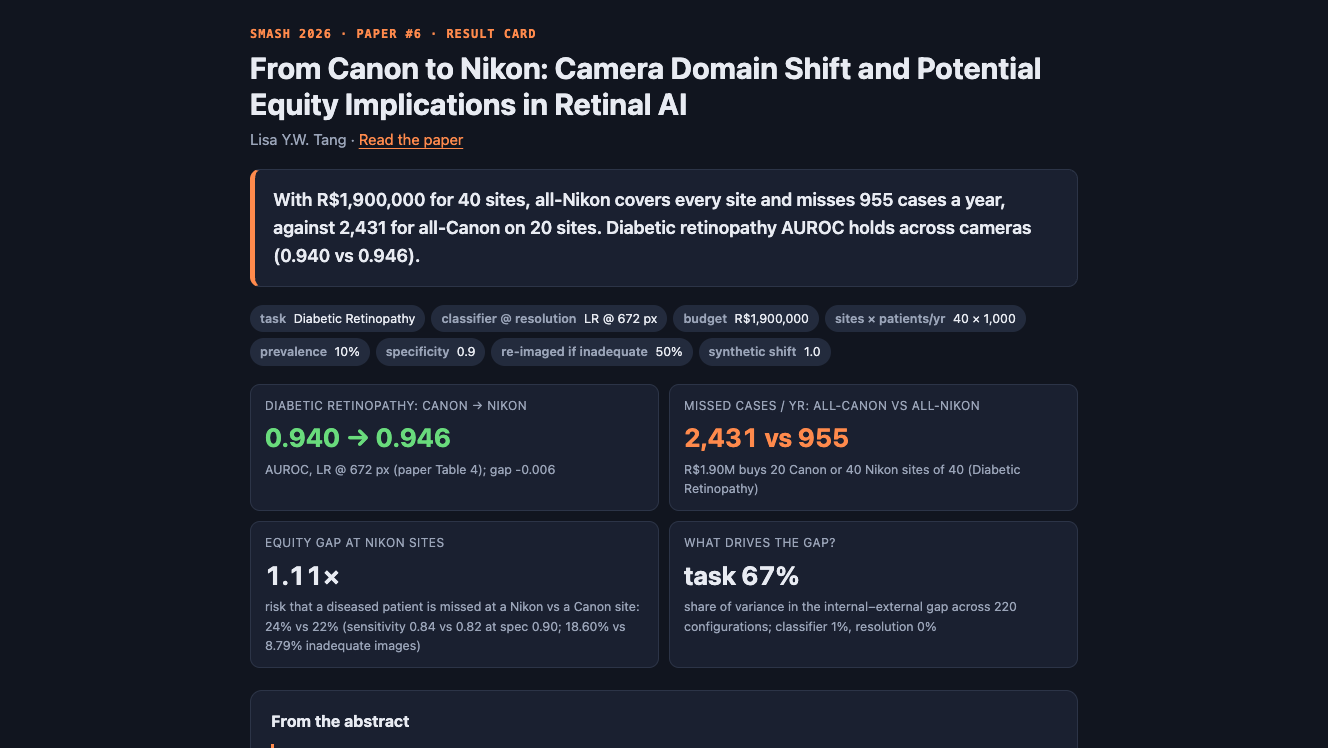
With R$1,900,000 for 40 sites, all-Nikon covers every site and misses 955 cases a year, against 2,431 for all-Canon on 20 sites. Diabetic retinopathy AUROC holds across cameras (0.940 vs 0.946). Model performance is transcribed from the paper's Table 4; the screening calculator is an extension. Camera type is confounded with case mix and site in the source cohort.
Inputs
Acceptance checklist
15/15 checks passed.- Set up the sandbox and parameters
- Extract the tested code
- Run the experiment
- Write the narrative
- Render the result card and summary
- The headline states this run's finding with its numbers, not a description of the method
- Paper numbers are quoted exactly and any disagreement with the paper is stated plainly
- Caveats say what is synthetic, reconstructed or an extension of the paper
- Each try-next suggestion would plausibly give a contrasting result
- Result card, numbers, narrative and summary were written
- Experiment numbers are valid JSON and the experiment stayed within its time budget
- The narrative has a headline, three idea bullets, findings, try-next runs and caveats
- Every try-next suggestion uses only this runbook's parameters
- Every number in the headline appears in the run's results
- The card embeds its figures, shows the headline, and contains no NaN
Runbook
| version | 1.0.0 |
| evaluation | programmatic |
| evals_version | 2 |
| agent | claude-code |
| model | anthropic/claude-haiku-5.5 |
| model_provider | openrouter |
| snapshot | python312-uv |
| primary_outputs | result_card.html |
Canon or Nikon? Camera Shift and Who Gets Missed in Retinal AI Screening (SMASH 2026 · Paper #6)
Objective
This runbook is an interactive companion to the SMASH 2026 paper "From Canon to Nikon: Camera Domain Shift and Potential Equity Implications in Retinal AI" (Lisa Y.W. Tang). Read the paper: https://drive.google.com/file/d/1cEMU7Sho9vz6uA6rD2xq78R9KDpaOwuK/view?usp=sharing
The paper's claims: in the Brazilian BRSET cohort (8,524 patients), a classifier trained on frozen RETFound-Green embeddings of Canon CR-2 images and tested on Nikon NF5050 images loses performance on some retinal tasks and not others. The loss depends far more on the task than on the input resolution or downstream classifier, and Nikon images are more than twice as likely to be inadequate although the Nikon camera costs much less. That is a cost–quality trade-off with equity consequences.
BRSET is credentialed, so this runbook uses the paper's own published numbers: all 240 internal/external cells of Table 4 are transcribed verbatim, along with Table 1's quality rates and the footnoted camera prices. The participant chooses a task, classifier, resolution and a screening program (budget, sites, patients, prevalence, operating point). The run:
- Explorer: compares internal and external performance across all 12 tasks and decomposes the gap's variance into task, classifier and resolution.
- Screening calculator (this runbook's extension): for the budget, compares all-Canon, all-Nikon and the best mix of cameras by referable cases missed per year (unscreened + ungradable + false negatives), and computes the equity gap, meaning how much likelier a diseased patient at a Nikon site is to be missed than one at a Canon site.
- Synthetic mechanism demo: simulated embeddings in which the "Nikon camera" remixes colour/optical features. It shows why tasks whose signal lives in camera-sensitive features break, and why cleaner (higher-resolution) features do not close the gap.
Output: a shareable result card. Target wall-clock: under 4 minutes. The experiment takes about 1 second.
Calculator model (state it on the card)
- A Canon-trained model runs at every site. Canon sites see the internal AUROC and Nikon sites the external AUROC (Table 4).
- Sensitivity at the chosen specificity follows from an equal-variance binormal ROC:
d' = √2·Φ⁻¹(AUROC),sens = Φ(d' − Φ⁻¹(spec)). - Inadequate images (Canon 8.79%, Nikon 18.60%): a fraction
recapture_pctare retaken and graded; the rest are never graded. - Prices: Canon CR-2 R$95,000, Nikon NF5050 R$35,000 (paper footnote 1). Sites without a camera are unscreened.
- The "best mix" is an exhaustive search over the number of Canon and Nikon sites within the budget that minimises missed cases.
Paper headline numbers (quote exactly)
- Inadequate images: Canon CR 8.79%, Nikon NF5050 18.60% (Table 1; Cramér's V 0.142, p < 0.001). Image field 4.76% vs 15.84% (Table 1); the text says "16.5% vs. 4.8%" (OR = 3.95).
- Table 2 (best classifier): DR 0.940 → 0.946, scar 0.964 → 0.955, hemorrhage 0.804 → 0.569, hypertensive retinopathy 0.864 → 0.690, DR staging (QWK) 0.692 → 0.527, AMD 0.976 → 0.909, nevus 0.840 → 0.795.
- Figure 2 caption: hemorrhage and hypertensive retinopathy degrade by "∆ AUROC=0.15–0.28".
- "neither higher input resolution nor classifier choice consistently mitigated cross-camera variation."
- Known inconsistencies in the paper, which the card states: the cost wording ("approximately half as much" in the abstract, "1.5 times more" in the introduction, while R$95,000 vs R$35,000 is 2.71×); image field 15.84% vs 16.5%; illumination Cramér's V 0.028 (table) vs 0.023 (text).
REQUIRED OUTPUT FILES (MANDATORY)
All in {{results_dir}}:
| File | Description |
|---|---|
result_card.html | Primary output. Self-contained, shareable one-page result card |
results.json | All computed numbers (written by experiment.py) |
card_data.json | Numbers/figures for the card (written by experiment.py) |
narrative.json | Your interpretation of this run (Step 4) |
fig_*.png | Figures (written by experiment.py) |
summary.md | 5–10 line plain-text summary |
validation_report.json | Evals v2 report: steps, code checks, checklist (see Write Validation Report) |
Parameters
| Parameter | Template Variable | Default | Description |
|---|---|---|---|
| Task | {{task}} | Diabetic Retinopathy | One of: DR Staging (ICDR), Diabetic Retinopathy, AMD, Hemorrhage, Hypertensive Retinopathy, Increased Cup/Disc, Macular Edema, Myopic Fundus, Nevus, Other, Scar, Vascular Occlusion |
| Classifier | {{classifier}} | best | best (the paper's Table 2 choice for the task) or SVM, LR, HGB, kNN, RF |
| Resolution | {{resolution}} | best | best (Table 2) or 224, 392, 672, 952 px |
| Budget (R$) | {{budget_brl}} | 1900000 | Camera budget for the screening program, in Brazilian reais |
| Sites | {{n_sites}} | 40 | Screening sites that need a camera |
| Patients per site | {{patients_per_site}} | 1000 | Patients screened per site per year |
| Prevalence (%) | {{prevalence_pct}} | 10 | Share of screened patients who have the condition and should be referred |
| Specificity | {{specificity}} | 0.90 | Operating point for the AI referral decision |
| Re-imaged if inadequate (%) | {{recapture_pct}} | 50 | Share of inadequate photos that are retaken and graded |
| Synthetic shift strength | {{shift_strength}} | 1.0 | Camera-shift strength in the synthetic mechanism demo (0 = none, 3 = severe) |
| Seed | {{seed}} | 7 | Random seed (synthetic demo only) |
Dependencies
numpy, scikit-learn and matplotlib (preinstalled in python312-uv). No downloads.
Step 1: Set up
mkdir -p {{results_dir}} /app/work && cd /app/work
python -c "import numpy, sklearn, matplotlib" 2>/dev/null || uv pip install --system -q numpy scikit-learn matplotlib
Write /app/work/params.json. If a value still looks like an unsubstituted {{…}} placeholder, use the table
default. task, classifier and resolution are strings; the rest are numbers. The script clamps out-of-range
numbers itself and lists each clamp in results.json → caveats_from_inputs. Copy those entries into the caveats.
{"task": "{{task}}", "classifier": "{{classifier}}", "resolution": "{{resolution}}", "budget_brl": {{budget_brl}},
 "n_sites": {{n_sites}}, "patients_per_site": {{patients_per_site}}, "prevalence_pct": {{prevalence_pct}},
 "specificity": {{specificity}}, "recapture_pct": {{recapture_pct}}, "shift_strength": {{shift_strength}},
 "seed": {{seed}}, "runbook_url": ""}
Step 2: Get the code (extract it, don't retype it)
The tested implementation, including the transcribed Table 4, is embedded in the Appendix at the end of this runbook. Do not rewrite, "improve", or re-derive it. Always run the command below first, exactly as written. It copies the files out of this runbook's text (which the sandbox exposes to running processes) in about a second, and it is far faster and more reliable than retyping several hundred lines. Do not skip it on the assumption that it won't work: run it and read its output:
cd /app/work && cat > extract.py <<'PYEOF'
"""Extract the runbook's embedded files without retyping them.

The runbook text reaches the agent as one command-line argument, so it is readable from /proc.
Every embedded file sits under a heading "### `/app/work/<name>`" followed by one fenced block.
Exits non-zero if any requested file can't be found, so the caller falls back to writing it by hand.

usage: python3 extract.py <name> [<name> ...]   (writes /app/work/<name>)
"""
import ast, glob, re, sys
from pathlib import Path

want = sys.argv[1:]
cands = []
for p in glob.glob("/proc/[0-9]*/cmdline"):
    try:
        s = Path(p).read_bytes().decode("utf-8", "ignore")
    except OSError:
        continue
    if all(f"### `/app/work/{w}`" in s for w in want):
        cands.append(s)
if not cands:
    sys.exit("runbook text not found in /proc; write the files by hand")
# The agent's own argv holds the raw text; wrapper shells hold a shell-quoted copy, so prefer the shortest
# and undo shell single-quote escaping as a fallback.
best = min(cands, key=len).replace("'\"'\"'", "'")
ok = True
for w in want:
    m = re.search(r"### `/app/work/" + re.escape(w) + r"`\s*\n+```[a-z]*\n(.*?)\n```\n", best, re.S)
    if not m or len(m.group(1)) < 50:
        print(f"MISSING {w}"); ok = False; continue
    code = m.group(1) + "\n"
    if w.endswith(".py"):
        try:
            ast.parse(code)
        except SyntaxError as e:
            print(f"MISSING {w} (extracted text does not parse: {e})"); ok = False; continue
    Path("/app/work", w).write_text(code)
    print(f"extracted {w}: {code.count(chr(10))} lines")
sys.exit(0 if ok else 1)
PYEOF
python3 extract.py experiment.py render_card.py validate.py
If it exits non-zero or prints MISSING, write each missing file from the Appendix exactly as given, one
heredoc per file (quoted delimiter, e.g. cat > experiment.py <<'PYEOF'). If a later step fails, fix only
environment problems (missing package), never the methodology or the transcribed numbers.
Step 3: Run the experiment
cd /app/work && export OMP_NUM_THREADS=4 OPENBLAS_NUM_THREADS=4 MKL_NUM_THREADS=4 SMASH_CPUS=4 && timeout 240 python -W ignore experiment.py params.json {{results_dir}}Expected: about 1 second. It ends with a done: line giving the task's internal → external score, missed cases per year for
all-Canon, all-Nikon and the best mix, the equity ratio, and the most camera-fragile task.
The sandbox has 4 CPUs even though nproc may report more; the exports keep numpy/BLAS and process pools from oversubscribing them.
Step 4: Interpret: write narrative.json
Read {{results_dir}}/results.json and card_data.json, and look at every fig_*.png. Write
{{results_dir}}/narrative.json with keys headline, idea (exactly 3), findings (2–4), try_next (2–3),
caveats (2–4):
- headline (≤ 30 words): a finding for this participant's budget and task, with 1–2 numbers copied from
results.json. Examples: missed cases per year under all-Nikon vs all-Canon (calculator.programs.*.missed, rounded to integers), or the equity ratio (calculator.equity_miss_ratio) for a fragile task. Not a method description. - idea: (1) the same model trained on one camera and tested on another; (2) the damage is task-specific; (3) resolution or classifier changes do not fix it, so programs must evaluate per camera.
- findings: (1) the chosen task's internal → external score (
selected) and where it ranks among the 12 tasks (per_task,most_fragile_task); (2) variance shares (gap_variance_share) and the resolution check (resolution_952_vs_224_shrinks_gap/widens_gapcounts out of 11); (3) the program comparison at this budget (calculator.programs: sites covered, missed, inadequate images;best_mixcomposition; CI range fromprograms_ci_low/high); (4) whether the answer flips across tasks (tasks_where_all_nikon_misses_fewer,all_tasks_calculator). Every number must come fromresults.json. Do not round 0.940 to 0.94 in one place and leave it unrounded elsewhere. - try_next: 2–3 contrasting runs with exact values, using only the keys
task, classifier, resolution, budget_brl, n_sites, patients_per_site, prevalence_pct, specificity, recapture_pct, shift_strength, seed. Good contrasts: a fragile task (HemorrhageorHypertensive Retinopathy); a large budget (budget_brl≥ 3800000, where all-Canon covers every site);recapture_pct0; a different classifier (kNN) for DR staging. - caveats: the numbers are transcribed from the paper, not recomputed, and no images were used; the calculator is this runbook's
extension, with its stated assumptions; camera and image quality are confounded and the case mix differs between cohorts; the paper's
internal inconsistencies. Add any
caveats_from_inputs.
Step 5: Render the card and summary
cd /app/work && python render_card.py {{results_dir}}/card_data.json {{results_dir}}/narrative.json {{results_dir}}/result_card.htmlWrite {{results_dir}}/summary.md (5–10 lines: settings, the task's score change, the three programs' missed cases, the equity ratio, the headline).
Writing style for narrative.json
These rules apply to every field and override any longer limits stated earlier in this runbook. Let the paper and the numbers speak; the card is not the place for commentary.
- Length:
headlineone sentence;idea1–3 bullets of at most 30 words;findings1–2 paragraphs of at most 60 words each;caveats1–2 bullets of at most 20 words. Cut anything the tiles, figures or tables already show. - Plain statements of what was measured. Write "Sensitivity gap −0.284 [−0.354, −0.218]; the paper reports +0.088", not an interpretation of what it means for the field.
- Avoid: em-dash asides; "not X, but Y" framings; colon-then-reveal sentences; rhetorical questions; words such as crucially, notably, strikingly, remarkably, collapses, illustrating, underscores, highlights, delve, powerful, key insight, worth noting; exclamation marks; restating the method before the result.
- Use the paper's own terms for its concepts. Quote the paper's numbers exactly.
Code Checks
Jetty runs these checks itself in the sandbox after the agent finishes, so they cannot be skipped or
misreported. validate.py (see Write Validation Report) runs the same checks first so you can fix problems before you stop.
outputs-exist — Result card, numbers, narrative and summary were written
cd {{results_dir}} && for f in result_card.html results.json card_data.json narrative.json summary.md; do test -s "$f" || { echo "missing or empty: $f"; exit 1; }; done; echo "all 5 outputs present"results-valid — Experiment numbers are valid JSON and the experiment stayed within its time budget
python3 - "{{results_dir}}" 120 <<'PY'
import json, sys
from pathlib import Path
R, budget = Path(sys.argv[1]), float(sys.argv[2])
res = json.loads((R / "results.json").read_text())
json.loads((R / "card_data.json").read_text())
rt = float(res.get("runtime_sec", 0))
if rt > budget:
    sys.exit(f"experiment took {rt}s, budget {budget}s")
print(f"results.json and card_data.json parse; experiment {rt}s within {budget:.0f}s")
PY
narrative-complete — The narrative is complete and within the length limits
python3 - "{{results_dir}}" <<'PY'
import json, sys
from pathlib import Path
n = json.loads((Path(sys.argv[1]) / "narrative.json").read_text())
problems = []
if not str(n.get("headline", "")).strip(): problems.append("no headline")
if len(str(n.get("headline", "")).split()) > 45: problems.append("headline over 45 words")
if not 1 <= len(n.get("idea", [])) <= 3: problems.append(f"idea has {len(n.get('idea', []))} bullets, need 1-3")
if not 1 <= len(n.get("findings", [])) <= 2: problems.append(f"{len(n.get('findings', []))} findings, need 1-2")
if any(len(f.split()) > 70 for f in n.get("findings", [])): problems.append("a findings paragraph is over 60 words")
if not 2 <= len(n.get("try_next", [])) <= 3: problems.append(f"{len(n.get('try_next', []))} try_next, need 2-3")
if not 1 <= len(n.get("caveats", [])) <= 2: problems.append(f"{len(n.get('caveats', []))} caveats, need 1-2")
if problems: sys.exit("; ".join(problems))
print("headline, %d idea bullets, %d findings, %d try_next, %d caveats" % (len(n["idea"]), len(n["findings"]), len(n["try_next"]), len(n["caveats"])))
PY
try-next-valid — Every try-next suggestion uses only this runbook's parameters
python3 - "{{results_dir}}" "task,classifier,resolution,budget_brl,n_sites,patients_per_site,prevalence_pct,specificity,recapture_pct,shift_strength,seed" <<'PY'
import json, sys
from pathlib import Path
allowed = set(sys.argv[2].split(","))
n = json.loads((Path(sys.argv[1]) / "narrative.json").read_text())
bad = sorted({k for t in n.get("try_next", []) for k in (t.get("params") or {}) if k not in allowed})
empty = [t.get("label", "?") for t in n.get("try_next", []) if not t.get("params")]
if bad or empty: sys.exit(f"unknown parameters: {bad}; suggestions without params: {empty}")
print("all try_next parameters are declared runbook parameters")
PY
headline-grounded — Every number in the headline appears in the run's results
python3 - "{{results_dir}}" <<'PY'
import json, re, sys
from pathlib import Path
R = Path(sys.argv[1])
blob = (R / "results.json").read_text() + (R / "card_data.json").read_text()
vals = [float(x) for x in re.findall(r"-?\d+(?:\.\d+)?(?:[eE]-?\d+)?", blob)]
head = json.loads((R / "narrative.json").read_text())["headline"]
nums = re.findall(r"(?<![\w.−-])[−-]?\d[\d,]*(?:\.\d+)?(?![\w-])", head)
missing = []
for n in nums:
    s = n.replace("−", "-").replace(",", ""); v = float(s); dec = len(s.split(".")[1]) if "." in s else 0
    tol = 0.5 * 10 ** (-dec) + 1e-9
    if not any(abs(abs(x) - abs(v)) <= tol or abs(abs(x * 100) - abs(v)) <= max(tol, 0.5) for x in vals):
        missing.append(n)
if missing: sys.exit(f"headline numbers not found in results: {missing}")
print(f"{len(nums)} headline number(s) all grounded in results")
PY
card-integrity — The card embeds its figures, shows the headline, and contains no NaN
python3 - "{{results_dir}}" <<'PY'
import html, json, re, sys
from pathlib import Path
R = Path(sys.argv[1])
card = (R / "result_card.html").read_text()
text = re.sub(r"data:image/[a-z]+;base64,[A-Za-z0-9+/=]+", "", card)
head = json.loads((R / "narrative.json").read_text())["headline"]
problems = []
if card.count("data:image/png;base64") < 1: problems.append("no embedded figures")
if re.search(r"\bNaN\b|\bnan%|\bInfinity\b", text): problems.append("NaN/Infinity in card text")
if len(card) > 5_000_000: problems.append(f"card is {len(card) // 1024} KB")
plain = html.unescape(re.sub(r"<[^>]+>", "", text))
if re.sub(r"[*`]", "", head)[:40] not in plain: problems.append("headline not on card")
if problems: sys.exit("; ".join(problems))
print(f"card {len(card) // 1024} KB, {card.count('data:image/png;base64')} figures, headline present")
PY
Checklist
- The headline states this run's finding with its numbers, not a description of the method
- Paper numbers are quoted exactly and any disagreement with the paper is stated plainly
- Caveats say what is synthetic, reconstructed or an extension of the paper
- Each try-next suggestion would plausibly give a contrasting result
Write Validation Report
Judge the four Checklist items honestly against your outputs and write them to /app/work/checklist.json as a
list, using the checklist ids Jetty gives you (one entry per item):
[{"id": "<checklist id>", "status": "pass", "message": "one line on why"}]Then write the report and self-check in one command:
cd /app/work && python3 validate.py {{results_dir}} task,classifier,resolution,budget_brl,n_sites,patients_per_site,prevalence_pct,specificity,recapture_pct,shift_strength,seed 120 checklist.jsonvalidate.py writes {{results_dir}}/validation_report.json in the v2 shape Jetty reads (version: 2, one
step entry per runbook step, one code_check entry per check above, one checklist entry per item). Jetty
replaces the code_check entries with its own independent run of the same checks. Do not write the report by hand.
Iteration (up to 2 rounds)
If validate.py prints any FAIL, fix the named problem (usually a headline number that does not match
results.json, or an unknown try_next key), re-render the card (Step 5) and rerun the command above. Never
rerun the experiment just to change the narrative.
Appendix: code
These files are extracted verbatim in Step 2.
/app/work/experiment.py
"""Canon -> Nikon camera-shift explorer and screening-program calculator — SMASH 2026 paper #6 (Lisa Y.W. Tang).

The paper's raw data (BRSET) is credentialed, so this runbook works from the paper's OWN published numbers:
  1. Table 4 (transcribed verbatim: 12 tasks x 5 classifiers x 4 resolutions, internal Canon test vs external
     Nikon cohort, with 95% bootstrap CIs) -> which tasks are camera-fragile, and does resolution/classifier help?
  2. Table 1 image-quality rates + the paper's camera prices -> a screening-program calculator: for a budget,
     number of sites and a task, compare all-Canon, all-Nikon and mixed programs (coverage, ungradable images,
     detected and missed referrals, equity gap between Canon and Nikon sites).
  3. A synthetic domain-shift demo (simulated embeddings, NOT RETFound-Green) showing why tasks whose signal
     lives in camera-sensitive features degrade, and why higher resolution does not close the gap.

usage: python experiment.py params.json outdir
"""
import json, sys, time
from pathlib import Path
from statistics import NormalDist

import numpy as np
import matplotlib
matplotlib.use("Agg")
import matplotlib.pyplot as plt
from sklearn.linear_model import LogisticRegression
from sklearn.metrics import roc_auc_score

T0 = time.time()
P = json.loads(Path(sys.argv[1]).read_text())
OUT = Path(sys.argv[2]); OUT.mkdir(parents=True, exist_ok=True)
ND = NormalDist()


def log(m):
    print(f"[{time.time() - T0:6.1f}s] {m}", flush=True)


# ------------------------------------------------------------------ the paper's numbers (verbatim)
# Table 4: Task|Alg|  per resolution 224 ; 392 ; 672 ; 952:  internal lo hi external lo hi
# (QWK for DR Staging, AUROC otherwise). "0.65674" is printed that way in the paper.
TABLE4 = """
DR Staging (ICDR)|SVM|0.611 0.508 0.682 0.669 0.619 0.728 ; 0.635 0.549 0.725 0.705 0.657 0.752 ; 0.662 0.581 0.739 0.716 0.671 0.760 ; 0.538 0.452 0.635 0.657 0.610 0.701
DR Staging (ICDR)|LR|0.579 0.524 0.629 0.601 0.551 0.652 ; 0.65674 0.606 0.699 0.579 0.538 0.632 ; 0.637 0.580 0.699 0.503 0.469 0.550 ; 0.587 0.523 0.656 0.549 0.513 0.596
DR Staging (ICDR)|HGB|0.642 0.549 0.715 0.580 0.525 0.634 ; 0.692 0.615 0.765 0.527 0.478 0.577 ; 0.574 0.499 0.672 0.350 0.284 0.410 ; 0.516 0.415 0.607 0.292 0.207 0.359
DR Staging (ICDR)|kNN|0.487 0.390 0.590 0.276 0.215 0.353 ; 0.469 0.372 0.584 0.229 0.166 0.291 ; 0.329 0.216 0.443 0.130 0.076 0.195 ; 0.296 0.179 0.407 0.112 0.061 0.164
DR Staging (ICDR)|RF|0.301 0.192 0.409 0.065 0.026 0.107 ; 0.262 0.165 0.386 0.074 0.031 0.116 ; 0.203 0.087 0.310 0.018 -0.001 0.043 ; 0.142 0.051 0.250 0.019 0.000 0.044
Diabetic Retinopathy|SVM|0.887 0.847 0.915 0.893 0.872 0.911 ; 0.933 0.905 0.954 0.930 0.915 0.946 ; 0.934 0.906 0.958 0.936 0.918 0.949 ; 0.935 0.910 0.953 0.912 0.893 0.926
Diabetic Retinopathy|LR|0.893 0.859 0.922 0.906 0.886 0.924 ; 0.933 0.907 0.956 0.940 0.926 0.954 ; 0.940 0.916 0.963 0.946 0.932 0.957 ; 0.938 0.912 0.957 0.930 0.914 0.943
Diabetic Retinopathy|HGB|0.900 0.869 0.926 0.897 0.878 0.919 ; 0.926 0.903 0.948 0.933 0.915 0.948 ; 0.919 0.890 0.941 0.924 0.907 0.941 ; 0.911 0.890 0.932 0.907 0.893 0.924
Diabetic Retinopathy|kNN|0.817 0.778 0.853 0.796 0.763 0.821 ; 0.837 0.800 0.871 0.829 0.802 0.856 ; 0.808 0.765 0.853 0.794 0.767 0.822 ; 0.770 0.723 0.815 0.770 0.745 0.795
Diabetic Retinopathy|RF|0.894 0.864 0.918 0.891 0.871 0.911 ; 0.913 0.883 0.939 0.931 0.917 0.945 ; 0.908 0.886 0.936 0.927 0.912 0.941 ; 0.889 0.863 0.914 0.893 0.877 0.908
AMD|SVM|0.925 0.887 0.959 0.906 0.870 0.941 ; 0.948 0.912 0.973 0.888 0.844 0.928 ; 0.971 0.958 0.984 0.889 0.842 0.932 ; 0.965 0.936 0.985 0.890 0.829 0.935
AMD|LR|0.941 0.910 0.968 0.907 0.873 0.937 ; 0.962 0.939 0.979 0.901 0.865 0.941 ; 0.975 0.958 0.989 0.915 0.873 0.951 ; 0.976 0.961 0.987 0.909 0.857 0.948
AMD|HGB|0.958 0.939 0.973 0.821 0.751 0.870 ; 0.960 0.938 0.978 0.839 0.779 0.883 ; 0.972 0.956 0.984 0.819 0.768 0.875 ; 0.967 0.949 0.982 0.831 0.772 0.891
AMD|kNN|0.794 0.719 0.847 0.671 0.614 0.725 ; 0.857 0.786 0.905 0.741 0.682 0.806 ; 0.899 0.851 0.946 0.704 0.638 0.762 ; 0.849 0.802 0.899 0.737 0.672 0.795
AMD|RF|0.943 0.916 0.962 0.790 0.711 0.855 ; 0.954 0.930 0.974 0.829 0.761 0.877 ; 0.958 0.933 0.980 0.813 0.744 0.866 ; 0.958 0.938 0.973 0.804 0.715 0.865
Hemorrhage|SVM|0.782 0.619 0.888 0.586 0.454 0.710 ; 0.709 0.559 0.797 0.568 0.453 0.700 ; 0.779 0.657 0.867 0.555 0.432 0.685 ; 0.705 0.560 0.808 0.572 0.470 0.697
Hemorrhage|LR|0.794 0.619 0.906 0.601 0.478 0.733 ; 0.754 0.599 0.840 0.580 0.456 0.707 ; 0.804 0.670 0.891 0.569 0.451 0.716 ; 0.728 0.565 0.841 0.594 0.491 0.723
Hemorrhage|HGB|0.705 0.506 0.824 0.682 0.552 0.784 ; 0.757 0.537 0.887 0.610 0.511 0.738 ; 0.738 0.584 0.884 0.676 0.579 0.794 ; 0.701 0.485 0.864 0.674 0.540 0.775
Hemorrhage|kNN|0.622 0.519 0.733 0.551 0.480 0.624 ; 0.596 0.478 0.694 0.583 0.499 0.665 ; 0.500 0.463 0.550 0.534 0.478 0.612 ; 0.533 0.469 0.620 0.569 0.502 0.648
Hemorrhage|RF|0.785 0.621 0.907 0.749 0.670 0.806 ; 0.785 0.593 0.907 0.727 0.630 0.823 ; 0.725 0.516 0.884 0.696 0.558 0.824 ; 0.707 0.560 0.848 0.746 0.627 0.846
Hypertensive Retinopathy|SVM|0.703 0.597 0.805 0.530 0.470 0.579 ; 0.793 0.719 0.877 0.523 0.462 0.567 ; 0.776 0.682 0.857 0.567 0.507 0.618 ; 0.776 0.688 0.864 0.532 0.478 0.586
Hypertensive Retinopathy|LR|0.734 0.645 0.836 0.568 0.511 0.621 ; 0.840 0.774 0.914 0.564 0.502 0.609 ; 0.822 0.739 0.901 0.599 0.546 0.648 ; 0.803 0.721 0.879 0.552 0.494 0.601
Hypertensive Retinopathy|HGB|0.818 0.747 0.889 0.664 0.625 0.708 ; 0.826 0.741 0.891 0.663 0.601 0.710 ; 0.799 0.723 0.856 0.673 0.617 0.715 ; 0.761 0.696 0.832 0.634 0.586 0.698
Hypertensive Retinopathy|kNN|0.646 0.575 0.732 0.547 0.503 0.607 ; 0.673 0.607 0.762 0.568 0.530 0.607 ; 0.616 0.554 0.698 0.517 0.466 0.567 ; 0.617 0.545 0.710 0.502 0.462 0.551
Hypertensive Retinopathy|RF|0.797 0.694 0.870 0.690 0.629 0.753 ; 0.864 0.809 0.909 0.690 0.635 0.745 ; 0.820 0.731 0.875 0.622 0.579 0.672 ; 0.794 0.725 0.848 0.628 0.587 0.679
Increased Cup/Disc|SVM|0.853 0.836 0.869 0.829 0.817 0.841 ; 0.871 0.855 0.888 0.850 0.836 0.863 ; 0.865 0.848 0.879 0.844 0.827 0.855 ; 0.859 0.838 0.872 0.843 0.829 0.855
Increased Cup/Disc|LR|0.854 0.838 0.872 0.839 0.828 0.850 ; 0.870 0.854 0.887 0.856 0.843 0.869 ; 0.868 0.851 0.882 0.852 0.837 0.864 ; 0.862 0.841 0.874 0.846 0.831 0.857
Increased Cup/Disc|HGB|0.804 0.781 0.823 0.749 0.730 0.767 ; 0.813 0.790 0.830 0.793 0.777 0.807 ; 0.818 0.800 0.835 0.783 0.766 0.799 ; 0.819 0.799 0.836 0.781 0.762 0.795
Increased Cup/Disc|kNN|0.737 0.710 0.760 0.683 0.662 0.703 ; 0.729 0.700 0.751 0.699 0.676 0.714 ; 0.735 0.715 0.758 0.678 0.658 0.695 ; 0.719 0.694 0.739 0.664 0.642 0.684
Increased Cup/Disc|RF|0.782 0.759 0.801 0.746 0.730 0.766 ; 0.790 0.773 0.808 0.784 0.767 0.801 ; 0.793 0.771 0.808 0.782 0.765 0.798 ; 0.792 0.771 0.808 0.783 0.767 0.798
Macular Edema|SVM|0.881 0.820 0.949 0.961 0.941 0.978 ; 0.897 0.815 0.969 0.984 0.975 0.991 ; 0.916 0.856 0.973 0.983 0.976 0.989 ; 0.917 0.867 0.970 0.979 0.965 0.989
Macular Edema|LR|0.906 0.853 0.962 0.968 0.948 0.985 ; 0.913 0.839 0.974 0.987 0.980 0.994 ; 0.927 0.875 0.978 0.990 0.986 0.993 ; 0.928 0.883 0.977 0.982 0.970 0.992
Macular Edema|HGB|0.946 0.919 0.969 0.946 0.929 0.959 ; 0.934 0.895 0.971 0.965 0.951 0.978 ; 0.945 0.909 0.976 0.962 0.949 0.974 ; 0.939 0.911 0.966 0.963 0.953 0.974
Macular Edema|kNN|0.809 0.724 0.878 0.851 0.816 0.888 ; 0.844 0.781 0.893 0.901 0.871 0.936 ; 0.765 0.678 0.847 0.842 0.808 0.892 ; 0.750 0.671 0.814 0.786 0.752 0.840
Macular Edema|RF|0.942 0.917 0.964 0.936 0.916 0.959 ; 0.952 0.928 0.975 0.952 0.931 0.965 ; 0.948 0.920 0.970 0.954 0.936 0.969 ; 0.926 0.889 0.955 0.954 0.935 0.969
Myopic Fundus|SVM|0.960 0.923 0.986 0.975 0.965 0.983 ; 0.974 0.953 0.991 0.978 0.966 0.989 ; 0.990 0.984 0.994 0.972 0.959 0.986 ; 0.991 0.986 0.994 0.975 0.963 0.984
Myopic Fundus|LR|0.970 0.944 0.990 0.985 0.979 0.991 ; 0.981 0.965 0.992 0.983 0.972 0.991 ; 0.989 0.983 0.994 0.978 0.958 0.992 ; 0.989 0.984 0.993 0.977 0.968 0.989
Myopic Fundus|HGB|0.981 0.970 0.991 0.965 0.942 0.986 ; 0.986 0.978 0.993 0.990 0.984 0.994 ; 0.982 0.973 0.989 0.975 0.955 0.989 ; 0.983 0.971 0.990 0.972 0.952 0.989
Myopic Fundus|kNN|0.905 0.838 0.960 0.878 0.835 0.925 ; 0.890 0.826 0.955 0.864 0.817 0.927 ; 0.892 0.827 0.951 0.882 0.841 0.924 ; 0.892 0.827 0.950 0.835 0.782 0.888
Myopic Fundus|RF|0.980 0.971 0.990 0.975 0.955 0.991 ; 0.983 0.975 0.991 0.989 0.982 0.994 ; 0.983 0.975 0.991 0.986 0.979 0.993 ; 0.981 0.972 0.989 0.981 0.969 0.990
Nevus|SVM|0.721 0.614 0.854 0.724 0.632 0.815 ; 0.685 0.578 0.803 0.751 0.654 0.839 ; 0.822 0.749 0.878 0.771 0.682 0.861 ; 0.830 0.712 0.893 0.795 0.710 0.885
Nevus|LR|0.724 0.610 0.847 0.738 0.659 0.831 ; 0.708 0.601 0.827 0.754 0.662 0.842 ; 0.832 0.772 0.894 0.775 0.692 0.858 ; 0.840 0.729 0.903 0.795 0.711 0.886
Nevus|HGB|0.521 0.380 0.643 0.617 0.517 0.703 ; 0.582 0.435 0.694 0.683 0.582 0.781 ; 0.607 0.503 0.731 0.666 0.570 0.746 ; 0.526 0.364 0.646 0.591 0.490 0.687
Nevus|kNN|0.553 0.480 0.658 0.520 0.461 0.593 ; 0.473 0.424 0.549 0.538 0.469 0.605 ; 0.514 0.456 0.602 0.546 0.477 0.607 ; 0.490 0.439 0.562 0.593 0.508 0.671
Nevus|RF|0.548 0.396 0.659 0.610 0.493 0.720 ; 0.493 0.387 0.592 0.644 0.544 0.740 ; 0.563 0.423 0.670 0.634 0.529 0.725 ; 0.539 0.401 0.647 0.548 0.451 0.650
Other|SVM|0.808 0.770 0.842 0.695 0.659 0.732 ; 0.789 0.725 0.828 0.720 0.692 0.750 ; 0.796 0.748 0.832 0.695 0.663 0.731 ; 0.808 0.757 0.840 0.712 0.680 0.747
Other|LR|0.822 0.785 0.852 0.729 0.694 0.762 ; 0.804 0.750 0.845 0.749 0.721 0.781 ; 0.812 0.768 0.847 0.727 0.698 0.758 ; 0.828 0.784 0.858 0.740 0.708 0.774
Other|HGB|0.796 0.753 0.827 0.697 0.669 0.724 ; 0.785 0.751 0.819 0.722 0.700 0.745 ; 0.797 0.766 0.832 0.736 0.706 0.768 ; 0.803 0.767 0.832 0.732 0.706 0.765
Other|kNN|0.673 0.620 0.720 0.595 0.564 0.630 ; 0.671 0.623 0.716 0.625 0.599 0.657 ; 0.660 0.606 0.703 0.614 0.581 0.641 ; 0.615 0.563 0.670 0.606 0.577 0.636
Other|RF|0.790 0.750 0.824 0.732 0.700 0.761 ; 0.789 0.759 0.822 0.735 0.709 0.761 ; 0.782 0.745 0.816 0.746 0.722 0.778 ; 0.798 0.761 0.826 0.749 0.718 0.780
Scar|SVM|0.927 0.849 0.979 0.961 0.943 0.976 ; 0.948 0.895 0.977 0.947 0.916 0.973 ; 0.955 0.920 0.977 0.943 0.908 0.969 ; 0.942 0.892 0.973 0.953 0.924 0.976
Scar|LR|0.945 0.887 0.989 0.958 0.937 0.979 ; 0.964 0.926 0.986 0.955 0.923 0.977 ; 0.959 0.915 0.982 0.957 0.925 0.977 ; 0.952 0.910 0.982 0.957 0.934 0.978
Scar|HGB|0.925 0.861 0.974 0.938 0.911 0.961 ; 0.927 0.838 0.971 0.910 0.867 0.939 ; 0.928 0.876 0.963 0.930 0.892 0.956 ; 0.925 0.837 0.974 0.930 0.892 0.960
Scar|kNN|0.769 0.675 0.857 0.815 0.767 0.863 ; 0.781 0.683 0.864 0.816 0.759 0.854 ; 0.754 0.677 0.841 0.781 0.731 0.827 ; 0.737 0.661 0.820 0.768 0.718 0.822
Scar|RF|0.921 0.854 0.963 0.920 0.892 0.948 ; 0.923 0.833 0.968 0.897 0.844 0.932 ; 0.919 0.827 0.969 0.917 0.869 0.945 ; 0.920 0.843 0.967 0.928 0.888 0.957
Vascular Occlusion|SVM|0.913 0.834 0.968 0.935 0.889 0.978 ; 0.929 0.865 0.968 0.919 0.831 0.985 ; 0.913 0.824 0.975 0.932 0.870 0.982 ; 0.872 0.773 0.946 0.921 0.861 0.973
Vascular Occlusion|LR|0.923 0.853 0.967 0.943 0.906 0.980 ; 0.950 0.904 0.978 0.930 0.857 0.988 ; 0.917 0.833 0.970 0.943 0.886 0.985 ; 0.894 0.809 0.955 0.934 0.877 0.978
Vascular Occlusion|HGB|0.938 0.892 0.973 0.814 0.716 0.937 ; 0.949 0.914 0.990 0.878 0.800 0.960 ; 0.902 0.824 0.970 0.784 0.665 0.897 ; 0.794 0.653 0.907 0.791 0.693 0.902
Vascular Occlusion|kNN|0.833 0.714 0.934 0.778 0.679 0.906 ; 0.831 0.722 0.932 0.769 0.647 0.891 ; 0.808 0.683 0.906 0.732 0.645 0.820 ; 0.740 0.607 0.849 0.769 0.665 0.878
Vascular Occlusion|RF|0.941 0.863 0.990 0.902 0.826 0.966 ; 0.954 0.913 0.992 0.906 0.835 0.971 ; 0.920 0.840 0.987 0.934 0.887 0.973 ; 0.930 0.862 0.977 0.868 0.767 0.941
"""
TASKS = ["DR Staging (ICDR)", "Diabetic Retinopathy", "AMD", "Hemorrhage", "Hypertensive Retinopathy",
         "Increased Cup/Disc", "Macular Edema", "Myopic Fundus", "Nevus", "Other", "Scar", "Vascular Occlusion"]
ALGS, RES = ["SVM", "LR", "HGB", "kNN", "RF"], [224, 392, 672, 952]
T4 = {}
for line in TABLE4.strip().splitlines():
    tk, alg, cells = line.split("|")
    for r, c in zip(RES, cells.split(";")):
        v = [float(x) for x in c.split()]
        T4[(tk, alg, r)] = {"internal": v[0], "int_ci": v[1:3], "external": v[3], "ext_ci": v[4:6]}
assert len(T4) == 240
# Table 2: best classifier/resolution per task (selected by the authors on internal validation data)
TABLE2 = {"DR Staging (ICDR)": ("HGB", 392), "Scar": ("LR", 392), "Diabetic Retinopathy": ("LR", 672),
          "Hemorrhage": ("LR", 672), "AMD": ("LR", 952), "Nevus": ("LR", 952), "Other": ("LR", 952),
          "Hypertensive Retinopathy": ("RF", 392), "Macular Edema": ("RF", 392), "Vascular Occlusion": ("RF", 392),
          "Increased Cup/Disc": ("SVM", 392), "Myopic Fundus": ("SVM", 952)}
# Table 1 (image quality) and footnote 1 (refurbished prices)
INADEQ = {"Canon": 0.0879, "Nikon": 0.1860}
PRICE = {"Canon": 95000, "Nikon": 35000}
BINARY = [t for t in TASKS if t != "DR Staging (ICDR)"]


def pick(val, options, default):
    s = str(val).strip().lower()
    if not s or s.startswith("{{"):
        return default, False
    for o in options:
        if s == str(o).lower():
            return o, True
    for o in options:
        if s in str(o).lower() or str(o).lower().split()[0] in s:
            return o, True
    return default, False


ALIAS = {"dr": "Diabetic Retinopathy", "hr": "Hypertensive Retinopathy", "hypertensive": "Hypertensive Retinopathy",
         "cup": "Increased Cup/Disc", "glaucoma": "Increased Cup/Disc", "edema": "Macular Edema", "dme": "Macular Edema",
         "myopia": "Myopic Fundus", "rvo": "Vascular Occlusion", "occlusion": "Vascular Occlusion",
         "haemorrhage": "Hemorrhage", "staging": "DR Staging (ICDR)", "icdr": "DR Staging (ICDR)"}
caveats = []
traw = str(P.get("task", "Diabetic Retinopathy")).strip()
TASK = ALIAS.get(traw.lower()) or pick(traw, TASKS, None)[0]
if TASK is None:
    caveats.append(f"task '{traw}' not recognised; used Diabetic Retinopathy"); TASK = "Diabetic Retinopathy"
ALG, ok = pick(P.get("classifier", "best"), ALGS, TABLE2[TASK][0])
RESO = TABLE2[TASK][1]
try:
    rv = int(float(str(P.get("resolution", "best"))))
    RESO = rv if rv in RES else RESO
    if rv not in RES:
        caveats.append(f"resolution {rv} not in {RES}; used {RESO}")
except ValueError:
    pass
CONFIG_IS_TABLE2 = (ALG, RESO) == TABLE2[TASK]


def num(k, d, lo, hi):
    try:
        v = float(P.get(k, d))
    except (TypeError, ValueError):
        v = d
    if not lo <= v <= hi:
        caveats.append(f"{k}={v} clamped to [{lo}, {hi}]"); v = min(max(v, lo), hi)
    return v


BUDGET = num("budget_brl", 1900000, 35000, 100_000_000)
NSITES = int(num("n_sites", 40, 1, 500))
PPS = int(num("patients_per_site", 1000, 10, 100000))
PREV = num("prevalence_pct", 10, 0.1, 60) / 100
SPEC = num("specificity", 0.90, 0.5, 0.995)
RECAP = num("recapture_pct", 50, 0, 100) / 100
SHIFT = num("shift_strength", 1.0, 0, 3)
SEED = int(num("seed", 7, 0, 10**6))
CALC_TASK = TASK if TASK in BINARY else "Diabetic Retinopathy"
if TASK not in BINARY:
    caveats.append("DR Staging is scored with QWK, not AUROC; the screening calculator uses the binary "
                   "Diabetic Retinopathy task instead")
cell = T4[(TASK, ALG, RESO)]
ccell = T4[(CALC_TASK, ALG, RESO)]
log(f"task {TASK} | {ALG} @ {RESO}px: internal {cell['internal']:.3f} -> external {cell['external']:.3f}"
    f" ({'Table 2 selection' if CONFIG_IS_TABLE2 else 'custom configuration'})")

# ------------------------------------------------------------------ 1. explorer over the paper's Table 4
delta = {k: v["internal"] - v["external"] for k, v in T4.items()}
per_task = []
for t in TASKS:
    a, r = (ALG, RESO)
    v = T4[(t, a, r)]; v2 = T4[(t,) + TABLE2[t]]
    ds = [delta[(t, al, re)] for al in ALGS for re in RES]
    per_task.append({"task": t, "metric": "QWK" if t not in BINARY else "AUROC",
                     "internal": v["internal"], "external": v["external"], "delta": v["internal"] - v["external"],
                     "ci_overlap": not (v["ext_ci"][1] < v["int_ci"][0] or v["int_ci"][1] < v["ext_ci"][0]),
                     "table2": {"alg": TABLE2[t][0], "res": TABLE2[t][1], "internal": v2["internal"], "external": v2["external"]},
                     "delta_min": min(ds), "delta_max": max(ds), "delta_mean": float(np.mean(ds))})
fragile = sorted([p for p in per_task if p["task"] in BINARY], key=lambda p: -p["delta"])

# variance decomposition of the internal-external gap (11 binary tasks x 5 classifiers x 4 resolutions)
D = np.array([[[delta[(t, a, r)] for r in RES] for a in ALGS] for t in BINARY])
gm = D.mean()
ss = {"task": D.shape[1] * D.shape[2] * ((D.mean((1, 2)) - gm) ** 2).sum(),
      "classifier": D.shape[0] * D.shape[2] * ((D.mean((0, 2)) - gm) ** 2).sum(),
      "resolution": D.shape[0] * D.shape[1] * ((D.mean((0, 1)) - gm) ** 2).sum()}
ss_tot = ((D - gm) ** 2).sum(); ss["interactions/other"] = ss_tot - sum(ss.values())
var_share = {k: float(v / ss_tot) for k, v in ss.items()}
# does going from 224 to 952 px shrink the gap for the Table-2 classifier?
res_helps = [t for t in BINARY if delta[(t, TABLE2[t][0], 952)] < delta[(t, TABLE2[t][0], 224)] - 0.01]
res_hurts = [t for t in BINARY if delta[(t, TABLE2[t][0], 952)] > delta[(t, TABLE2[t][0], 224)] + 0.01]
# is there a classifier that removes the gap? best-case gap per task over all 20 configurations
best_case = {t: min(delta[(t, a, r)] for a in ALGS for r in RES) for t in BINARY}
lr_range = {t: [min(delta[(t, "LR", r)] for r in RES), max(delta[(t, "LR", r)] for r in RES)]
            for t in ["Hemorrhage", "Hypertensive Retinopathy"]}
log(f"variance of internal-external gap: task {var_share['task']:.0%}, classifier {var_share['classifier']:.0%}, "
    f"resolution {var_share['resolution']:.0%}")

# ------------------------------------------------------------------ 2. screening-program calculator


def sens_at(auc, spec):
    """Equal-variance binormal ROC: d' = sqrt(2) * z(AUC); sensitivity at a fixed specificity."""
    auc = min(max(auc, 0.5001), 0.9999)
    return ND.cdf(np.sqrt(2) * ND.inv_cdf(auc) - ND.inv_cdf(spec))


def site_rates(cam, auc):
    """Per screened patient: graded fraction, detection prob among diseased, false referrals."""
    g = 1 - INADEQ[cam] * (1 - RECAP)                 # inadequate images not recaptured are never graded
    se = sens_at(auc, SPEC)
    return {"graded": g, "sens": se, "detect_given_disease": g * se, "false_ref": (1 - PREV) * g * (1 - SPEC),
            "miss_given_disease": 1 - g * se}


def program(n_canon, n_nikon, auc_int, auc_ext):
    pts = {"Canon": n_canon * PPS, "Nikon": n_nikon * PPS}
    unc = (NSITES - n_canon - n_nikon) * PPS
    rc, rn = site_rates("Canon", auc_int), site_rates("Nikon", auc_ext)
    det = PREV * (pts["Canon"] * rc["detect_given_disease"] + pts["Nikon"] * rn["detect_given_disease"])
    diseased = PREV * NSITES * PPS
    ungr = pts["Canon"] * INADEQ["Canon"] + pts["Nikon"] * INADEQ["Nikon"]
    fr = pts["Canon"] * rc["false_ref"] + pts["Nikon"] * rn["false_ref"]
    return {"canon_sites": n_canon, "nikon_sites": n_nikon, "uncovered_sites": NSITES - n_canon - n_nikon,
            "cost_brl": n_canon * PRICE["Canon"] + n_nikon * PRICE["Nikon"], "screened": pts["Canon"] + pts["Nikon"],
            "unscreened": unc, "inadequate_images": ungr, "diseased": diseased, "detected": det, "missed": diseased - det,
            "missed_unscreened": PREV * unc, "false_referrals": fr}


def best_mix(budget, auc_int, auc_ext):
    best = None
    for c in range(0, min(NSITES, int(budget // PRICE["Canon"])) + 1):
        m = min(NSITES - c, int((budget - c * PRICE["Canon"]) // PRICE["Nikon"]))
        pr = program(c, m, auc_int, auc_ext)
        if best is None or pr["missed"] < best["missed"] - 1e-9:
            best = pr
    return best


def programs(budget, auc_int, auc_ext):
    return {"all_canon": program(min(NSITES, int(budget // PRICE["Canon"])), 0, auc_int, auc_ext),
            "all_nikon": program(0, min(NSITES, int(budget // PRICE["Nikon"])), auc_int, auc_ext),
            "best_mix": best_mix(budget, auc_int, auc_ext)}


AI, AE = ccell["internal"], ccell["external"]
progs = programs(BUDGET, AI, AE)
prog_lo = programs(BUDGET, ccell["int_ci"][0], ccell["ext_ci"][0])
prog_hi = programs(BUDGET, ccell["int_ci"][1], ccell["ext_ci"][1])
rc, rn = site_rates("Canon", AI), site_rates("Nikon", AE)
equity_ratio = rn["miss_given_disease"] / rc["miss_given_disease"]
# same calculator for every binary task (same classifier/resolution rule: Table 2 selection unless overridden)
all_tasks_calc = []
for t in BINARY:
    a, r = (ALG, RESO) if not CONFIG_IS_TABLE2 else TABLE2[t]
    v = T4[(t, a, r)]; pp = programs(BUDGET, v["internal"], v["external"])
    rc_t, rn_t = site_rates("Canon", v["internal"]), site_rates("Nikon", v["external"])
    all_tasks_calc.append({"task": t, "alg": a, "res": r, "missed_all_canon": pp["all_canon"]["missed"],
                           "missed_all_nikon": pp["all_nikon"]["missed"], "missed_best_mix": pp["best_mix"]["missed"],
                           "equity_ratio": rn_t["miss_given_disease"] / rc_t["miss_given_disease"],
                           "nikon_sens": rn_t["sens"], "canon_sens": rc_t["sens"]})
nikon_wins = [x["task"] for x in all_tasks_calc if x["missed_all_nikon"] < x["missed_all_canon"]]
budgets = np.linspace(0, NSITES * PRICE["Canon"] * 1.05, 60)
sweep = {k: [programs(b, AI, AE)[k]["missed"] for b in budgets] for k in ["all_canon", "all_nikon", "best_mix"]}
full_cov_nikon = NSITES * PRICE["Nikon"]; full_cov_canon = NSITES * PRICE["Canon"]
log(f"budget R${BUDGET:,.0f}: missed/yr all-Canon {progs['all_canon']['missed']:.0f}, all-Nikon "
    f"{progs['all_nikon']['missed']:.0f}, best mix {progs['best_mix']['missed']:.0f}; equity ratio {equity_ratio:.2f}")

# ------------------------------------------------------------------ 3. synthetic domain-shift demo
rng = np.random.default_rng(SEED)
DC, DA = 12, 36                                     # camera-sensitive ("colour/optics") vs anatomical feature dims
Qm, _ = np.linalg.qr(rng.normal(size=(DC, DC)))
u_cam = rng.normal(size=DC); u_cam /= np.linalg.norm(u_cam)
u_ana = rng.normal(size=DA); u_ana /= np.linalg.norm(u_ana)
mix = min(1.0, 0.6 * SHIFT)
A = (1 - mix) * np.eye(DC) + mix * Qm


def make(n, camera, frac, noise, r):
    y = (r.random(n) < 0.2).astype(int)
    X = r.normal(0, noise, (n, DC + DA))
    w = np.r_[np.sqrt(frac) * u_cam, np.sqrt(1 - frac) * u_ana]
    s = np.ones(n)
    field_fail = r.random(n) < (0.0476 if camera == "Canon" else 0.1584)   # Table 1 image-field rates
    s[field_fail] = 0.3                                                       # lesion partly outside the field
    X += (2.4 * y * s)[:, None] * w
    if camera == "Nikon":
        X[:, :DC] = X[:, :DC] @ A.T + 0.6 * SHIFT * r.normal(size=(n, DC)) + 0.8 * SHIFT
    return X, y


demo = []
fracs = np.linspace(0, 1, 11)
for label, noise in [("224 px (noisier features)", 1.0), ("952 px (cleaner features)", 0.7)]:
    for f in fracs:
        r = np.random.default_rng([SEED, int(noise * 10)])   # common random numbers across the sweep
        Xtr, ytr = make(3000, "Canon", f, noise, r); Xte, yte = make(2000, "Canon", f, noise, r)
        Xn, yn = make(4000, "Nikon", f, noise, r)
        clf = LogisticRegression(max_iter=500).fit(Xtr, ytr)
        demo.append({"resolution": label, "camera_sensitive_fraction": float(f),
                     "internal": float(roc_auc_score(yte, clf.decision_function(Xte))),
                     "external": float(roc_auc_score(yn, clf.decision_function(Xn)))})
log(f"synthetic demo: {len(demo)} train/test fits (shift strength {SHIFT})")

# ------------------------------------------------------------------ figures
plt.rcParams.update({"font.size": 9.5, "axes.spines.top": False, "axes.spines.right": False})
INK, ACC, BLUE, MUTED = "#1f2a44", "#d9480f", "#1971c2", "#868e96"

# fig 1: internal vs external per task (chosen classifier/resolution)
fig, ax = plt.subplots(figsize=(6.4, 4.0))
order = sorted(per_task, key=lambda p: p["delta"])
for i, p in enumerate(order):
    v = T4[(p["task"], ALG, RESO)]
    c = ACC if p["delta"] >= 0.05 else (BLUE if p["delta"] <= -0.02 else MUTED)
    ax.plot([v["internal"], v["external"]], [i, i], color=c, lw=2, alpha=0.7)
    ax.errorbar(v["internal"], i, xerr=[[v["internal"] - v["int_ci"][0]], [v["int_ci"][1] - v["internal"]]],
                fmt="o", mfc="white", mec=INK, ecolor=MUTED, ms=5, capsize=0, lw=0.8)
    ax.errorbar(v["external"], i, xerr=[[v["external"] - v["ext_ci"][0]], [v["ext_ci"][1] - v["external"]]],
                fmt="o", color=c, ecolor=c, ms=5, capsize=0, lw=0.8)
ax.set_yticks(range(len(order)))
ax.set_yticklabels([("▶ " if p["task"] == TASK else "") + p["task"] + (" (QWK)" if p["metric"] == "QWK" else "")
                    for p in order], fontsize=8.5)
ax.set_xlabel(f"○ internal (Canon test) → ● external (Nikon)  ·  {ALG}, {RESO} px")
ax.axvline(0.5, color=MUTED, ls=":", lw=1)
fig.tight_layout(); fig.savefig(OUT / "fig_tasks.png", dpi=160); plt.close(fig)

# fig 2: gap heatmap over all 220 binary configurations
fig, ax = plt.subplots(figsize=(6.4, 3.6))
M = np.array([[delta[(t, a, r)] for a in ALGS for r in RES] for t in BINARY])
im = ax.imshow(M, cmap="RdBu_r", vmin=-0.3, vmax=0.3, aspect="auto")
ax.set_yticks(range(len(BINARY))); ax.set_yticklabels(BINARY, fontsize=8)
ax.set_xticks(range(20)); ax.set_xticklabels([str(r) for a in ALGS for r in RES], fontsize=6.5, rotation=90)
for j, a in enumerate(ALGS):
    ax.text(j * 4 + 1.5, -0.9, a, ha="center", fontsize=8.5, fontweight="bold")
    if j:
        ax.axvline(j * 4 - 0.5, color="white", lw=2)
cb = fig.colorbar(im, ax=ax, fraction=0.03, pad=0.02); cb.set_label("internal − external AUROC", fontsize=8)
ax.set_xlabel("classifier × input resolution (px)")
fig.tight_layout(); fig.savefig(OUT / "fig_gap_heatmap.png", dpi=160); plt.close(fig)

# fig 3: missed referrals vs budget
fig, ax = plt.subplots(figsize=(6.4, 3.5))
bk = budgets / 1e6
ax.plot(bk, sweep["all_canon"], color=INK, lw=2, label="all Canon CR-2 (R$95k each)")
ax.plot(bk, sweep["all_nikon"], color=ACC, lw=2, label="all Nikon NF5050 (R$35k each)")
ax.plot(bk, sweep["best_mix"], color=BLUE, lw=1.5, ls="--", label="best mix")
ax.axvline(BUDGET / 1e6, color=MUTED, ls=":", lw=1.2); ax.text(BUDGET / 1e6, ax.get_ylim()[1] * 0.99, " your budget", fontsize=8, va="top", color=MUTED)
ax.set_xlabel("Equipment budget (R$ millions)"); ax.set_ylabel("Missed referable cases / year")
ax.set_title(f"{CALC_TASK}: {NSITES} sites × {PPS:,} patients, prevalence {100 * PREV:g}%, spec {SPEC:.2f}", fontsize=9)
ax.legend(frameon=False, fontsize=8, loc="upper center", bbox_to_anchor=(0.5, -0.2), ncol=3)
fig.tight_layout(); fig.savefig(OUT / "fig_program.png", dpi=160); plt.close(fig)

# fig 4: synthetic demo
fig, ax = plt.subplots(figsize=(6.4, 3.0))
for label, ls in [("224 px (noisier features)", "-"), ("952 px (cleaner features)", "--")]:
    rows = [d for d in demo if d["resolution"] == label]
    xs = [d["camera_sensitive_fraction"] for d in rows]
    ax.plot(xs, [d["internal"] for d in rows], ls, color=INK, lw=1.5, label=f"internal (Canon) · {label}")
    ax.plot(xs, [d["external"] for d in rows], ls, color=ACC, lw=1.8, label=f"external (Nikon) · {label}")
ax.set_xlabel("Share of the disease signal carried by camera-sensitive (colour/optical) features")
ax.set_ylabel("AUROC (synthetic)"); ax.set_ylim(0.45, 1.0); ax.axhline(0.5, color=MUTED, ls=":", lw=1)
ax.legend(frameon=False, fontsize=7, loc="lower left")
fig.tight_layout(); fig.savefig(OUT / "fig_shift_demo.png", dpi=160); plt.close(fig)

# ------------------------------------------------------------------ results + card
ac, an, bm = progs["all_canon"], progs["all_nikon"], progs["best_mix"]
res = {"params": P, "caveats_from_inputs": caveats, "task": TASK, "calculator_task": CALC_TASK, "classifier": ALG,
       "resolution": RESO, "config_is_table2": CONFIG_IS_TABLE2,
       "selected": {"internal": cell["internal"], "external": cell["external"], "delta": cell["internal"] - cell["external"],
                    "int_ci": cell["int_ci"], "ext_ci": cell["ext_ci"]},
       "per_task": per_task, "most_fragile_task": fragile[0]["task"], "most_fragile_delta": fragile[0]["delta"],
       "gap_variance_share": var_share, "resolution_952_vs_224_shrinks_gap": res_helps,
       "resolution_952_vs_224_widens_gap": res_hurts, "best_case_gap_any_config": best_case,
       "lr_gap_range_hemorrhage_hypertensive": lr_range,
       "constants": {"inadequate_canon": INADEQ["Canon"], "inadequate_nikon": INADEQ["Nikon"],
                     "price_canon_brl": PRICE["Canon"], "price_nikon_brl": PRICE["Nikon"],
                     "price_ratio": PRICE["Canon"] / PRICE["Nikon"], "inadequacy_ratio": INADEQ["Nikon"] / INADEQ["Canon"]},
       "calculator": {"budget_brl": BUDGET, "n_sites": NSITES, "patients_per_site": PPS, "prevalence": PREV,
                      "specificity": SPEC, "recapture": RECAP, "auroc_canon_sites": AI, "auroc_nikon_sites": AE,
                      "canon_site": rc, "nikon_site": rn, "equity_miss_ratio": equity_ratio,
                      "programs": progs, "programs_ci_low": prog_lo, "programs_ci_high": prog_hi,
                      "missed_saved_nikon_vs_canon": ac["missed"] - an["missed"],
                      "full_coverage_cost_nikon": full_cov_nikon, "full_coverage_cost_canon": full_cov_canon},
       "all_tasks_calculator": all_tasks_calc, "tasks_where_all_nikon_misses_fewer": nikon_wins,
       "synthetic_demo": demo, "shift_strength": SHIFT}
better = "all-Nikon" if an["missed"] < ac["missed"] else "all-Canon"
tiles = [
    {"label": f"{TASK}: Canon → Nikon", "value": f"{cell['internal']:.3f} → {cell['external']:.3f}",
     "sub": f"{'QWK' if TASK not in BINARY else 'AUROC'}, {ALG} @ {RESO} px (paper Table 4); "
            f"gap {cell['internal'] - cell['external']:+.3f}", "tone": "warn" if cell["internal"] - cell["external"] >= 0.05 else "good"},
    {"label": "Missed cases / yr: all-Canon vs all-Nikon", "value": f"{ac['missed']:,.0f} vs {an['missed']:,.0f}",
     "sub": f"R${BUDGET / 1e6:.2f}M buys {ac['canon_sites']} Canon or {an['nikon_sites']} Nikon sites of {NSITES} "
            f"({CALC_TASK})", "tone": "accent"},
    {"label": "Equity gap at Nikon sites", "value": f"{equity_ratio:.2f}×",
     "sub": f"risk that a diseased patient is missed at a Nikon vs a Canon site: {100 * rn['miss_given_disease']:.0f}% vs "
            f"{100 * rc['miss_given_disease']:.0f}% (sensitivity {rn['sens']:.2f} vs {rc['sens']:.2f} at spec {SPEC:.2f}; "
            f"{100 * INADEQ['Nikon']:.2f}% vs {100 * INADEQ['Canon']:.2f}% inadequate images)",
     "tone": "warn" if equity_ratio > 1.2 else "neutral"},
    {"label": "What drives the gap?", "value": f"task {100 * var_share['task']:.0f}%",
     "sub": f"share of variance in the internal−external gap across 220 configurations; classifier "
            f"{100 * var_share['classifier']:.0f}%, resolution {100 * var_share['resolution']:.0f}%", "tone": "neutral"},
]
t2 = T4[(TASK,) + TABLE2[TASK]]
compare = [
    {"metric": f"{TASK} internal → external (Table 2: {TABLE2[TASK][0]}, {TABLE2[TASK][1]} px)",
     "paper": f"{t2['internal']:.3f} → {t2['external']:.3f}",
     "yours": f"{cell['internal']:.3f} → {cell['external']:.3f} ({ALG}, {RESO} px)",
     "note": "transcribed, not recomputed" + ("" if CONFIG_IS_TABLE2 else "; your configuration differs from Table 2")},
    {"metric": "Inadequate images, Canon vs Nikon (Table 1)", "paper": "8.79% vs 18.60%", "yours": "8.79% vs 18.60%",
     "note": "calculator input; discussion rounds to 8.8% vs 18.6%"},
    {"metric": "Image-field abnormality, Nikon", "paper": "15.84% (Table 1) / 16.5% (text)", "yours": "15.84% (used in demo)",
     "note": "paper is internally inconsistent"},
    {"metric": "Illumination Cramér's V", "paper": "0.028 (Table 1) / 0.023 (text)", "yours": "—", "note": "inconsistent in paper; not used"},
    {"metric": "Camera price ratio", "paper": "\"approximately half\" (abstract); \"1.5 times more\" (intro); R$95,000 vs R$35,000",
     "yours": f"{PRICE['Canon'] / PRICE['Nikon']:.2f}× (from the quoted prices)", "note": "calculator uses the prices"},
    {"metric": "Hemorrhage / hypertensive ΔAUROC (LR, all resolutions)", "paper": "∆ AUROC=0.15–0.28 (Fig. 2 caption)",
     "yours": f"{min(lr_range['Hemorrhage'][0], lr_range['Hypertensive Retinopathy'][0]):.3f}–"
              f"{max(lr_range['Hemorrhage'][1], lr_range['Hypertensive Retinopathy'][1]):.3f} from Table 4",
     "note": "hemorrhage at 952 px is 0.134"},
    {"metric": "Resolution / classifier fix the gap?", "paper": "neither ... consistently mitigated cross-camera variation",
     "yours": f"952 vs 224 px shrinks the gap for {len(res_helps)}/11 tasks, widens it for {len(res_hurts)}/11",
     "note": "Table-2 classifier per task"},
]
Path(OUT / "card_data.json").write_text(json.dumps({
    "paper": {"num": 6, "title": "From Canon to Nikon: Camera Domain Shift and Potential Equity Implications in Retinal AI",
              "authors": "Lisa Y.W. Tang", "url": "https://drive.google.com/file/d/1cEMU7Sho9vz6uA6rD2xq78R9KDpaOwuK/view?usp=sharing", "affiliation": ""},
    "inputs": {"task": TASK, "classifier @ resolution": f"{ALG} @ {RESO} px", "budget": f"R${BUDGET:,.0f}",
               "sites × patients/yr": f"{NSITES} × {PPS:,}", "prevalence": f"{100 * PREV:g}%", "specificity": SPEC,
               "re-imaged if inadequate": f"{100 * RECAP:g}%", "synthetic shift": SHIFT},
    "tiles": tiles,
    "figures": [{"path": "fig_tasks.png", "title": "Which tasks survive the camera change?",
                 "caption": "The paper's own internal (Canon) and external (Nikon) estimates with 95% bootstrap CIs. "
                            "Orange = external drops ≥ 0.05; blue = external is higher (different case mix). ▶ = your task."},
                {"path": "fig_gap_heatmap.png", "title": "Does a different classifier or resolution fix it?",
                 "caption": "Internal − external AUROC for all 220 binary configurations in Table 4. Rows (tasks) differ far "
                            "more than columns (classifier × resolution)."},
                {"path": "fig_program.png", "title": "Your screening program: coverage vs camera quality",
                 "caption": "Missed referable cases per year (unscreened + ungradable + false negatives). Canon sites use the "
                            "internal AUROC, Nikon sites the external one. A modelling illustration built on the paper's numbers."},
                {"path": "fig_shift_demo.png", "title": "Why some tasks break: a synthetic mechanism",
                 "caption": "Simulated embeddings (not RETFound-Green). The Nikon 'camera' remixes colour/optical features. "
                            "Tasks whose signal lives there degrade; cleaner (higher-resolution) features lift both lines but keep the gap."}],
    "compare": compare, "runbook": {"name": "smash-06-canon-to-nikon", "url": P.get("runbook_url", "")}}, indent=2))
res["runtime_sec"] = round(time.time() - T0, 1)
(OUT / "results.json").write_text(json.dumps(res, indent=2))
log(f"done: {TASK} {cell['internal']:.3f}->{cell['external']:.3f}; missed/yr Canon {ac['missed']:.0f} vs Nikon "
    f"{an['missed']:.0f} vs best mix {bm['missed']:.0f} ({bm['canon_sites']}C+{bm['nikon_sites']}N); "
    f"equity ratio {equity_ratio:.2f}; most fragile {fragile[0]['task']} ({fragile[0]['delta']:.3f})")
/app/work/render_card.py
"""Render a SMASH 2026 paper-playground result card (one self-contained HTML file).

usage: python render_card.py card_data.json narrative.json out.html

card_data.json  (written by the experiment script — numbers only)
  paper:   {num, title, authors, affiliation, url?}
  inputs:  {label: value}                         the participant's run settings
  tiles:   [{label, value, sub, tone}]            tone: accent|good|warn|neutral
  figures: [{path, title, caption}]               PNGs, embedded as base64
  compare: [{metric, paper, yours, note}]         paper-vs-your-run table (optional)
  runbook: {name, url}                            fork link (optional)
narrative.json  (written by the agent — words only)
  headline:  one sentence, the finding of THIS run
  idea:      [1-3 bullets] the paper's contribution in plain language
  abstract:  (optional) a verbatim abstract excerpt, shown instead of idea
  findings:  [2-4 short paragraphs] what this run shows, tied to the numbers
  try_next:  [{label, why, params}]               2-3 follow-up runs with exact parameter values
  caveats:   [bullets]
"""
import base64, html, json, sys
from pathlib import Path

data = json.loads(Path(sys.argv[1]).read_text())
narr = json.loads(Path(sys.argv[2]).read_text())
base = Path(sys.argv[1]).parent
e = lambda s: html.escape(str(s))


def md_inline(s):
    """Escape, then allow **bold**, *italic* and `code` only."""
    import re
    s = e(s)
    s = re.sub(r"\*\*(.+?)\*\*", r"<strong>\1</strong>", s)
    s = re.sub(r"(?<![\w*])\*(?!\s)(.+?)(?<!\s)\*(?![\w*])", r"<em>\1</em>", s)
    return re.sub(r"`(.+?)`", r"<code>\1</code>", s)


p = data["paper"]
tiles = "".join(
    f'<div class="tile {e(t.get("tone", "neutral"))}"><div class="tl">{e(t["label"])}</div>'
    f'<div class="tv">{e(t["value"])}</div><div class="ts">{md_inline(t.get("sub", ""))}</div></div>'
    for t in data.get("tiles", []))
# Columns that fill every row: 4 tiles as 2x2, never 3 + 1 orphan.
n_tiles = len(data.get("tiles", []))
tile_cols = 2 if n_tiles == 4 else min(max(n_tiles, 1), 3)
inputs = "".join(f'<span class="chip"><b>{e(k)}</b> {e(v)}</span>' for k, v in data.get("inputs", {}).items())
figs = ""
for f in data.get("figures", []):
    fp = Path(f["path"]); fp = fp if fp.is_absolute() else base / fp
    if fp.exists():
        b64 = base64.b64encode(fp.read_bytes()).decode()
        figs += (f'<figure><figcaption class="ft">{e(f.get("title", ""))}</figcaption>'
                 f'<img alt="{e(f.get("title", ""))}" src="data:image/png;base64,{b64}">'
                 f'<figcaption>{md_inline(f.get("caption", ""))}</figcaption></figure>')
compare = ""
if data.get("compare"):
    rows = "".join(f'<tr><td>{md_inline(r["metric"])}</td><td>{md_inline(r["paper"])}</td>'
                   f'<td class="y">{md_inline(r["yours"])}</td><td class="n">{md_inline(r.get("note", ""))}</td></tr>'
                   for r in data["compare"])
    compare = (f'<section><h2>Paper vs. your run</h2><div class="tw"><table><thead><tr><th>Metric</th>'
               f'<th>Paper</th><th>Your run</th><th></th></tr></thead><tbody>{rows}</tbody></table></div></section>')
idea = "".join(f"<li>{md_inline(b)}</li>" for b in narr.get("idea", []))
abstract = narr.get("abstract", "")
findings = "".join(f"<p>{md_inline(x)}</p>" for x in narr.get("findings", []))
tries = "".join(
    f'<li><strong>{md_inline(t["label"])}</strong> — {md_inline(t.get("why", ""))}'
    f'<pre>{e(json.dumps(t.get("params", {}), ensure_ascii=False))}</pre></li>' for t in narr.get("try_next", []))
cav = "".join(f"<li>{md_inline(c)}</li>" for c in narr.get("caveats", []))
rb = data.get("runbook", {})
fork = (f'<a class="fork" href="{e(rb["url"])}">Fork this runbook on Jetty →</a>' if rb.get("url") else "")

page = f"""<!doctype html><html lang="en"><head><meta charset="utf-8">
<meta name="viewport" content="width=device-width,initial-scale=1">
<title>SMASH 2026 · #{e(p['num'])} · Result card</title>
<style>
:root{{--bg:#f6f4ef;--card:#fff;--ink:#1f2a44;--muted:#5c677d;--line:#e3dfd5;--accent:#d9480f;--good:#2b8a3e;--warn:#e67700;--chip:#efece4}}
@media (prefers-color-scheme:dark){{:root{{--bg:#11151f;--card:#1a2030;--ink:#e8ebf2;--muted:#9aa4b8;--line:#2c3447;--accent:#ff8a4c;--good:#69db7c;--warn:#ffc078;--chip:#232b3d}}
figure img{{background:#fff;border-radius:6px}}}}
*{{box-sizing:border-box}}body{{margin:0;background:var(--bg);color:var(--ink);font:15px/1.55 ui-sans-serif,system-ui,-apple-system,"Segoe UI",Roboto,sans-serif}}
main{{max-width:860px;margin:0 auto;padding:28px 16px 48px}}
.kicker{{font:600 12px/1 ui-monospace,SFMono-Regular,Menlo,monospace;letter-spacing:.08em;text-transform:uppercase;color:var(--accent)}}
h1{{font-size:clamp(22px,4vw,30px);line-height:1.2;margin:10px 0 6px}}.authors{{color:var(--muted);margin:0 0 18px}}.authors a{{color:var(--accent);text-underline-offset:3px}}
.headline{{background:var(--card);border:1px solid var(--line);border-left:5px solid var(--accent);border-radius:10px;padding:16px 18px;font-size:18px;font-weight:600;margin:0 0 18px}}
.chips{{display:flex;flex-wrap:wrap;gap:6px;margin:0 0 18px}}.chip{{background:var(--chip);border-radius:999px;padding:4px 10px;font-size:12.5px}}.chip b{{font-weight:600;color:var(--muted);margin-right:4px}}
.tiles{{display:grid;grid-template-columns:repeat(var(--cols),minmax(0,1fr));gap:10px;margin:0 0 22px}}
@media (max-width:560px){{.tiles{{grid-template-columns:1fr}}}}
.tile{{background:var(--card);border:1px solid var(--line);border-radius:10px;padding:12px 14px}}.tl{{font-size:12px;color:var(--muted);text-transform:uppercase;letter-spacing:.04em}}
.tv{{font-size:26px;font-weight:700;margin:2px 0;font-variant-numeric:tabular-nums}}.ts{{font-size:12.5px;color:var(--muted)}}
.tile.accent .tv{{color:var(--accent)}}.tile.good .tv{{color:var(--good)}}.tile.warn .tv{{color:var(--warn)}}
section{{background:var(--card);border:1px solid var(--line);border-radius:12px;padding:18px 20px;margin:0 0 16px}}
h2{{font-size:16px;margin:0 0 10px}}ul{{padding-left:20px;margin:0}}li{{margin:4px 0}}p{{margin:0 0 10px}}
figure{{margin:0 0 18px}}figure img{{width:100%;height:auto;display:block}}figcaption{{font-size:13px;color:var(--muted);margin-top:6px}}.ft{{font-weight:600;color:var(--ink);font-size:14px;margin:0 0 6px}}
.tw{{overflow-x:auto}}table{{border-collapse:collapse;width:100%;font-size:13.5px;font-variant-numeric:tabular-nums}}th,td{{text-align:left;padding:7px 8px;border-bottom:1px solid var(--line);vertical-align:top}}th{{color:var(--muted);font-weight:600}}td.y{{font-weight:600}}td.n{{color:var(--muted);font-size:12.5px}}
pre{{background:var(--chip);border-radius:6px;padding:6px 8px;font-size:12px;white-space:pre-wrap;word-break:break-word;margin:4px 0 8px}}code{{background:var(--chip);border-radius:4px;padding:1px 4px;font-size:.92em}}
.fork{{display:inline-block;background:var(--ink);color:var(--bg);text-decoration:none;font-weight:600;border-radius:8px;padding:10px 14px;margin-top:6px}}
footer{{color:var(--muted);font-size:12.5px;margin-top:22px}}
.abs{{margin:0;padding-left:14px;border-left:3px solid var(--accent);color:var(--ink)}}
</style></head><body><main>
<div class="kicker">SMASH 2026 · Paper #{e(p['num'])} · Result card</div>
<h1>{e(p['title'])}</h1><p class="authors">{e(p['authors'])}{(' · ' + e(p['affiliation'])) if p.get('affiliation') else ''}{(f' · <a href="{e(p["url"])}">Read the paper</a>') if p.get('url') else ''}</p>
<div class="headline">{md_inline(narr['headline'])}</div>
<div class="chips">{inputs}</div>
<div class="tiles" style="--cols:{tile_cols}">{tiles}</div>
{f'<section><h2>From the abstract</h2><blockquote class="abs">{e(abstract)}</blockquote></section>' if abstract else f'<section><h2>The idea</h2><ul>{idea}</ul></section>'}
{f'<section><h2>What this run shows</h2>{findings}</section>' if findings else ''}
<section><h2>Evidence</h2>{figs}</section>
{compare}
<section><h2>Try next</h2><ul>{tries}</ul>{fork}</section>
<section><h2>Read this before sharing</h2><ul>{cav}</ul></section>
<footer>Generated by a Jetty runbook built from the authors' SMASH 2026 paper. Numbers on this card come from code run in a sandbox; the words were written by an AI agent reading those numbers. This is an interactive companion, not the authors' own results unless labelled “Paper”.</footer>
</main></body></html>"""
Path(sys.argv[3]).write_text(page)
print(f"wrote {sys.argv[3]} ({len(page) // 1024} KB)")
/app/work/validate.py
"""Self-check a SMASH paper-playground run and write validation_report.json (evals v2 shape).

Runs the same checks as the runbook's `## Code Checks` (which Jetty re-runs independently after the agent
exits and substitutes for these entries), adds one `step` entry per runbook step and the agent's checklist
judgements, and prints PASS/FAIL lines.

usage: python validate.py <results_dir> <param,param,...> <budget_sec> [checklist.json]
"""
import html, json, re, sys
from pathlib import Path

R = Path(sys.argv[1])
allowed = set(sys.argv[2].split(","))
budget = float(sys.argv[3])
checklist_path = Path(sys.argv[4]) if len(sys.argv) > 4 else None


def load(name):
    try:
        return json.loads((R / name).read_text())
    except Exception:
        return None


res, cdata, narr = load("results.json"), load("card_data.json"), load("narrative.json")
card = (R / "result_card.html").read_text() if (R / "result_card.html").exists() else ""


def c_outputs_exist():
    missing = [f for f in ["result_card.html", "results.json", "card_data.json", "narrative.json", "summary.md"]
               if not (R / f).exists() or (R / f).stat().st_size == 0]
    return not missing, f"missing or empty: {missing}" if missing else "all 5 outputs present"


def c_results_valid():
    if res is None or cdata is None:
        return False, "results.json or card_data.json does not parse"
    rt = float(res.get("runtime_sec", 0))
    return rt <= budget, f"experiment {rt}s (budget {budget:.0f}s)"


def c_narrative_complete():
    if narr is None:
        return False, "narrative.json does not parse"
    p = []
    if not str(narr.get("headline", "")).strip(): p.append("no headline")
    if len(str(narr.get("headline", "")).split()) > 45: p.append("headline over 45 words")
    if not 1 <= len(narr.get("idea", [])) <= 3: p.append(f"idea has {len(narr.get('idea', []))} bullets, need 1-3")
    if not 1 <= len(narr.get("findings", [])) <= 2: p.append(f"{len(narr.get('findings', []))} findings, need 1-2")
    if any(len(f.split()) > 70 for f in narr.get("findings", [])): p.append("a findings paragraph is over 60 words")
    if not 2 <= len(narr.get("try_next", [])) <= 3: p.append(f"{len(narr.get('try_next', []))} try_next, need 2-3")
    if not 1 <= len(narr.get("caveats", [])) <= 2: p.append(f"{len(narr.get('caveats', []))} caveats, need 1-2")
    return not p, "; ".join(p) or "complete and within the length limits"


def c_try_next_valid():
    if narr is None:
        return False, "narrative.json does not parse"
    bad = sorted({k for t in narr.get("try_next", []) for k in (t.get("params") or {}) if k not in allowed})
    empty = [t.get("label", "?") for t in narr.get("try_next", []) if not t.get("params")]
    ok = not bad and not empty
    return ok, "all try_next parameters are declared" if ok else f"unknown parameters: {bad}; without params: {empty}"


def c_headline_grounded():
    if narr is None or res is None:
        return False, "missing narrative or results"
    blob = json.dumps(res) + json.dumps(cdata or {})
    vals = [float(x) for x in re.findall(r"-?\d+(?:\.\d+)?(?:[eE]-?\d+)?", blob)]
    nums = re.findall(r"(?<![\w.−-])[−-]?\d[\d,]*(?:\.\d+)?(?![\w-])", narr.get("headline", ""))
    missing = []
    for n in nums:
        s = n.replace("−", "-").replace(",", ""); v = float(s); dec = len(s.split(".")[1]) if "." in s else 0
        tol = 0.5 * 10 ** (-dec) + 1e-9
        if not any(abs(abs(x) - abs(v)) <= tol or abs(abs(x * 100) - abs(v)) <= max(tol, 0.5) for x in vals):
            missing.append(n)
    return not missing, f"not found in results: {missing}" if missing else f"{len(nums)} headline number(s) grounded"


def c_card_integrity():
    if not card or narr is None:
        return False, "no card or narrative"
    text = re.sub(r"data:image/[a-z]+;base64,[A-Za-z0-9+/=]+", "", card)
    plain = html.unescape(re.sub(r"<[^>]+>", "", text))
    p = []
    if card.count("data:image/png;base64") < 1: p.append("no embedded figures")
    if re.search(r"\bNaN\b|\bnan%|\bInfinity\b", text): p.append("NaN/Infinity in card text")
    if len(card) > 5_000_000: p.append(f"card is {len(card) // 1024} KB")
    if re.sub(r"[*`]", "", narr.get("headline", ""))[:40] not in plain: p.append("headline not on card")
    return not p, "; ".join(p) or f"card {len(card) // 1024} KB, {card.count('data:image/png;base64')} figures"


CODE_CHECKS = [  # ids and names match the runbook's ## Code Checks headings
    ("outputs-exist", "Result card, numbers, narrative and summary were written", c_outputs_exist),
    ("results-valid", "Experiment numbers are valid JSON and the experiment stayed within its time budget", c_results_valid),
    ("narrative-complete", "The narrative is complete and within the length limits", c_narrative_complete),
    ("try-next-valid", "Every try-next suggestion uses only this runbook's parameters", c_try_next_valid),
    ("headline-grounded", "Every number in the headline appears in the run's results", c_headline_grounded),
    ("card-integrity", "The card embeds its figures, shows the headline, and contains no NaN", c_card_integrity),
]
STEPS = [  # (id, name, evidence that the step happened)
    ("setup", "Set up the sandbox and parameters", Path("/app/work/params.json").exists() or res is not None),
    ("get-code", "Extract the tested code", Path("/app/work/experiment.py").exists() or res is not None),
    ("experiment", "Run the experiment", res is not None),
    ("interpret", "Write the narrative", narr is not None),
    ("render", "Render the result card and summary", bool(card) and (R / "summary.md").exists()),
]

checks = [{"kind": "step", "id": i, "name": n, "status": "pass" if ok else "fail"} for i, n, ok in STEPS]
for cid, name, fn in CODE_CHECKS:
    try:
        ok, msg = fn()
    except Exception as e:  # a check that crashes is an error, never a silent pass
        ok, msg = None, f"{type(e).__name__}: {e}"
    status = "pass" if ok else ("error" if ok is None else "fail")
    checks.append({"kind": "code_check", "id": cid, "name": name, "status": status, "message": str(msg)[:1000]})
    print(f"{'PASS' if ok else 'FAIL'} {cid}: {msg}")

if checklist_path and checklist_path.exists():
    for item in json.loads(checklist_path.read_text()):
        st = item.get("status", "skipped")
        st = st if st in ("pass", "fail", "skipped", "error") else "skipped"
        checks.append({"kind": "checklist", "id": str(item["id"]), "name": str(item.get("name") or item["id"]),
                       "status": st, "message": str(item.get("message", ""))[:1000]})
        print(f"{'PASS' if st == 'pass' else 'FAIL'} checklist {item['id']}: {item.get('message', '')}")
else:
    print("NOTE no checklist.json given; checklist items will be recorded as not reported")

gating = [c for c in checks if c["kind"] != "step"]
verdict = "fail" if any(c["status"] in ("fail", "error") for c in gating) else ("pass" if gating else "unknown")
(R / "validation_report.json").write_text(json.dumps({"version": 2, "verdict": verdict, "checks": checks}, indent=2))
print(json.dumps({"verdict": verdict, "passed": sum(c["status"] == "pass" for c in gating), "gating_checks": len(gating)}))