
Durable Objects
Turn a spec into a production-ready Cloudflare Durable Object in TypeScript, self-reviewed against the gotchas.
Example runs
ChatRoom — WebSockets + persistent counter + idle cleanup
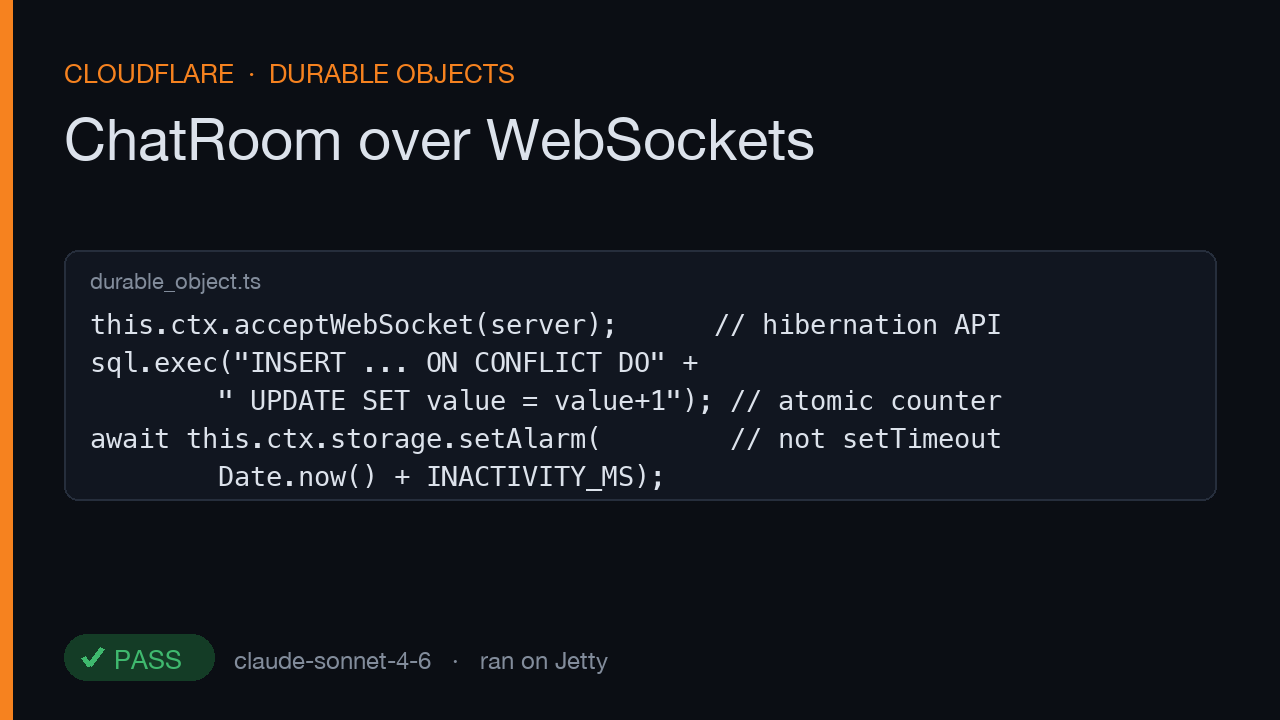
A multi-room chat DO: WebSocket Hibernation API for broadcast, a SQLite-backed message counter incremented with an atomic INSERT ... ON CONFLICT upsert, and a setAlarm()-debounced 30-minute idle purge that rebuilds its schema on reconnect. Self-review guards 9 gotchas.
Inputs
Acceptance checklist
10/10 checks passed.- durable_object.ts is complete, idiomatic, and deployable (extends DurableObject)
- Anything that must survive idle is persisted in ctx.storage, not an in-memory field
- Scheduling uses ctx.storage.setAlarm() + alarm(), never setTimeout
- Counters / read-modify-write are atomic (SQL ON CONFLICT or blockConcurrencyWhile)
- WebSockets use the hibernation handlers (acceptWebSocket + webSocketMessage)
- Only one alarm is used (queue pattern if multiple events are needed)
- Constructor is light (no heavy work on every wake)
- wrangler.jsonc has the DO binding + a unique/sequential migration tag
- self_review.md addresses each relevant gotcha with a specific reference
- Verification script printed PASS for every line
System outputs
validation_report.jsonRunbook
| version | 1.0.0 |
| evaluation | programmatic |
| agent | claude-code |
| model | anthropic/claude-sonnet-4.6 |
| model_provider | openrouter |
| snapshot | python312-uv |
| primary_outputs | durable_object.ts |
Cloudflare Durable Objects — Build a Durable Object — Agent Runbook
Converted, with attribution, from Cloudflare's Durable Objects reference (github.com/cloudflare/skills, Apache-2.0). The Rules, API notes, patterns, configuration, and gotchas below are Cloudflare's; this runbook turns them into an executable "spec → production DO" build with a self-review against the gotchas.
EXECUTE THIS RUNBOOK NOW with tools. Write the deliverables to
{{results_dir}}. Your first action is a tool call. Do not ask questions — implement the spec.
Inputs (already provided)
- Spec: {{spec}} — the Durable Object to build (behavior, persistence, scheduling, API).
- Language/runtime: TypeScript on Cloudflare Workers (the only supported target here).
Objective
Implement a production-ready Cloudflare Durable Object in TypeScript from a spec, and
get it right where most implementations get it wrong. Durable Objects combine compute with
strongly-consistent, co-located storage in globally-unique, single-threaded instances. That
model has sharp edges — hibernation clears in-memory state, setTimeout doesn't survive
eviction, only one alarm exists per DO, and await is a yield point that allows races even
though the object is single-threaded. This runbook bakes Cloudflare's documented rules,
patterns, and gotchas into the build and verifies the output against them, so the code is
deployable, not just plausible.
Parameters
| Parameter | Template Variable | Default | Description |
|---|---|---|---|
| Results directory | {{results_dir}} | /app/results | Output directory |
| Spec | {{spec}} | (required) | The Durable Object to build (behavior, persistence, scheduling, public surface) |
Dependencies
| Dependency | Type | Required | Description |
|---|---|---|---|
| (none at build time) | — | — | Generates + statically reviews TypeScript; deploying needs wrangler + a Cloudflare account (out of scope for this sandbox). |
The Rules of Durable Objects (apply all six)
- One alarm per DO — schedule multiple events via a queue pattern, not multiple alarms.
- ~1K req/s per DO max — shard across DOs for higher throughput.
- Constructor runs on every wake — keep init light; use lazy loading.
- Hibernation clears memory — in-memory state is lost; persist critical data.
- Use
ctx.waitUntil()for cleanup — ensures completion after the response is sent. - No
setTimeoutfor persistence — usectx.storage.setAlarm()for reliable scheduling.
API essentials
- A DO extends
DurableObject; the constructor receivesctx: DurableObjectState(storage, WebSockets, alarms,blockConcurrencyWhile,waitUntil) andenv: Env(bindings). - Storage:
ctx.storage— KV (get/put/delete/deleteAll) and SQL (ctx.storage.sql.exec(...)), strongly consistent and co-located. SQL gives atomic read-modify-write. - WebSocket hibernation: accept with
ctx.acceptWebSocket(ws)and handle with the asyncwebSocketMessage(ws, msg)/webSocketClose(...)handlers — these survive hibernation.server.accept()+ws.addEventListener('message', …)does not hibernate and drops on eviction. Per-connection metadata goes inws.serializeAttachment()(small, JSON-serializable). - Alarms:
ctx.storage.setAlarm(timestampMs)schedules; theasync alarm()handler runs. One alarm per DO — setting a new alarm replaces the old one. - Concurrency: the DO is single-threaded, but
awaityields. Guard read-modify-write withctx.blockConcurrencyWhile(async () => { … })or use atomic SQL.
Patterns to reach for
- Rate limiting / distributed lock / counters → atomic SQL (
ON CONFLICT … DO UPDATE) orblockConcurrencyWhile. - Real-time / chat → WebSocket hibernation API + reconnection on the client; persist
per-connection state with
serializeAttachment(). - Multiple scheduled events → one alarm + an event queue in storage; on
alarm(), process due events and re-arm the alarm for the next one. - Graceful cleanup →
ctx.waitUntil()for post-response work;deleteAll()for purges. - High throughput → shard across
idFromName()instances.
Configuration (wrangler)
wrangler.jsonc needs the DO binding and a migration:
{
  "durable_objects": { "bindings": [{ "name": "CHAT_ROOM", "class_name": "ChatRoom" }] },
  "migrations": [{ "tag": "v1", "new_sqlite_classes": ["ChatRoom"] }]
}
Migration tags must be unique and sequential; RPC needs compatibility_date >= 2024-04-03;
raise limits.cpu_ms (max 300s) for long work. deleted_classes destroys data — prefer
transferred_classes; migrations cannot be rolled back (test with --dry-run).
Durable Objects Gotchas (the heart — guard against every one)
Hibernation cleared in-memory state
In-memory fields are lost when the DO hibernates/evicts. Persist with ctx.storage;
per-connection metadata with ws.serializeAttachment().
// ❌ lost on hibernation
private userCount = 0;
async webSocketMessage(ws, msg) { this.userCount++; }
// ✅ persisted
async webSocketMessage(ws, msg) {
  const c = (await this.ctx.storage.get<number>("userCount")) || 0;
  await this.ctx.storage.put("userCount", c + 1);
}
setTimeout didn't fire after restart
setTimeout is in-memory; eviction clears it. Use an alarm.
// ❌ lost on eviction:  setTimeout(() => this.cleanup(), 3600000)
// ✅ survives:          await this.ctx.storage.setAlarm(Date.now() + 3600000)
//                        async alarm() { await this.cleanup() }
Constructor runs on every wake
Runs on cold start AND on wake-from-hibernation. Keep it light; lazy-load heavy data.
Race condition despite single-threading
await is a yield point — a concurrent request can interleave between a get and a put.
Use atomic SQL or blockConcurrencyWhile.
// ❌ race:
const n = (await this.ctx.storage.get("count")) || 0;   // another request can run here
await this.ctx.storage.put("count", n + 1);
// ✅ atomic SQL:
this.ctx.storage.sql.exec("INSERT INTO counters(id,value) VALUES(1,1) ON CONFLICT(id) DO UPDATE SET value=value+1 RETURNING value").one().value;
// ✅ or lock:
await this.ctx.blockConcurrencyWhile(async () => { /* read-modify-write */ });
Only one alarm per DO
Need multiple timers? Keep an event queue in storage and re-arm the single alarm for the next due event.
WebSockets disconnect on eviction
Use the hibernation handlers (ctx.acceptWebSocket + webSocketMessage) + client reconnection — not addEventListener.
Other documented gotchas: 503 under load → shard (~1K req/s/DO); storage quota (10 GB/DO,
5 GB free account-wide) → cleanup via alarms + deleteAll; CPU time exceeded (30s default,
300s max) → raise limits.cpu_ms or chunk; migration failed → unique/sequential tags;
RPC not found → compatibility_date >= 2024-04-03; deleted_classes destroys data →
use transferred_classes; cold starts slow → expected; optimize the constructor / warm
critical DOs. Hibernation caveats: memory cleared, constructor reruns, eviction may happen
instead of hibernation (design for both), attachments must be small + JSON-serializable, an
alarm prevents hibernation until its handler completes.
Step 1: Environment Setup
mkdir -p "{{results_dir}}"
S="{{spec}}"
[ -n "$S" ] && [ "$S" != "{{spec}}" ] || { echo "ERROR: no spec provided"; exit 1; }
echo "Building Durable Object for spec (first 120 chars): ${S:0:120}"
Step 2: Understand the Spec
Identify, from the spec: the DO's state (what must persist), any scheduling (→ alarm, not
setTimeout), any concurrency-sensitive mutations (→ atomic SQL / blockConcurrencyWhile),
any WebSocket usage (→ hibernation API), and the public surface (HTTP routes / RPC).
Step 3: Implement durable_object.ts
Write the full TypeScript implementation. Apply the Rules, the API, and the Gotchas above. In
particular: persist anything that must survive idle; schedule with setAlarm; make counters
atomic; use the WebSocket hibernation handlers; keep the constructor light. The code must be
idiomatic and deployable, not pseudo-code.
Step 4: Configure wrangler.jsonc
Write the Workers config: the DO binding and a new_sqlite_classes migration (unique,
sequential tag). Set compatibility_date >= 2024-04-03.
Step 5: Self-Review Against the Gotchas
Write {{results_dir}}/self_review.md: for each relevant gotcha, state how the implementation
guards against it (or why it does not apply). Be specific — quote the line that handles it. If
you find a violation, fix the code before finishing (max 3 rounds).
Step 6: Evaluate & Validate
Evaluate the implementation against the gotcha checklist, then write
{{results_dir}}/validation_report.json:
{
  "version": "1.0.0", "run_date": "<ISO>",
  "stages": [
    { "name": "implement", "passed": true, "message": "durable_object.ts written" },
    { "name": "configure", "passed": true, "message": "wrangler.jsonc written" },
    { "name": "self_review", "passed": true, "message": "reviewed against N gotchas" }
  ],
  "results": { "gotchas_guarded": 0 },
  "overall_passed": true
}
REQUIRED OUTPUT FILES (MANDATORY)
| File | Description |
|---|---|
{{results_dir}}/durable_object.ts | The complete, deployable Durable Object implementation. |
{{results_dir}}/wrangler.jsonc | Workers config: DO binding + migration. |
{{results_dir}}/self_review.md | Per-gotcha review of how the code guards against each. |
{{results_dir}}/summary.md | What was built + the key DO decisions. |
{{results_dir}}/validation_report.json | stages, results, overall_passed. |
The task is NOT complete until every file exists and is non-empty.
Final Checklist (MANDATORY — do not skip)
Verification Script
echo "=== FINAL OUTPUT VERIFICATION ==="
RESULTS_DIR="{{results_dir}}"
for f in "$RESULTS_DIR/durable_object.ts" "$RESULTS_DIR/wrangler.jsonc" "$RESULTS_DIR/self_review.md" "$RESULTS_DIR/summary.md" "$RESULTS_DIR/validation_report.json"; do
  [ -s "$f" ] && echo "PASS: $f ($(wc -c < "$f") bytes)" || echo "FAIL: $f is missing or empty"
done
TS="$RESULTS_DIR/durable_object.ts"
grep -q "setTimeout" "$TS" && echo "WARN: setTimeout in code — should be setAlarm for persistence" || echo "PASS: no setTimeout"
grep -qE "acceptWebSocket|webSocketMessage" "$TS" && echo "PASS: uses WebSocket hibernation API" || echo "NOTE: no hibernation API (ok if no WebSockets in spec)"
echo "=== VERIFICATION COMPLETE ==="
Checklist
-
durable_object.tsis complete, idiomatic, and deployable (extendsDurableObject) - Anything that must survive idle is persisted in
ctx.storage, not an in-memory field - Scheduling uses
ctx.storage.setAlarm()+alarm(), neversetTimeout - Counters / read-modify-write are atomic (SQL
ON CONFLICTorblockConcurrencyWhile) - WebSockets use the hibernation handlers (
acceptWebSocket+webSocketMessage) - Only one alarm is used (queue pattern if multiple events are needed)
- Constructor is light (no heavy work on every wake)
-
wrangler.jsonchas the DO binding + a unique/sequential migration tag -
self_review.mdaddresses each relevant gotcha with a specific reference - Verification script printed PASS for every line
If ANY item fails, go back and fix it. Do NOT finish until all items pass.
Tips
- The single-threaded DO still has races.
awaityields; a second request can run between agetand aput. Make read-modify-write atomic — this is the #1 silent DO bug. - Persist before you hibernate. Treat every in-memory field as ephemeral; if it must
survive idle, it lives in
ctx.storage(or a smallserializeAttachment). setAlarm, neversetTimeout. Timers die on eviction; the single alarm survives. Re-arm it on each relevant event (debounce) and keep a queue in storage if you need several timers.- WebSockets must hibernate.
ctx.acceptWebSocket+webSocketMessage, notaddEventListener— otherwise connections drop when the DO is evicted. - Keep the constructor cheap. It runs on every wake; lazy-load anything expensive.